
 Adam Pichardo
TL;DR:
- An AI receptionist answers missed calls instantly with automated SMS, qualifying callers for better lead recovery.
- It ensures graceful failure by providing clear escalation paths and owner alerts, protecting brand trust.
An AI receptionist is a phone-and-SMS agent that answers missed calls within seconds, qualifies the caller, and either books the job or flags the lead for a human follow-up — so you stop losing high-intent customers to voicemail. For a small business, the highest-value features are the 30-second missed-call SMS, after-hours auto-reply, appointment booking, and automatic CRM write-back.
- Missed-call text-back: Fires a branded SMS within 30 seconds of a missed call, inviting the caller to reply.
- After-hours auto-reply: Handles inbound messages when your team is unavailable, capturing intent and booking slots.
- Appointment booking: Checks live calendar availability and confirms the slot during the conversation.
- CRM write-back and owner alerts: Pushes every recovered lead into your pipeline and sends you an instant phone alert.
A well-designed AI receptionist should never guess on a critical answer. It takes a message, logs the exact query, and flags it for human follow-up — protecting your brand and the caller’s trust.
Pulp AI Studio delivers each build live in two weeks, and you own the system outright rather than renting a monthly subscription.
How does the call flow work from ring to outcome?
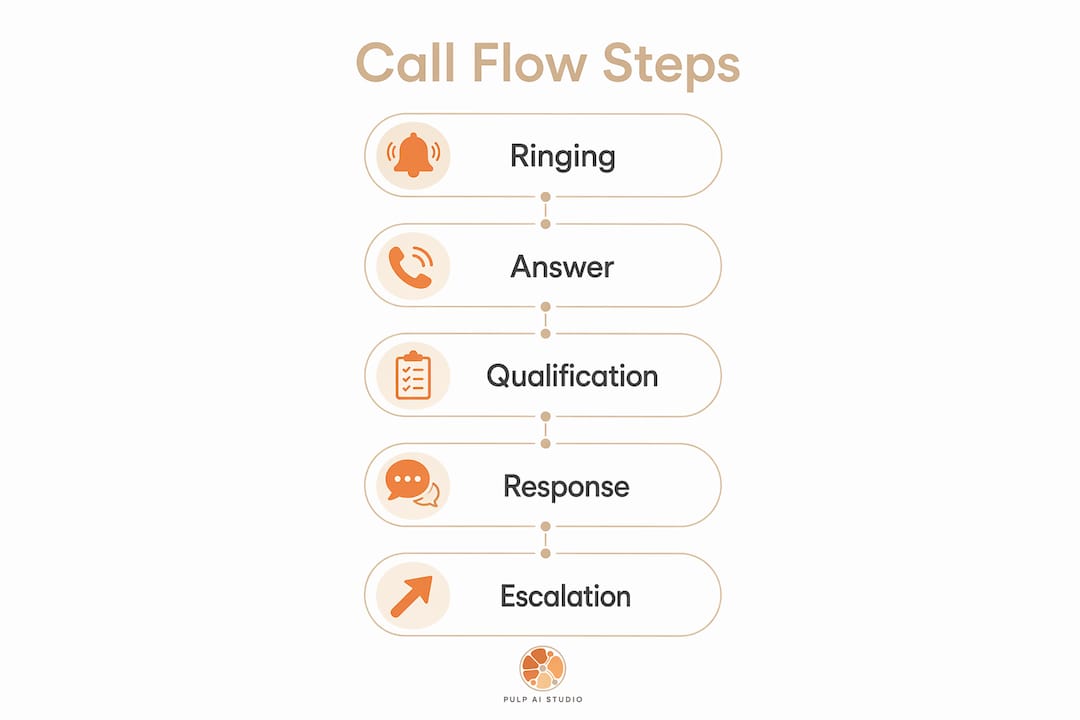
The flow below covers every path a call can take, from a live answer to a missed-call recovery.
- Call arrives. Your business line rings. If a team member answers, the AI stays silent. If the line is busy or unanswered, the system detects the missed-call event within seconds.
- SMS fires within 30 seconds. A branded text goes to the caller’s number: “Sorry we missed you — how can we help?” The caller is often still holding their phone, so the reply rate is high.
- AI qualifies the caller by SMS. The two-way agent asks one or two focused questions (service needed, location, urgency) to understand intent without overwhelming the caller.
- Booking or escalation. If the caller is ready to book, the AI checks live calendar availability and confirms the slot. If the query is complex or urgent, the system flags it and sends you an immediate alert.
- CRM write-back. Every recovered lead, along with the conversation transcript and caller intent, is written into your pipeline automatically so nothing goes cold.
- Owner alert. You get a push notification with the caller’s name, number, and what they need — so you can follow up with full context.
Pro Tip: Ask any vendor to show you the exact SMS that fires on a missed call and the exact alert format you receive. If they can’t demo it live, that’s a gap in the build.
What are the core technical components you should know?
You don’t need to write code, but you do need to know what to ask for. Here’s what’s inside every AI receptionist and why each piece affects your callers.

| Component | What it does | Why it matters to you |
|---|---|---|
| STT / ASR (speech-to-text) | Converts spoken words to text in real time | Top-tier engines have high accuracy on clear audio; noisy channels and accents reduce this |
| NLU / Dialog manager | Reads intent, not just words | Distinguishes “I need a quote” from “I have an emergency” |
| LLM (language model) | Generates natural responses and calls functions | Powers the conversation; the prompt is your script |
| TTS (text-to-speech) | Converts the AI’s reply back to voice | Voice quality and latency directly affect caller experience |
| Telephony / SIP layer | Routes the call, handles transfers | Determines call quality, overflow behavior, and recording |
| SMS gateway | Sends and receives text messages | Must support two-way threads, not just one-way blasts |
| Calendar / CRM integration | Books slots and writes lead data | Without this, a recovered call is still a manual task |
The full round trip from a caller’s spoken word to the AI’s spoken reply — STT to LLM to TTS — typically completes in roughly 800 ms–1.5 s on a modern stack, which feels natural for short exchanges. Latency above two seconds starts to feel like a bad connection. Ask vendors which STT provider they use and what accuracy they guarantee on accented English, because that number directly affects how often callers get misrouted.
How do you design a system that fails gracefully?
The single worst failure mode is an AI that confidently invents an answer — a service you don’t offer, a price you don’t charge, or an availability you don’t have. The fix lives in the design, not the technology.
- Write an explicit “I don’t know” rule. The system prompt must instruct the AI: if the answer isn’t in the script, say “I’ll have someone follow up with you shortly” and log the exact question.
- Set transfer fallbacks. If a live transfer fails because no one is available, the AI must offer a callback and log the request rather than dropping the caller silently.
- Define urgency flags. Medical emergencies, gas leaks, and water damage need a different path than a routine booking. Build those triggers explicitly.
- Require transcript logging. Every conversation, including failed transfers and escalations, should be stored and reviewable by you.
- Test before you go live. Call your own number 20–30 times with different scenarios. The first ten calls always surface something the script didn’t anticipate.
Pro Tip: A graceful failure design protects your reputation far more than a clever AI response. Callers forgive “I’ll have someone call you back.” They don’t forgive wrong information.
You own the prompts, the transcripts, and the escalation workflows. A vendor who can’t hand those over at the end of the project is renting you a black box.
What outcomes and metrics should you track?
The missed-call text-back captures already-intentful callers rather than chasing new demand, which is why it often delivers faster ROI than adding a new marketing channel. Industry research reports that 15–40% of missed calls convert into booked appointments, completed sales, or qualified leads when the caller is immediately texted and engaged.
Track these five metrics from week one:
- Missed-call capture rate: What percentage of missed calls receive an SMS reply and get a response back.
- SMS reply rate: How many callers engage with the auto-text. Low reply rates usually mean the first message needs rewriting.
- Conversion-to-booking rate: Of the callers who reply, how many book an appointment or become a qualified lead.
- Time-to-first-reply: The gap between the missed call and the SMS. It should stay under 30 seconds.
- Escalation rate: How often the AI hands off to a human. A very high rate signals the script needs tuning; a very low rate may signal the AI is answering things it shouldn’t.
Ask your vendor for a reporting dashboard that shows these numbers weekly. If they can’t produce it, you’re flying blind on a system that’s supposed to be recovering revenue.
How do you choose the right vendor and build type?
The build-vs-buy decision often comes down to call volume and workflow complexity. Below 100 calls a month, a turnkey subscription product handles standard use cases cleanly. Above 300 calls a month with specific needs — custom CRM, multilingual callers, or vertical-specific scripts — a custom build gives you control that no off-the-shelf product can match.
Questions to ask every vendor:
- Which STT provider do you use, and what accuracy do you guarantee on accented English?
- Who owns the prompts, transcripts, and configuration files at the end of the project?
- What happens when a transfer fails? Show me the fallback behavior.
- How does the system handle a caller who asks something outside the script?
- What are the pass-through costs for STT, LLM, TTS, and telephony? Are those billed to me separately?
Red flags to walk away from:
- No CRM sync or calendar integration in the base build.
- Pricing that hides per-minute API pass-through costs.
- An AI that “always has an answer” with no escalation path.
- The vendor can’t show you a live demo on a real phone number.
- You don’t own the configuration when the contract ends.
On cost shape: turnkey SaaS products bill monthly and look cheaper upfront; custom builds carry a one-time project fee and end with you owning the system. For businesses with mobile-first call workflows, confirm the vendor handles VoIP forwarding and number porting cleanly before signing.
What does a Pulp AI Studio build actually deliver?
A scoped build from Pulp AI Studio goes live in two weeks. Here’s what’s included as standard.
| Deliverable | Detail |
|---|---|
| 30-second missed-call SMS | Branded auto-text fires within 30 seconds of every missed call |
| Two-way SMS agent | AI handles the reply thread, qualifies the caller, and books or escalates |
| Calendar booking | Live availability check and confirmed slot during the SMS conversation |
| CRM write-back | Every recovered lead and transcript pushed to your CRM automatically |
| Owner alerts | Instant push notification with caller name, number, and intent |
| Transcript storage | Full conversation logs stored and accessible to you |
| Graceful-failure rules | Explicit “I don’t know” and escalation paths built into every prompt |
| Optional managed plan | Ongoing monitoring, tuning, and script improvements after launch |
The person you talk to on day one is the same person writing the code. You own the system outright instead of renting it. The optional managed plan covers tuning and improvements if you want a hands-off ongoing experience. Pulp AI Studio’s after-hours answering service follows the same ownership model.
Key Takeaways
An AI receptionist recovers missed-call revenue by firing a branded SMS within 30 seconds, qualifying the caller, and writing every recovered lead into your CRM — a system you own, not one you rent.
| Point | Details |
|---|---|
| Missed-call recovery is the fastest ROI | 15–40% of missed calls convert to bookings when the caller is immediately texted and engaged. |
| Graceful failure protects your brand | Require an explicit “I don’t know” rule and a transfer fallback in every build. |
| Integrations determine real value | Without CRM write-back and calendar booking, a recovered call is still a manual task. |
| Five KPIs tell the whole story | Track capture rate, reply rate, conversion, time-to-first-reply, and escalation rate from week one. |
| Pulp AI Studio builds and you own it | Every build goes live in two weeks; you own the code and configuration outright. |
Why the design philosophy matters more than the technology
Most conversations about AI receptionists focus on the AI. The smarter conversation is about the failure mode.
Every system will eventually encounter a caller it can’t fully serve — an unusual request, a noisy line, a question outside the script. What happens in that moment is what separates a system that builds trust from one that quietly damages it. A confident wrong answer is worse than a polite “I’ll have someone follow up.” The first feels like a lie. The second feels like a business that takes care of its customers.
The other thing owners underestimate is the tuning cadence. A build that goes live and never gets reviewed will drift. Callers change how they phrase things. New services get added. Edge cases accumulate. The businesses that get the most from their AI receptionist are the ones that treat it like a staff member who needs a monthly check-in, not a piece of software that runs forever without attention.
The technology is genuinely good now. The discipline is in the design and the follow-through.
Your next step toward recovering missed-call revenue
Pulp AI Studio builds the missed-call text-back and after-hours answering system as a fixed-scope project: a 30-second auto-SMS, a two-way AI agent trained on your services, calendar booking, CRM write-back, and owner alerts — delivered in two weeks and owned by you outright.
If you want to see the full scope, the missed-call text-back build is the place to start. For businesses that need dedicated after-hours coverage, the after-hours answering service covers the full overnight and weekend flow as a fixed-scope build. Request a scoped quote and get a clear answer on what your build includes before you commit to anything.
Useful sources
- What Is an AI Receptionist? — TalkRoute: Covers graceful-failure design and core use cases for small businesses.
- Missed Call Text Back AI — Top Notch AI Tools: Source for the 15–40% missed-call conversion range and the ROI argument.
- How AI Receptionists Work in 2026 — Frostbite Marketing: Technical breakdown of STT/LLM/TTS latency and accuracy benchmarks.
- AI Missed Call Text-Back — Echelon Advising: Pipeline design for missed-call recovery and CRM write-back.
- AI Receptionist: Build vs Buy — Stork.AI: Cost and control trade-offs between turnkey SaaS and custom builds.
- AI Phone Receptionist: Build vs Rent — Bunny Honey Club: Practical volume thresholds and failure-mode patterns from real deployments.
FAQ
What does an AI receptionist actually do for a small business?
It answers missed calls with an instant SMS, qualifies the caller through a two-way text conversation, books appointments, and alerts the owner — all without a live staff member being available.
How fast does the missed-call text-back fire?
A well-built system sends the first SMS within 30 seconds of a missed call, while the caller is still holding their phone and most likely to reply.
What happens when the AI doesn’t know the answer?
A properly designed system follows a graceful-failure rule: it tells the caller someone will follow up, logs the exact question, and sends the owner an alert — rather than guessing or going silent.
How long does it take to get a custom AI receptionist live?
Pulp AI Studio delivers a scoped custom build in two weeks, from signed agreement to a live system on your phone number.
Do I own the system after it’s built, or is it a subscription?
With a custom build from Pulp AI Studio, you own the code and configuration outright. It is a build you own, not a subscription you rent; an optional managed plan is available for ongoing tuning and improvements.