
 Adam Pichardo
TL;DR:
- A missed call text back service automatically responds to unanswered calls with personalized SMS messages to re-engage potential customers. It significantly increases conversion rates, recovers lost leads, and boosts revenue by enabling quick follow-up within minutes. Proper setup, compliance, and ongoing tracking optimize its effectiveness for small businesses seeking affordable automation.
A missed call text back service automatically sends an SMS to any caller whose call your business misses, turning a lost contact into an active conversation within seconds. Over 60% of inbound calls to small businesses go unanswered, and 85% of those callers never leave a voicemail. They call a competitor instead. The industry term for this technology is “automated SMS follow-up,” though “missed call text back” is the phrase most business owners search for and recognize. Understanding how this system works, what it costs, and how to configure it correctly is the fastest way to recover leads you are already paying to generate.
How does a missed call text back service work?
The workflow behind a missed call text back service is straightforward. When a call goes unanswered, the phone system detects the missed call event and triggers an outbound SMS within seconds. That message is personalized with the caller’s name when available, your business name, and a clear invitation to continue the conversation by text.
Here is a typical communication flow from missed call to booked appointment:
- Call comes in. A potential customer dials your number during or after business hours.
- Call goes unanswered. The system detects the missed call event in real time.
- SMS fires within seconds. The caller receives a message such as: “Hi, this is [Business Name]. Sorry we missed you! Reply here and we’ll get right back to you.”
- Caller responds by text. The conversation moves to SMS, which most people prefer over voicemail.
- Booking link or callback option is offered. Systems can embed booking links directly in the follow-up message, letting the caller self-schedule without waiting on hold.
- Appointment confirmed. The lead is captured and logged before your team even picks up the phone.
This process runs without any manual input from your staff. Think of it as a front-desk employee who never sleeps, always responds, and never forgets to follow up.
Pro Tip: Write your initial auto-text in a conversational tone, not a corporate one. “Hey, sorry we missed you!” outperforms “We were unable to take your call” in response rates because it sounds like a real person sent it.

The integration layer matters here. The best setups connect the auto-text system to your CRM or booking calendar so every response is logged automatically. After-hours calls are especially well-served by this setup, since those callers have no other way to reach you until the next morning.
What are the measurable benefits for business growth?
The ROI case for automated SMS follow-up is concrete. Responding within 5 minutes increases conversion rates by up to 80%. That single data point explains why speed is the entire value proposition of this technology.
“Missed call text back is the highest ROI automation in modern sales.” — Ryan Whitton, automation expert
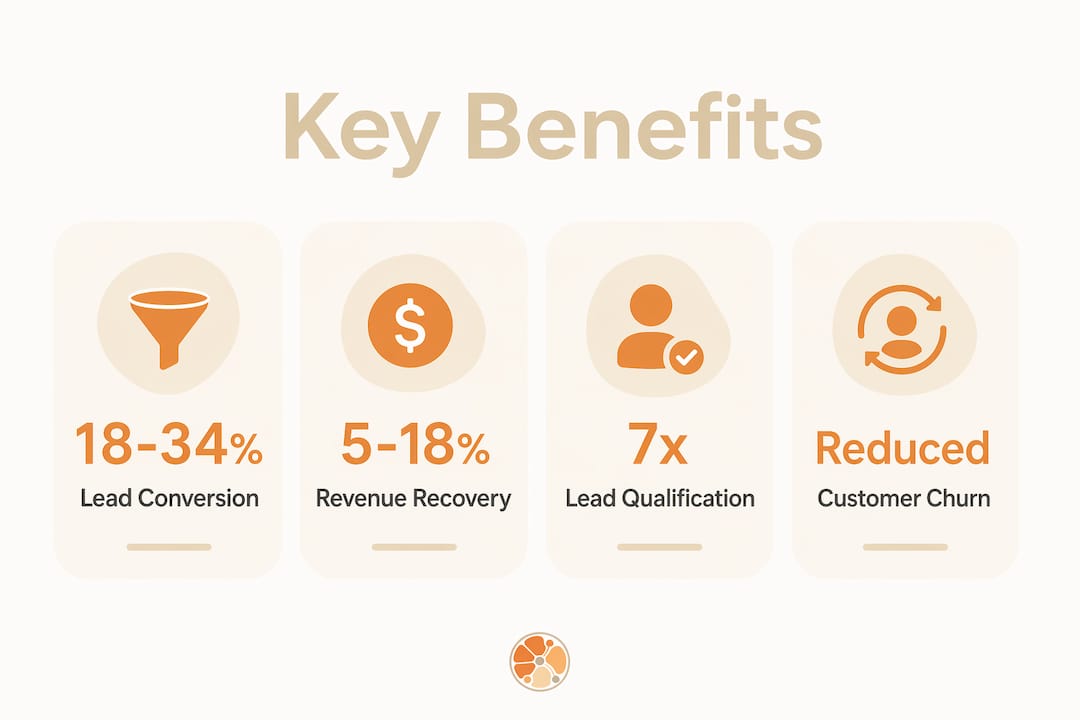
Whitton’s assessment is backed by deployment data. In live business deployments, 18–34% of missed calls converted to active conversations, and 30–60% of those conversations became bookings or quote requests. For a business receiving 40 missed calls per month, that translates to 2–7 recovered bookings monthly, at a software cost of $19–$99 per month.
Revenue recovery is equally measurable. Businesses using auto-text replies recover 5–18% more revenue from calls that would otherwise be permanently lost. For a contractor averaging $500 per job, recovering even two extra bookings per month adds $1,000 in revenue against a $50 software bill.
Speed also drives lead qualification. Responding within 1 hour makes lead qualification 7 times more likely than callbacks made after 1 hour, and 60 times more likely than responses made after 24 hours. Voicemail callbacks almost always fall into that 24-hour window. SMS replies do not.
Customer retention improves as well. Auto-text replies reduce churn by immediately acknowledging the missed call and giving the customer a convenient channel to continue the conversation. Customers who receive an instant text feel acknowledged. Customers who hear silence call someone else.
How to set up and configure an effective missed call text back system
Setup is faster than most business owners expect. Standalone missed call text back software costs $19–$100 per month, and non-technical users typically complete the initial configuration in 30–60 minutes.
Core setup steps
- Choose your platform. Entry-level tools handle basic SMS triggers. Mid-tier platforms add CRM integration, booking links, and conversation tracking. Enterprise platforms include AI-driven response branching and multi-location support.
- Connect your phone number. The system monitors your business line for missed call events. Most platforms support both VoIP and traditional phone numbers.
- Write your message templates. Create 2–3 variations for different scenarios: business hours, after hours, and repeat callers.
- Set notification filters. Configure a wait window (typically 24 hours) so the system does not send multiple texts to the same caller in a short period.
- Integrate your calendar or CRM. Embed a booking link in the initial message so callers can self-schedule immediately.
- Test the full flow. Call your own number, let it ring to missed, and confirm the SMS arrives within 10 seconds.
Compliance requirements
Missed call text back messages must include opt-in language and STOP instructions to comply with TCPA regulations. A simple addition like “Reply STOP to opt out” at the end of your message satisfies this requirement. Skipping compliance language exposes your business to legal risk, so treat it as non-negotiable from day one.
| Configuration element | Recommended setting | Why it matters |
|---|---|---|
| Response delay | 0–10 seconds | Faster response increases conversion rates |
| Message frequency filter | 1 text per caller per 24 hours | Prevents appearing spammy |
| Opt-out instruction | “Reply STOP to opt out” | Required for TCPA compliance |
| Booking link inclusion | Yes, in first message | Reduces friction to appointment booking |
| After-hours message variant | Yes, separate template | Sets accurate expectations for response time |
Pro Tip: Keep your initial SMS under 160 characters. Messages that exceed one SMS segment have lower open rates and can display oddly on older phones. Get to the point fast.
The speed of deployment matters because every week without the system is another week of missed calls going unanswered.
Common challenges and best practices in managing text back communications
Automation creates new problems when it is not configured carefully. The most common issue is sending multiple texts to the same caller in a short window, which reads as spam and damages your brand. Workflow filters with wait steps prevent this by ensuring only one text per caller per defined period.
Beyond frequency management, these best practices separate high-performing setups from mediocre ones:
- Use a conversational tone. Auto-responses that sound robotic get ignored. Write messages the way a real team member would text a customer.
- Personalize where possible. Including the caller’s name or referencing the time of their call (“We missed your call this afternoon”) increases reply rates.
- Handle after-hours calls with a specific template. A message sent at 10 PM should set expectations differently than one sent at 2 PM. “We’re closed for the evening but will follow up first thing tomorrow” is honest and reassuring.
- Monitor your response metrics weekly. Track reply rate, conversion rate from reply to booking, and average response time. These three numbers tell you whether your templates are working.
- Avoid over-automating the conversation. The first text should invite a reply. After that, a real team member should take over as quickly as possible. Customers who receive three automated texts in a row before reaching a human will disengage.
Balancing automation with a personal touch is the real skill here. The system handles the first contact. Your team handles the close. Real contractor examples show that this handoff, done well, consistently increases job closure rates.
The metrics you track also shape how you improve. If your reply rate is below 20%, the message template needs work. If your reply-to-booking rate is low, the booking link or offer in the message needs adjustment. Treat the system as a living workflow, not a one-time setup.
Key Takeaways
A missed call text back service is the fastest, lowest-cost automation a small business can deploy to recover lost leads and convert unanswered calls into booked appointments.
| Point | Details |
|---|---|
| Speed drives conversion | Responding within 5 minutes increases conversion rates by up to 80% compared to delayed callbacks. |
| Setup is fast and affordable | Most platforms cost $19–$100 per month and take 30–60 minutes to configure for non-technical users. |
| Frequency filters prevent spam | Set a 24-hour wait window per caller to avoid sending multiple texts and damaging your brand. |
| Compliance is non-negotiable | Every auto-text must include opt-in language and a STOP opt-out instruction to meet TCPA requirements. |
| Metrics guide improvement | Track reply rate, reply-to-booking rate, and response time weekly to refine templates and workflows. |
Why I think most businesses are leaving their easiest revenue on the table
After working across hundreds of business communication setups, the pattern I see most often is not that business owners lack tools. It is that they underestimate how much a missed call actually costs. A caller who does not reach you does not wait. They move on within minutes, and your competitor answers.
What surprises most business owners is how little friction stands between them and fixing this. The technology is not complex. The cost is lower than a single lost job. The setup takes an afternoon. Yet the majority of small businesses still rely on voicemail, which 85% of callers skip entirely. That is not a technology problem. It is a habit problem.
The businesses I have seen get the most out of auto-text follow-up treat it as the start of a conversation, not a notification system. They write messages that invite a reply. They have someone ready to respond when the reply comes. They track what works and adjust. That combination, fast automation plus a human follow-through, is what actually closes jobs.
The future of this technology is AI-powered branching, where the system can answer basic questions, qualify the lead, and book the appointment without any human involvement at all. Pulp AI Studio is already building in that direction. But even the basic version, a single well-written text sent within seconds of a missed call, outperforms every other low-cost lead recovery tool I have seen in practice.
The business process automation case for missed call text back is not theoretical. It is measurable, repeatable, and available to any business willing to spend an afternoon on setup.
— Adam
How Pulp AI Studio helps small businesses capture every missed call
Pulp AI Studio builds and deploys missed call text back systems alongside AI-powered customer engagement tools for small businesses, contractors, clinics, and retailers. Every client gets a fully functioning setup within two weeks and no technical expertise required. The results across more than 300 deployed sites show consistent reductions in ghosting and measurable increases in job closures.
For businesses that want to go further than basic SMS follow-up, Pulp AI Studio offers custom AI chatbot builds that handle lead qualification, appointment booking, and customer questions around the clock. Medical practices and specialized service providers can also explore automated medical answering services designed for their specific compliance and communication needs. If you are ready to stop losing leads to unanswered calls, Pulp AI Studio has a solution built for your business size and industry.
FAQ
What is a missed call text back service?
A missed call text back service automatically sends an SMS to any caller whose call goes unanswered, inviting them to continue the conversation by text. It replaces voicemail as the default response to missed calls and keeps potential customers engaged before they contact a competitor.
How quickly does the auto-text go out after a missed call?
Most systems send the automated text within seconds of the missed call event being detected. Responding within 5 minutes increases conversion rates by up to 80%, so speed is the core design principle of every reputable platform.
Is missed call text back software TCPA compliant?
Yes, when configured correctly. Every auto-text must include opt-in language and a STOP opt-out instruction to meet TCPA requirements. Skipping this language creates legal exposure, so compliance settings should be verified during initial setup.
How much does missed call text back software cost?
Standalone platforms typically cost $19–$100 per month. Setup takes 30–60 minutes for non-technical users, making it one of the most accessible automations available to small businesses.
Can the system handle after-hours calls differently?
Yes. Most platforms allow separate message templates for after-hours calls, so callers receive an honest, reassuring response that sets accurate expectations for when your team will follow up.