
 Adam Pichardo
TL;DR:
- AI communication automates and enhances business interactions, delivering faster responses and significantly lower costs. A hybrid AI-human escalation model improves customer satisfaction while maintaining operational efficiency through resolution-focused design. Continuous security governance is essential to mitigate risks and uphold trust in AI-powered business communications.
AI communication is the use of artificial intelligence technologies, including natural language processing (NLP) and machine learning, to automate and enhance how businesses interact with customers and internal teams. The case for why businesses need AI communication is no longer theoretical. 59% of consumers prefer instant, 24/7 AI customer service when it fully resolves their issue, yet only 24% of AI interactions currently achieve full resolution. That gap represents the single most important strategic challenge for business leaders deploying AI today. Tools like Ada for customer service automation, Grammarly for NLP-assisted writing, and platforms like Pulp AI Studio for missed-call response are already closing that gap for businesses across retail, healthcare, and contracting.
Why businesses need AI communication: the operational case
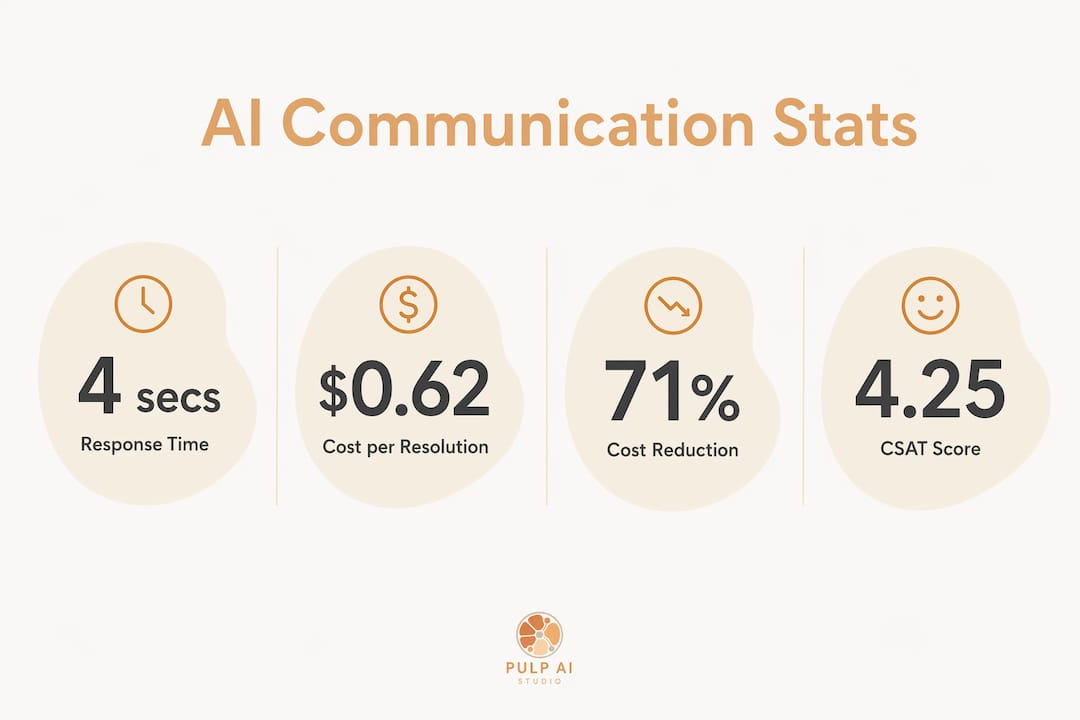
The operational argument for AI communication is built on numbers that are hard to ignore. AI first-response times average 4 seconds for chat, compared to 9 or more minutes for human agents. That speed difference alone changes whether a prospect stays or leaves.

Resolution time tells an equally stark story. AI reduces average resolution time from 11.4 minutes to under 2 minutes. For a business handling hundreds of inquiries daily, that is the difference between a lean operation and a team buried in repetitive work.
The cost data is where the argument becomes undeniable for any executive focused on unit economics.
| Metric | AI handling | Human handling |
|---|---|---|
| Cost per resolution | $0.62 | $7.40 |
| Average response time | 4 seconds | 9+ minutes |
| Average resolution time | Under 2 minutes | 11.4 minutes |
| Blended cost (hybrid model) | ~71% lower than human-only | Baseline |
Cost per resolution drops from $7.40 with human agents to $0.62 with AI, a reduction of roughly 90%. That is not a marginal efficiency gain. It is a structural shift in how customer communication gets funded.
The productivity picture is equally compelling at the small business level. 76% of small businesses currently use AI, and of those, 93% report a positive impact. Goldman Sachs data shows 84% cite productivity gains and 67% expect revenue increases. These are not early adopters chasing novelty. They are operators who found that AI handles the repetitive communication load so their teams can focus on work that actually requires human judgment.
- AI handles FAQ responses, appointment confirmations, and order status updates without human input
- Automated text replies capture after-hours leads before competitors respond the next morning
- AI drafting tools like Grammarly reduce time spent on internal and external written communication
- Freed human capacity shifts toward complex problem-solving, sales, and relationship management
Pro Tip: Before deploying any AI communication tool, audit your top 10 most frequent customer inquiries. If 7 or more are repetitive and factual, you have an immediate automation opportunity with measurable ROI from week one.
The role of AI in small business operations is not just about cutting costs. It is about reclaiming time. A contractor who misses a call at 7 PM and responds the next morning is competing against an AI-equipped competitor who replied at 7:01 PM. That is the real operational stakes.
How does AI communication improve customer engagement?
Customer engagement improves when responses are fast, accurate, and available at the moment the customer needs them. The data on consumer preferences makes this concrete. Consumers prefer always-on AI support, but only when it successfully resolves their issue. This is the critical distinction most businesses miss when they deploy AI purely to deflect volume.
Resolution quality drives satisfaction more than response speed alone. A customer who gets an instant reply that fails to solve their problem is not satisfied. They are frustrated faster. This means the benefits of AI in communication are only realized when the AI is actually capable of completing the task it is assigned.
“Always-on AI communication is valuable only if it reliably resolves customer issues. Resolution quality must trump cost-cutting alone.” — Ada Research, 2026
Customer satisfaction scores reflect this directly. Pure AI handling produces a CSAT score of 4.10 out of 5. Human agents score 4.30 out of 5. The gap is real, but it is not a reason to avoid AI. It is a reason to design AI communication systems that know when to hand off to a human.
Here is what the engagement data shows when you look at it by model type:
- Pure AI handling: CSAT 4.10/5, lowest cost, highest volume capacity, best for structured and repetitive intents
- Human-only handling: CSAT 4.30/5, highest cost, limited availability, best for complex or emotionally sensitive cases
- Hybrid AI-human escalation: CSAT 4.25/5 with 71% lower blended cost per resolution, preferred by customer experience leaders
The hybrid model is the practical answer for most businesses. It captures the cost and speed benefits of AI while preserving human judgment for the cases that genuinely need it. Customer loyalty follows from consistent, reliable resolution. When a customer knows your business will respond within seconds at any hour and escalate to a person when needed, that predictability builds trust more effectively than any loyalty program.
The impact of AI on business engagement also extends beyond reactive support. AI communication tools can send proactive follow-ups, appointment reminders, and post-service check-ins automatically. These touchpoints maintain the relationship between transactions, which is where brand trust actually forms. For sectors like medical practices, AI tools in healthcare show measurable gains in patient engagement and appointment adherence when automated reminders are deployed consistently.
What are the best practices for integrating AI communication?
Effective AI communication integration follows a sequenced approach, not a big-bang deployment. The most common mistake is deploying AI across all communication channels simultaneously before understanding which intents the AI can actually resolve. That path leads to customer frustration and erodes trust in the system.
Start with structured, high-volume intents. Deploying AI on FAQs and appointment scheduling first reduces risk, delivers measurable ROI quickly, and builds internal confidence in the technology before expanding to more complex cases. This sequenced approach is how businesses avoid the deflection-first trap, where AI pushes customers away from resolution rather than toward it.
Here is a practical integration sequence for business leaders:
- Audit your intent library. Identify your top 20 customer inquiry types and classify each by complexity and resolution confidence. High-confidence, high-volume intents go to AI first.
- Connect AI to your data sources. An AI communication agent with no access to your CRM, order management system, or knowledge base cannot resolve anything. Integration is not optional. It is the prerequisite for resolution quality.
- Design escalation triggers. Set confidence thresholds. When the AI’s confidence in a response drops below a defined level, the conversation routes to a human agent with full context attached. The customer never repeats themselves.
- Measure resolution rate, not just deflection rate. Deflection tells you how many conversations the AI touched. Resolution tells you how many it actually closed. Track both, but optimize for resolution.
- Run weekly performance reviews for the first 90 days. AI communication systems improve through iteration. Review mishandled conversations, update the knowledge base, and refine escalation rules based on real data.
Pro Tip: When configuring escalation handoffs, pass the full conversation transcript and detected intent to the human agent automatically. This single step eliminates the single biggest driver of customer dissatisfaction in hybrid AI-human flows: being asked to repeat information.
The importance of AI for companies extends to how they measure success. Traditional call center KPIs like average handle time are insufficient for AI-augmented operations. You need to track resolution rate, abandonment rate, escalation rate, and post-interaction CSAT separately for AI-handled and human-handled conversations. This gives you a clear picture of where AI is adding value and where it needs improvement. Pulp AI Studio’s approach to automated text replies demonstrates how even a single automated touchpoint, the missed-call text-back, can shift conversion rates when it is designed around resolution rather than just acknowledgment.
What security and governance considerations must businesses address?
Security is the most underestimated dimension of AI communication deployment. Most business leaders focus on capability and cost. They treat security as a compliance checkbox rather than an ongoing operational requirement. That framing is incorrect and creates real exposure.
AI agents introduce novel security threats that require adapted cybersecurity practices and continuous governance, not one-time compliance reviews. NIST’s analysis of AI agent security identifies risks that do not exist in traditional software: prompt injection attacks, unauthorized action execution, data exfiltration through conversational interfaces, and privilege escalation through chained agent actions. These are not theoretical. They are active attack vectors.
“Operational leaders must treat AI communication solutions as governed systems with rigorous monitoring, permissions control, and incident communication for security and trust.” — NIST AI RMF Guidance, 2026
The governance framework NIST recommends follows an AI Risk Management Framework lifecycle with four phases: Govern, Map, Measure, and Manage. For business leaders, this translates into concrete operational requirements.
- Agent inventory: Know every AI agent deployed, what data it can access, and what actions it can take. Undocumented agents are unmanaged risks.
- Scoped permissions: AI communication agents should have the minimum access required to complete their assigned tasks. An appointment-booking agent does not need access to financial records.
- Action logging: Every action an AI agent takes should be logged with timestamp, input, output, and confidence score. This is your audit trail for incident response.
- Continuous monitoring: Security posture for AI agents degrades over time as attack techniques evolve. Monthly reviews are the minimum. Weekly is better for high-volume deployments.
- Incident response workflow: Define in advance what happens when an AI agent behaves unexpectedly. Who gets notified? What triggers a shutdown? How do you communicate with affected customers?
The Goldman Sachs small business data shows that 50% of small businesses cite data privacy and security as their primary AI adoption challenge. That concern is legitimate. The answer is not to avoid AI communication. The answer is to deploy it with a governance structure that matches the risk profile of your business. For scaling AI agent deployments, enterprise AI agent frameworks provide structured approaches to permissions, monitoring, and performance measurement that translate directly to communication use cases.
Key takeaways
Businesses that deploy AI communication with a resolution-first design, hybrid escalation model, and active security governance will outperform those that treat it as a cost-cutting shortcut.
| Point | Details |
|---|---|
| Resolution quality drives ROI | AI communication only delivers value when it fully resolves customer issues, not just deflects them. |
| Hybrid models outperform pure AI | A hybrid AI-human escalation model achieves 4.25/5 CSAT at 71% lower cost than human-only handling. |
| Start with high-confidence intents | Deploy AI on FAQs and appointment scheduling first to build measurable ROI before expanding scope. |
| Security requires continuous governance | AI agents need scoped permissions, action logging, and monthly security reviews, not one-time compliance checks. |
| Small business adoption is accelerating | 76% of small businesses use AI, with 93% reporting positive impact and 84% citing productivity gains. |
Where I stand on AI communication strategy
I have watched businesses deploy AI communication in two fundamentally different ways. The first group treats it as a cost-reduction exercise. They automate as much as possible, measure deflection rate, and declare success when the support ticket volume drops. The second group treats it as a customer relationship investment. They measure resolution rate, design escalation flows with care, and review performance weekly.
The first group gets short-term cost savings and long-term customer attrition. The second group gets both cost savings and improved customer loyalty. The data backs this up, but the pattern is also just common sense. Customers remember how a problem made them feel, not how cheaply it was handled.
Here is what I have found actually works: start with one high-volume, well-defined communication use case. A missed-call text-back is the clearest example. It is a single trigger, a single response, and a measurable outcome. You can see within two weeks whether it is converting leads. That success builds internal confidence and gives you a real data point to justify expanding the AI communication footprint.
The governance piece is where I see the most neglect, even among sophisticated operators. People set up an AI agent, connect it to their CRM, and then never review what it is doing. Six months later, they cannot explain why certain conversations went sideways. Logging and monthly reviews are not bureaucratic overhead. They are how you keep the AI employee accountable.
My honest advice: do not let the complexity of a full AI communication stack stop you from starting. Pick the one communication gap that costs you the most leads or the most time, and close that gap first. Build from there.
— Adam
How Pulp AI Studio helps you close the communication gap
Pulp AI Studio was built specifically for the businesses that lose leads between 5 PM and 9 AM. The missed-call text-back system deploys in under two weeks and immediately converts missed calls into active text conversations before the prospect calls a competitor. For businesses that need a more tailored solution, the custom AI chatbot builds are fixed-fee and designed around your specific customer intents, not a generic template. Each build is scoped to one shop’s own lead flow — the same operator who writes the code wires the reply logic to how your customers actually ask, so it works against ghosting on your terms instead of a template’s. If you are a retailer, contractor, clinic, or small business owner who is losing leads after hours, the setup is faster to stand up than you expect, and you own the rig when it goes live.
FAQ
What is AI communication in business?
AI communication in business is the use of NLP and machine learning to automate customer and internal interactions, including chat, text, and email responses. It covers tools from AI chatbots and auto-reply systems to AI-assisted writing platforms like Grammarly.
Why do small businesses need AI communication tools?
Small businesses need AI communication tools because 76% of those already using AI report positive impact, including productivity gains and revenue growth. AI handles repetitive inquiries automatically, freeing owners and staff for higher-value work.
What is the best AI communication model for customer satisfaction?
The hybrid AI-human escalation model produces the best balance, achieving a CSAT score of 4.25 out of 5 at 71% lower cost than human-only handling. Pure AI scores 4.10 and human-only scores 4.30, making hybrid the practical optimum for most businesses.
How does AI communication affect response time and cost?
AI reduces first-response time from over 9 minutes to approximately 4 seconds and cuts cost per resolution from $7.40 to $0.62. These gains apply across chat and text channels and are measurable from the first week of deployment.
What security risks come with AI communication agents?
AI communication agents face novel threats including prompt injection, unauthorized action execution, and data exfiltration through conversational interfaces. NIST recommends continuous governance using the AI Risk Management Framework, including scoped permissions, action logging, and regular security reviews.