
 Adam Pichardo
TL;DR:
- AI-powered dealer engagement uses advanced systems that adapt communication in real time, managing the entire customer journey beyond basic chatbots. It delivers measurable results like a 46% increase in lead-to-close ratio and a 25-35% boost in appointments, emphasizing integration and human-AI collaboration. Successful implementation requires data auditing, workflow definition, proper integration, and clear planning of human handoffs to avoid common pitfalls.
Most people hear “AI dealer engagement” and picture a chatbot that answers basic FAQs. That picture is about three generations behind where the technology actually sits today. AI-powered dealer engagement is the practice of using machine learning, predictive analytics, and adaptive communication systems to manage the full customer lifecycle, from the first inquiry through to the closed deal and beyond. 39% of dealers actively use AI in their workflows in 2026, and the gap between dealers who get this right and those still relying on manual follow-ups is widening fast. This guide explains exactly what that gap looks like, and how to close it. (Where most stores start: an answering service for car dealerships that owns the first-response layer.)
Key takeaways
| Point | Details |
|---|---|
| AI goes beyond basic chatbots | Modern AI dealer engagement uses agentic systems that adapt tone, channel, and timing in real time based on customer signals. |
| Speed is a competitive weapon | AI agents that respond within 10 minutes of lead submission dramatically outperform slower, manual outreach in conversion rates. |
| Integration determines results | AI connected to your CRM and inventory data outperforms isolated tools by a wide margin, turning context into closed deals. |
| Human-AI collaboration wins | Dealers who use AI to handle repetitive outreach while freeing reps for relationship work see higher conversion than those replacing reps entirely. |
| ROI compounds with scope | The highest returns come from end-to-end orchestration of sales, marketing, and service, not from deploying a single AI tool in isolation. |
What is AI-powered dealer engagement and how it works
At its core, AI-powered dealer engagement means deploying software systems that handle communication, qualification, and follow-up tasks across the customer journey, without requiring a human to initiate every interaction. The “powered” part matters. This is not a rules-based script that fires a canned reply. These systems read context, make decisions, and adjust their approach in real time.
The technology stack typically includes three layers working together:
- Conversational AI: Chatbots and virtual assistants that handle inbound inquiries, answer questions about inventory, pricing, and availability, and qualify leads through natural dialog.
- Predictive analytics: Models that score leads by purchase intent, predict the best contact time, and surface high-probability buyers for sales team follow-up.
- Agentic AI: The most advanced layer. Agentic AI reads sentiment, urgency, and intent to dynamically adapt messaging, channel choice, and pacing in real time. Think of it as the AI employee who reads the room.
What separates a capable AI dealer engagement solution from a mediocre one is integration depth. Top-performing systems deeply integrate with CRM and customer data to maintain real-time context, including inventory awareness and customer purchase history. That context is what makes conversations feel relevant instead of robotic.
Practical workflows include automated lead qualification, personalized outreach sequences, and appointment booking without any human touch until the lead is genuinely ready to talk to a salesperson.

Pro Tip: When evaluating any AI dealer engagement platform, ask specifically how it connects to your CRM and whether it has live inventory access. A smart AI working from stale data is just a polite liability.
Measurable benefits you can actually track
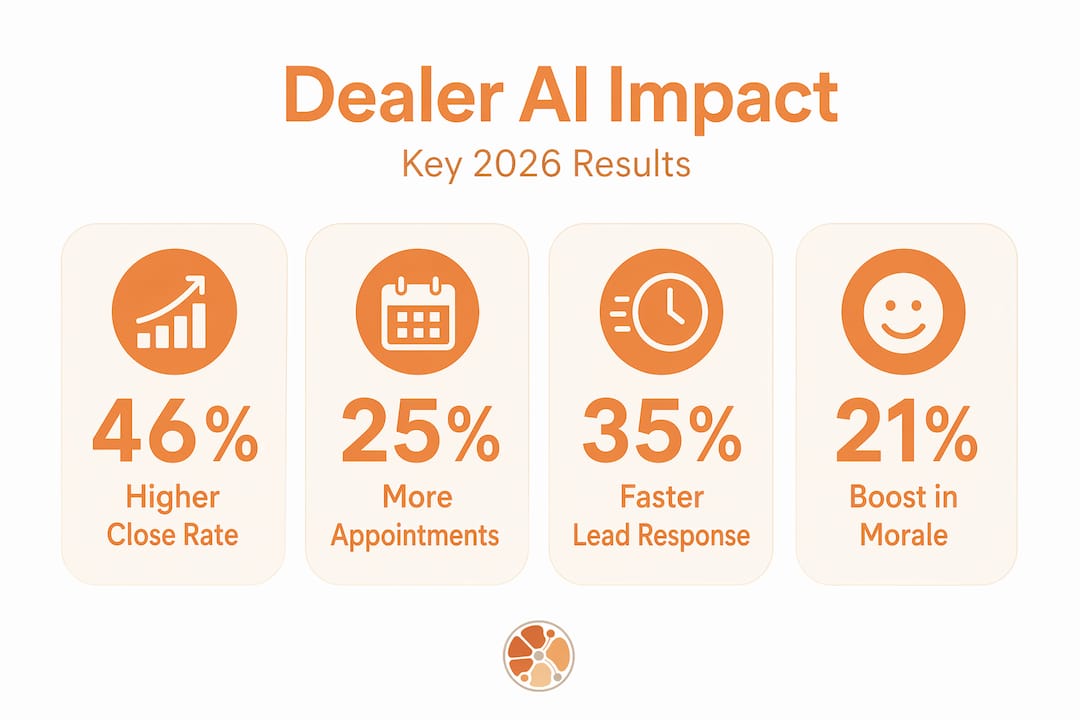
The numbers in AI in automotive sales are not speculative anymore. Dealerships see a 46% increase in lead-to-close ratio after applying AI, and users of AI Virtual Assistants report a 25% to 35% lift in booked appointments. Those are not marginal improvements. That is a structural shift in what the sales funnel looks like.
Content format matters too. Shoppers receiving personalized AI-generated video introductions engage at twice the rate and close 30% more often than leads receiving plain text responses. Video is not a nice-to-have anymore. AI is making it scalable and personalized at the same time.
Here is what the benefits of AI engagement look like when you break them down operationally:
- Speed advantage: AI agents can initiate outreach within 10 minutes of lead submission. Manual follow-up rarely hits that window consistently.
- Cost reduction: AI chatbots can automate up to 95% of customer service interactions, cutting support costs by up to 80%.
- Conversion range: Depending on implementation quality, conversion rates increase between 10% and 70% across sectors.
- Operational focus: Sales teams stop spending time on cold follow-ups and spend it on the conversations that actually require human judgment.
- Adoption momentum: 69% of AI-using dealerships report operational efficiency improvements, and nearly 75% have integrated AI into their core tech stacks.
The less obvious benefit is cultural. When your sales team stops chasing cold leads that AI should be handling, morale improves. People do the work they are actually good at.
Comparing AI approaches and avoiding costly mistakes
Not all AI dealer engagement solutions are built the same way, and choosing the wrong type costs you more than just money.
| Approach | Capability level | Weakness |
|---|---|---|
| Static chatbots | Handles scripted FAQs, basic routing | No context awareness, drops nuance, frustrates buyers |
| Rule-based automation | Triggers fixed messages based on actions | Rigid, becomes outdated, no real personalization |
| Agentic AI | Adapts tone, channel, and timing in real time | Requires proper CRM integration to reach full potential |
| Human-in-the-loop hybrid | AI handles volume, humans handle relationship moments | Most effective model, requires clear handoff protocols |
The most common mistake dealers make is deploying an isolated AI tool without connecting it to the rest of their data environment. Static AI chatbots deliver weaker customer experiences that lead to lost sales. A chatbot that does not know what inventory you have, what the customer already asked last week, or what stage of the purchase journey they are in is not an AI dealer engagement tool. It is a FAQ page with personality.
The human-in-the-loop model is where the advantages of AI in sales really show up. Dealers using AI augmentation see higher conversion than those attempting to replace reps entirely. The AI handles repetitive outreach. The rep handles moments that require trust and negotiation. That division of labor is the point.
Pro Tip: Before signing any AI engagement contract, ask the vendor to show you the handoff logic: specifically, how and when the AI transfers a conversation to a human. If that answer is vague, the product is not ready for production use.
How to implement AI-powered dealer engagement
Getting from “we should try AI” to a functioning setup requires a clear sequence. Here is the practical order that avoids the most common failure points:
- Audit your current CRM and data quality first. AI works on data. If your lead records are incomplete, duplicated, or stale, the AI will confidently do the wrong thing at scale. Fix the data before you buy the tool.
- Define the specific workflows you want to automate. Lead acknowledgment? Appointment reminders? Reactivation of cold leads? Start with one workflow, prove the ROI, then expand. Trying to automate everything simultaneously creates integration chaos.
- Evaluate platforms on integration depth, not feature count. The right AI tool for dealer marketing connects to your CRM, your inventory system, and your communication channels. A long feature list with shallow integrations is a warning sign.
- Plan the human handoff protocol before you go live. Decide exactly which signals trigger escalation to a human rep. Purchase intent signals, emotional escalation in messaging, or specific price-range conversations are common triggers. Document this clearly.
- Train your staff on what the AI will and will not handle. Resistance to AI tools often comes from ambiguity. When salespeople know exactly what the system covers and what they own, adoption improves dramatically.
- Set measurement baselines before deployment. Track lead response time, appointment booking rate, and lead-to-close ratio before the AI goes live. You cannot demonstrate ROI without a pre-AI benchmark to compare against. Review those metrics at 30, 60, and 90 days.
You can explore customer service automation types to understand which workflow categories are most relevant to your operation before you start vendor conversations.
Future trends in dealer engagement technology
The trajectory of AI-powered dealer engagement is not toward more chatbots. It is toward systems that behave less like software and more like a dedicated account manager who never clocks out.
- Hyper-personalization at scale: Manufacturers are building AI-powered loyalty ecosystems in 2026 that predict agent behaviors and automate engagement, shifting from reactive rewards to predictive participation. The same model is coming to dealer-level relationships.
- AI-generated multimedia content: Video introductions are just the start. Expect AI to generate personalized walkaround videos, custom financing scenario presentations, and follow-up content tailored to where each buyer is in their decision process.
- Continuous learning loops: Integrated AI across front-office functions creates customer journeys that improve over time, driving retention and increasing customer lifetime value through adaptive learning, not static rules.
- Full journey orchestration: The highest AI ROI comes from end-to-end orchestration that integrates sales, marketing, and service into one unified experience. Siloed AI tools will increasingly underperform against dealers running orchestrated systems.
The practical implication: dealers who invest in integration infrastructure now will find future AI upgrades easier and cheaper. Those who pile on disconnected tools will face a costly rebuild.
My take on why most dealers are still getting this wrong
I have watched a lot of businesses deploy AI tools and then wonder why the numbers barely moved. The pattern is almost always the same. They bought the AI product but skipped the AI mindset.
Here is what I mean. Treating AI agents as members of the sales team and enabling them to manage the full lead lifecycle is a fundamentally different operating model than using AI to send a few automated texts. The first approach rewires how your team works. The second just adds a new notification to your phone.
The empathy piece gets underestimated consistently. AI engagement success depends on interaction quality, particularly conversational clarity and the feeling of being heard, not just on response speed. A fast, cold reply drives people away. A slightly slower reply that actually addresses what the customer asked is worth more every time.
What successful adoption looks like, in my experience, is a sales floor that is calmer and more focused. Reps are on fewer dead-end calls. Managers are reviewing meaningful conversations instead of chasing follow-up compliance. The AI is doing the repetitive, time-sensitive work. The humans are doing the human work. That division is the whole game.
— Adam
How Pulp AI Studio handles the engagement gap
The problem Pulp AI Studio was built to solve is the one most businesses experience every day but rarely talk about: the lead that calls after hours, gets no response, and books with a competitor by morning. That is not a sales problem. It is a communication infrastructure problem. Pulp AI Studio’s missed call text-back system responds to every missed call within 30 seconds, keeping the lead engaged before they go looking elsewhere. For businesses that need more depth, the after-hours answering service runs continuously on a scoped AI rig you own. And for dealers who need a fully custom AI chatbot built to their specific workflow, Pulp AI Studio delivers a working setup in under two weeks. You own the rig. No guesswork.
FAQ
What is AI-powered dealer engagement exactly?
AI-powered dealer engagement uses machine learning, predictive analytics, and agentic AI to automate and personalize dealer communications across the full customer lifecycle, from first inquiry through close. It goes well beyond basic chatbots by integrating with CRM data, adapting in real time to customer signals, and managing lead follow-up without constant human input.
How much does AI improve dealer lead conversion?
Dealerships applying AI see a 46% increase in lead-to-close ratio and a 25% to 35% lift in booked appointments, according to CDK Global data. Results vary based on integration quality and how consistently the AI is used across the sales process.
What is the difference between a static chatbot and agentic AI?
A static chatbot follows fixed scripts and delivers the same response regardless of context. Agentic AI reads customer sentiment, urgency, and intent to adapt its messaging, timing, and channel choice in real time, which is why it consistently outperforms rule-based systems in competitive environments.
How do you measure ROI from AI dealer engagement solutions?
Set a baseline for lead response time, appointment rate, and lead-to-close ratio before deployment, then compare those metrics at 30, 60, and 90 days post-launch. Track operational hours recovered by your sales team as a secondary metric, since that time has real dollar value.
Is AI dealer engagement technology only for large dealerships?
No. The deployment models have changed significantly. Fixed-fee AI setups and rapid deployment services mean smaller operations can run the same quality of automated follow-up and lead engagement as large dealer groups, without enterprise-level budgets or IT teams.