
 Adam Pichardo
TL;DR:
- Over half of automotive dealership employees now use AI daily for customer communication and lead handling, with adoption accelerating. AI enables faster responses, personalized interactions, and seamless omnichannel conversations, significantly improving lead conversion and customer satisfaction. Proper implementation, ongoing support, and strategic handoffs are essential to maximize AI’s benefits across sales and fixed operations.
More than half of automotive dealership employees now use AI tools daily. The role of AI in dealership communication has moved well past novelty. 57% of dealership staff report using AI for customer communications, lead handling, and scheduling, with that number climbing to 70% among executives and principals. The dealers who are still running on manual follow-up cadences and inconsistent response times are not just falling behind. They are actively handing opportunities to competitors who respond faster, personalize better, and never miss a message after hours. The fastest place to start is an automotive answering service that catches every after-hours lead in under a minute.
Key takeaways
| Point | Details |
|---|---|
| AI adoption is already widespread | Over half of dealership staff use AI tools for customer-facing communication tasks right now. |
| Personalization drives conversion | AI-generated video introductions double lead engagement and lift closing rates by 30%. |
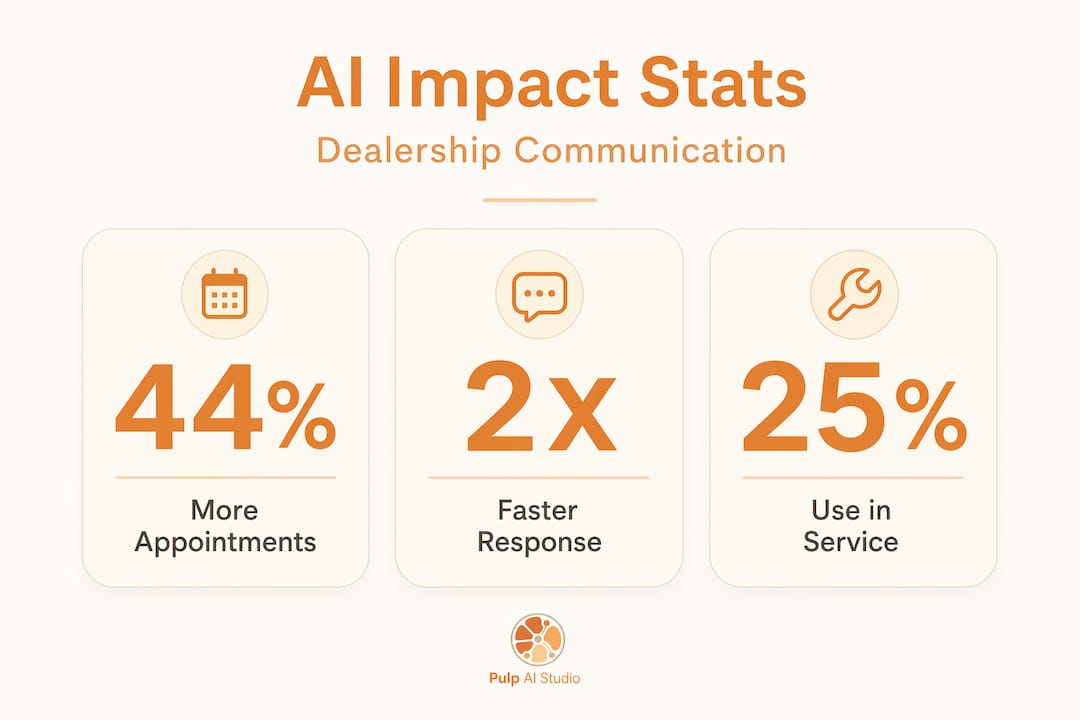
| Fixed ops is an untapped opportunity | Only about 25% of dealerships use AI in service communication, leaving most of the gains on the table. |
| Context continuity builds loyalty | LLM-powered tools that remember past interactions reduce customer frustration and speed up the sales process. |
| Implementation requires ongoing support | AI tools without proper training and vendor partnership get abandoned before they deliver results. |
The role of AI in dealership communication and personalization
The old model of dealership communication looked like this: a lead comes in, gets assigned to a sales rep, sits in a queue until someone gets to it, and by that time the prospect has already moved on to another store. AI breaks that chain. The new model responds in seconds, not hours.
What makes modern automotive AI communication tools different from the early chatbot era is language model sophistication. These systems do not just fire off canned replies. They read customer intent, match tone, and adapt the conversation based on what the customer has already said. That matters enormously in a dealership context, where one buyer is browsing casually and another is ready to sign today. The messaging for those two people should not look the same. For a channel-by-channel look at what that means at a store, from after-hours calls to service booking, see our field note on conversational AI for dealerships.
Here is what AI is actually doing inside high-performing dealership communication workflows right now:
- Instant response at scale. AI can reply to a website inquiry, SMS, or email within seconds across every active lead simultaneously. No rep can do that.
- Channel continuity. When a customer asks about a vehicle on chat and then texts the following day, an LLM-backed system carries the conversation forward without starting over.
- Personalized video outreach. Personalized AI-generated video introductions make leads twice as likely to engage, a genuine shift from the generic “Thanks for your inquiry” email.
- Intent-aware recommendations. AI tools that analyze browsing behavior, search terms, and prior messages can surface the right vehicle trim or financing option without the customer having to ask.
- Automated follow-up sequences. After an appointment, AI can trigger satisfaction check-ins, service reminders, and trade-in prompts without any manual input from staff.
The cumulative effect is not just faster communication. It is communication that feels like it was written for that specific person, because in practical terms, it was.
Pro Tip: Do not position AI as a replacement for your sales team. Position it as the employee who handles the first five touchpoints so your closers can focus on the customers who are actually ready to buy.
The impact on AI in dealership sales is measurable. Dealers using these tools report improved appointment rates, higher customer satisfaction scores, and lower lead abandonment. The role of AI in dealer customer retention is becoming just as significant as its role in acquisition.
AI communication in fixed operations service
If the sales floor is where most AI conversations happen, fixed operations is where the biggest untapped opportunity sits. Only about 25% of dealerships currently use AI in their service and fixed ops communication, which means the other 75% are still relying on service advisors to manually manage all customer updates, repair explanations, and follow-up outreach.
That gap is a real problem. Customers bring their vehicles in anxious, often uncertain about what is being done and what it will cost. The communication quality at that moment shapes how they feel about your dealership for years. AI addresses this in some specific, practical ways:
- Message translation and refinement. Service advisors can input a rough update about a repair and AI cleans it into a clear, professional message the customer actually understands.
- Video explanation support. AI-supported video in fixed ops is not just a feature. It is a trust-builder. Customers who see a short video of the issue under their hood authorize repairs faster and with less resistance.
- Consistent language across advisors. When you have five service advisors with five different communication styles, AI creates a unified standard that protects your brand.
- Automated status updates. Instead of customers calling in to ask where their vehicle is, AI sends proactive updates at each workflow stage.
The operational efficiency gains are real. Fewer inbound “where’s my car” calls, fewer misunderstandings that turn into disputes, and advisors who spend less time writing messages and more time actually moving vehicles through the shop. The impact of AI on communication in this department is less about flash and more about getting the basic job done right, every single time.
AI-powered lead management strategies

Lead management is where artificial intelligence dealership support has made the most quantifiable impact. The numbers are not incremental. Dealerships integrating AI for customer communication see a 44% lift in lead-to-appointment conversion and a doubling of AI-set appointments. That is the kind of result that gets a dealership manager’s attention fast.
Here is how the most effective AI lead systems currently operate:
| Capability | Traditional approach | AI-powered approach |
|---|---|---|
| Initial response time | 30 minutes to several hours | Under 60 seconds, any time of day |
| Personalization | Generic template emails | Video intros and intent-matched messaging |
| Follow-up timing | Fixed schedule (day 1, 3, 7) | Dynamic based on open rate and engagement signals |
| Channel selection | Email default | Adjusts to SMS, chat, or email based on behavior |
| Appointment setting | Manual rep outreach | AI sets appointment within conversation thread |
Agentic AI systems adjust messaging in real time, reading sentiment signals, open patterns, response speed, and even language choice. If a customer consistently responds to casual tone faster than formal language, the system adjusts automatically. That is not something a sales rep manually manages across 200 active leads.
The practical benefit for dealership staff is time recapture. When AI handles the first five to eight touchpoints and qualifies engagement, your salespeople walk into conversations with customers who have already been warmed up, are familiar with the dealership voice, and are closer to a decision. That is a better use of a skilled closer’s time than writing “just checking in” emails.
Pro Tip: Audit your current lead response time before deploying AI. If your average first response is over 30 minutes, you are losing 50% or more of your hottest leads. That benchmark alone justifies the AI investment.
Understanding automated text reply strategies is a good starting point before committing to a full AI platform, especially for smaller dealerships testing the waters with customer-facing automation.
Creating seamless omnichannel customer journeys
Here is the friction that kills automotive deals: a customer chats on your website Tuesday, calls in Thursday, and visits Saturday. Each time, they start the conversation from scratch. No one at the dealership knows what was said before. The customer repeats themselves three times, grows frustrated, and decides the competitor down the road “just feels easier to work with.”
This is where large language models change the calculus entirely. LLMs act as a unified conversational layer across website chat, SMS, and in-person interactions. The system retains context. When the customer walks in Saturday, the AI-informed CRM already knows they asked about the gray Tacoma with the tow package and that financing terms were a concern.
AI-driven customer engagement in an omnichannel context also means predictive outreach. The system detects when a customer has gone quiet for three days after active engagement and triggers a timely offer or question before the lead goes cold. For lifecycle communication, the same infrastructure handles service reminders, trade-in equity alerts, and recall notifications. These are not spam blasts. They are contextually timed messages based on where each customer sits in their ownership cycle.
Maintaining conversational context reduces cognitive load on the customer and accelerates the path to a decision. The role of AI in retail customer retention follows the same logic. When customers feel recognized and not just targeted, they come back. That principle applies whether you are running a dealership or a boutique, as seen in parallel examples from AI client retention in service businesses where continuity of context consistently outperforms volume-based outreach.
Best practices for successful AI adoption
Getting AI into your dealership communication stack is the easy part. Getting it to actually perform is where most implementations stall. Early AI adoption challenges consistently point to the same two culprits: incomplete solutions that were never properly configured, and staff who received a demo but no real training.
Here is a practical framework for getting it right:
- Define the problem first. Before selecting a tool, decide exactly what you want AI to solve. Lead response speed? Service update quality? After-hours coverage? A focused deployment outperforms a broad one every time.
- Require vendor education, not just onboarding. Your AI partner should provide ongoing training as the tool evolves. One setup call is not enough. Dealers who abandon AI tools early typically received no follow-up support.
- Set process standards before launch. Decide how AI and human staff hand off conversations. If a lead asks a question the AI cannot answer, the escalation path needs to be clear before day one.
- Audit performance monthly. Track response time, appointment rate, and customer satisfaction scores. AI systems need tuning. If the numbers are flat after 60 days, the configuration needs adjustment, not replacement.
- Keep humans in the closing loop. AI handles initiation and nurturing. Your sales staff handles the final conversation and the deal. The hybrid model consistently outperforms full automation or full manual approaches.
For a broader view of how these tools fit into retail customer communication, retail automation service types provides useful context on where AI starts and where human touchpoints should remain.
Pro Tip: Treat your AI deployment like a new hire. It needs onboarding, clear expectations, performance reviews, and ongoing coaching. Set a 90-day review cadence and adjust based on what the data tells you.
My take on what most dealerships get wrong
I’ve spent a lot of time watching AI tools get adopted, underused, and occasionally abandoned across client sites. And the pattern is consistent. Dealerships invest in the technology, do a soft launch, and then measure it against the wrong thing.
They ask: “Is the AI responding?” Yes. It is. But the better question is: “Is the AI creating continuity?” That is the hidden key. The difference between an AI that improves your numbers and one that feels like noise is whether it retains context across the conversation and across channels. A chatbot that forgets what the customer said 20 minutes ago is not AI-driven customer engagement. It is an expensive form letter.
What I’ve also seen is dealers treat AI as an either-or proposition. Either the AI handles it or the rep does. The dealers who are genuinely winning are the ones who designed a handoff model. AI owns the first eight touches. The rep owns the close. That is not a compromise. It is a system.
The uncomfortable truth about how AI improves dealership service is that it exposes the gaps that already existed. If your service advisors were inconsistent communicators before, AI will highlight that, not hide it. That is actually a good thing if you are willing to use the data. The dealers who treat AI output as a feedback loop improve faster than those who just treat it as a cost reduction tool.
Get started thoughtfully, audit relentlessly, and never let the automation fully replace the relationship.
— Adam
A Plan Run for You, Not Another Tool to Run
Most owners did not lose the lead because a tool was missing. They lost it because nobody had time to run the tool. So we run it for you: a hosted CRM with the AI already wired in, set up and managed for your shop, live in about two weeks, and priced in the same range as the do-it-yourself AI receptionist plans, at one flat monthly price. The pieces most shops start with:
- Voice AI receptionist. Answers, qualifies, and books onto your calendar day or night, connected to the CRM or field software you already use, and hands the call to a person when it needs one. See the after-hours answering service.
- Speed to lead. A new form fill, ad lead, or missed call gets a text back right away, while the customer is still shopping. More on why the first few minutes decide the job.
- Database reactivation. The old leads and past customers already sitting in your system get a conversational text campaign that books the ones who are ready now. Related: why leads go quiet and how to restart them.
- AI social replies. Facebook and Instagram comments and DMs get answered and routed instead of sitting unread until Monday. The AI chatbot guide covers how those replies work.
Your contacts, your conversation history, and your phone number stay yours to export or port out if you leave. For shops that want the whole system on hardware they own, prompts, logs, and models included, the custom build below is the step up (about 30 days, since there is hardware to set up). Most shops start managed and grow into a rig, not the other way around.
What Pulp AI Studio offers dealerships
If your dealership is losing leads after hours or getting ghosted because you were too slow to respond, Pulp AI Studio was built for exactly that problem. The missed call text-back and 30-second AI auto-reply system means every missed call becomes a text conversation before that customer dials a competitor. The managed setup is live in about two weeks, connected to the DMS or CRM you already use. For dealerships needing full after-hours coverage, the AI-powered answering service keeps the conversation alive around the clock. And for dealers who want a fully tailored experience, Pulp AI Studio’s custom AI chatbot builds are configured specifically to your brand voice, inventory workflow, and lead handling process, run on hardware you own and live in about 30 days.
FAQ
How does AI improve dealership communication?
AI improves dealership communication by responding to leads within seconds, maintaining conversation context across channels, and personalizing outreach based on customer behavior. The result is faster response, fewer dropped leads, and more consistent customer experiences.
What is the impact of AI on lead-to-appointment conversion?
Dealerships using AI for customer communication see up to a 44% lift in lead-to-appointment conversion and a doubling of AI-set appointments compared to traditional manual follow-up.
How many dealerships currently use AI in service communication?
Only about 25% of dealerships currently use AI in fixed operations, making service communication one of the biggest untapped opportunities in automotive retail today.
What is the biggest mistake dealerships make with AI adoption?
The most common mistake is deploying AI without ongoing training or a clear human handoff process. Without adequate vendor support, most AI tools get abandoned before they produce measurable results.
Can AI handle after-hours dealership communication?
Yes. AI tools like missed call text-back systems and AI receptionists can respond to customer inquiries instantly after hours, keeping leads engaged until a human can follow up during business hours.