
 Adam Pichardo
TL;DR:
- AI reduces clinic ghosting by predicting at-risk patients, automating personalized engagement, and managing cancellations efficiently. It can cut no-show rates by up to 50%, recovering significant revenue and easing staff workload without replacing human personnel. Implementing AI solutions typically shows results within months and effectively addresses communication and friction issues behind patient absences.
Patient ghosting costs clinics more than empty chairs. The role of AI in reducing clinic ghosting is now a concrete, measurable strategy, not a future concept. National no-show rates sit at 18 to 20% on average, and for a mid-size practice, that translates to over $150,000 in lost annual revenue. Most clinic administrators assume ghosting is a patient compliance problem. It is not. It is a communication and friction problem. And that distinction changes everything about how you fix it. Because the fix touches patient data, it has to run on a HIPAA compliant answering service.
Key takeaways
| Point | Details |
|---|---|
| Ghosting is a friction problem | Most no-shows stem from communication gaps, not patient indifference, making AI the right fix. |
| Prediction must be multi-stage | AI models updated through the day of appointment outperform single-point predictions made at booking. |
| Engagement beats reminders | Conversational AI that handles rescheduling and barrier surfacing cuts no-shows by 28 to 32%. |
| Automation frees your staff | AI scheduling and waitlist tools reduce front desk workload by up to 60%, freeing staff for care. |
| Calibration keeps models accurate | AI models must be monitored for drift as patient behavior and external conditions change over time. |
How AI predicts which patients will ghost
The most powerful place to intervene is before the appointment ever gets missed. That requires prediction, and modern AI does this in layers.
Single-point prediction at the time of booking is the old way. It captures almost nothing useful. Effective AI uses multi-stage prediction updated at booking, a few days out, and again on the morning of the appointment. Each stage pulls in new signals. A patient who confirmed two days ago but has not responded to a same-day check-in carries a very different risk profile than one who confirmed this morning.
The variables these models analyze go well beyond appointment history. Here is what a production-grade no-show prediction model typically tracks:
- Demographic factors: age, distance from clinic, insurance type
- Appointment details: lead time between booking and visit, appointment type, time of day
- Behavioral signals: prior no-show history, cancellation patterns, response rate to previous messages
- External factors: weather forecasts, local events, day of week
- Real-time signals: whether the patient opened a reminder, responded to a confirmation text, or went silent
Multi-stage prediction models achieve a 50.7% reduction in no-shows with ROI payback in four to eight months. That is not a marginal improvement. That is a structural change in how a clinic operates.
The common pitfall is deploying a model and leaving it alone. Patient behavior shifts with seasons, staff changes, and care patterns. Calibration and drift monitoring are not optional extras. They are what keep prediction accurate six months after launch.
Pro Tip: Set a quarterly review cadence for your AI model’s prediction accuracy. If your no-show rate starts creeping back up, the model likely needs recalibration, not replacement.
AI engagement strategies that actually prevent ghosting
A reminder is not engagement. Sending a text that says “You have an appointment tomorrow at 2pm” is better than nothing, but it does not address why patients ghost. Conversational AI does something fundamentally different. It opens a two-way channel.
Here is how a well-designed AI engagement sequence works in practice:
- Booking confirmation (immediately after scheduling): AI confirms the appointment details and asks the patient to confirm attendance. It also surfaces any prep instructions relevant to the visit type.
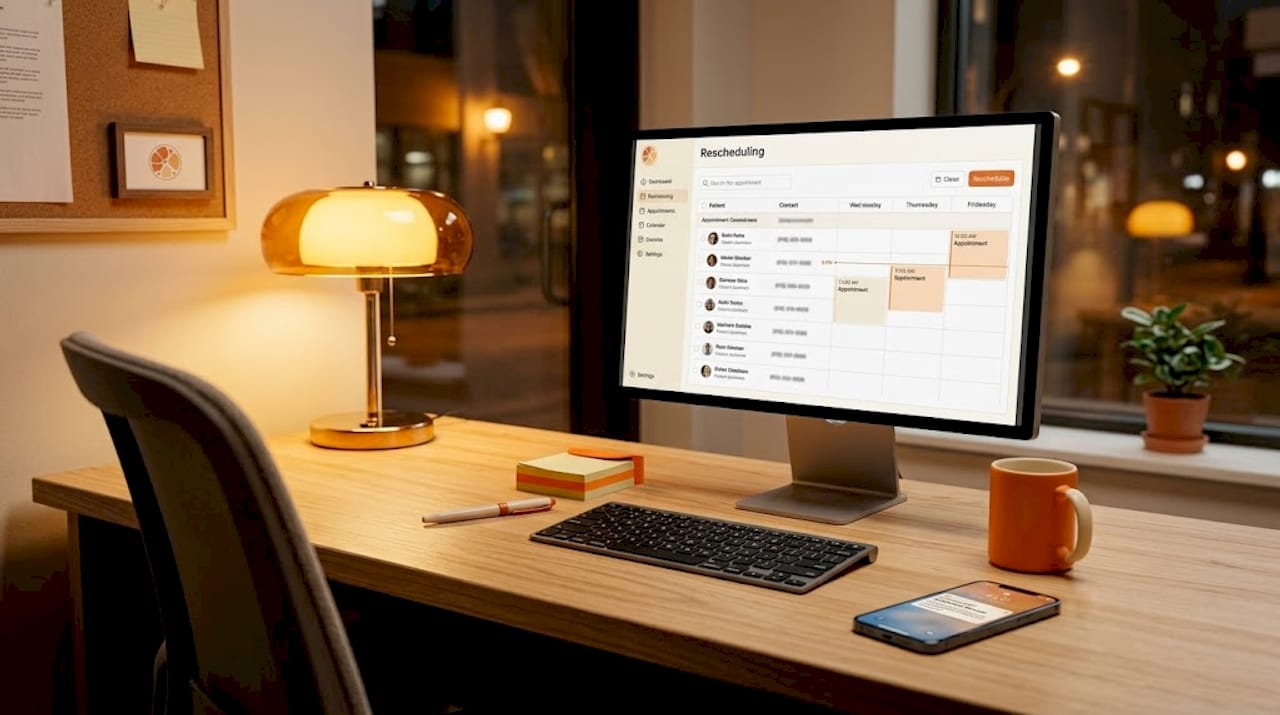
- Reminder with reschedule option (48 to 72 hours before): AI sends a personalized reminder that includes a one-tap reschedule link. Patients who cannot make it get an easy exit that keeps them in the system rather than disappearing.
- Barrier check-in (24 hours before): AI proactively asks if there is anything that might prevent attendance. Transportation issues, cost concerns, and childcare conflicts get surfaced here. Some AI tools can connect patients with solutions directly.
- Same-day check-in (morning of appointment): A brief, friendly confirmation. If the patient has gone silent, this triggers a higher-priority follow-up from staff.
- Post no-show reactivation (within 24 hours of a missed appointment): Post no-show messaging recovers 18 to 22% of missed appointments. Patients are most reachable in the first 24 hours after missing a visit.
The 24/7 availability piece matters more than most clinics realize. A patient who wants to reschedule at 9pm on a Sunday used to have two options: call and get voicemail, or just not show up. With AI handling urgent patient texts automatically, that patient gets a response and a new appointment time before they fall asleep. No-shows are primarily a communication and friction issue, not a compliance one, and after-hours availability directly attacks that friction.
Conversational AI engagement sequences reduce no-shows by 28 to 32%, and 75% of patients report that online rescheduling increases their likelihood of attendance. Those numbers hold across specialties.
Pro Tip: Personalize messages beyond just the patient’s name. Include the provider’s name, the appointment type, and any relevant prep instructions. Specificity signals that the message is not a mass blast, and response rates climb noticeably.
Operational automation and revenue recovery
Predictive models and engagement sequences do the heavy lifting on prevention. But there is a second layer of AI impact that clinic administrators often underestimate: operational automation that recovers revenue from slots that would otherwise go empty.
Here is a direct comparison of what manual operations look like versus AI-automated ones:
| Task | Manual process | AI-automated process |
|---|---|---|
| Appointment reminders | Staff calls or sends templates | AI sends personalized multi-touch sequences automatically |
| Waitlist management | Staff calls waitlisted patients one by one | AI contacts the full waitlist instantly when a slot opens |
| Cancellation backfill | Slot often stays empty | AI fills most cancellations within minutes |
| Overbooking decisions | Guesswork or blanket policy | AI applies overbooking only to high-risk slots above 60% predicted no-show probability |
| Post no-show follow-up | Rarely happens consistently | AI triggers reactivation within 24 hours every time |
AI workflow automation reduces front desk workload by up to 60%. That is not staff replacement. That is staff redirection toward tasks that actually require a human. The AI handles the repetitive, time-sensitive coordination work. Your team handles the nuanced patient interactions.
Predictive overbooking deserves its own explanation because it is frequently misunderstood. The goal is not to double-book your schedule. Overbooking is applied surgically, only to slots where the predicted no-show probability exceeds 60%, and the system monitors real-time confirmations to pull back if patients start confirming. The result is a 5 to 10% increase in patient volume without increased wait times. That is recovered revenue with no added chaos.
For clinics exploring how to integrate these tools with existing practice management systems, understanding AI automation integration is a practical starting point before committing to a vendor.
Pro Tip: When evaluating AI scheduling tools, ask specifically how they handle waitlist backfill speed. The difference between filling a cancellation in 8 minutes versus 8 hours is often the difference between a filled slot and lost revenue.
Implementation challenges and how to avoid them
Getting AI into your clinic is not plug-and-play, even when vendors say it is. Here are the real obstacles and how to handle them honestly:
- Staff trust: Front desk teams often fear AI will replace them or make their jobs harder. The clinics that succeed involve staff early, show them how the tool reduces their least-favorite tasks, and position AI as the assistant, not the supervisor.
- Data quality: AI models are only as good as the data they train on. Incomplete patient records, inconsistent appointment coding, and missing contact information all degrade prediction accuracy. Audit your data before deployment, not after.
- Workflow integration: AI that sits outside your EHR creates more work, not less. Prioritize tools that connect directly to your existing scheduling system. Fragmented systems produce fragmented results.
- Specialty-specific tuning: A one-size-fits-all approach leads to over-intervention or under-intervention. Operational thresholds must be specialty-specific and capacity-aware. A behavioral health clinic has very different no-show dynamics than an orthopedic surgery center.
- Over-reliance on punitive measures: No-show fees can alienate patients and damage long-term loyalty. AI enables targeted outreach that addresses root barriers, which is a far more durable strategy than charging patients for missing appointments.
Human oversight stays in the loop throughout. AI surfaces the risk scores and triggers the outreach. A human still makes the call on escalations, complex rescheduling, and any patient interaction that requires clinical judgment.
Pro Tip: Run a 90-day pilot on a single provider’s schedule before rolling out clinic-wide. This gives you clean performance data and builds staff confidence before the full deployment.
Measurable outcomes and where AI is heading
The numbers from clinics that have deployed AI solutions for clinic attendance are consistent and striking.
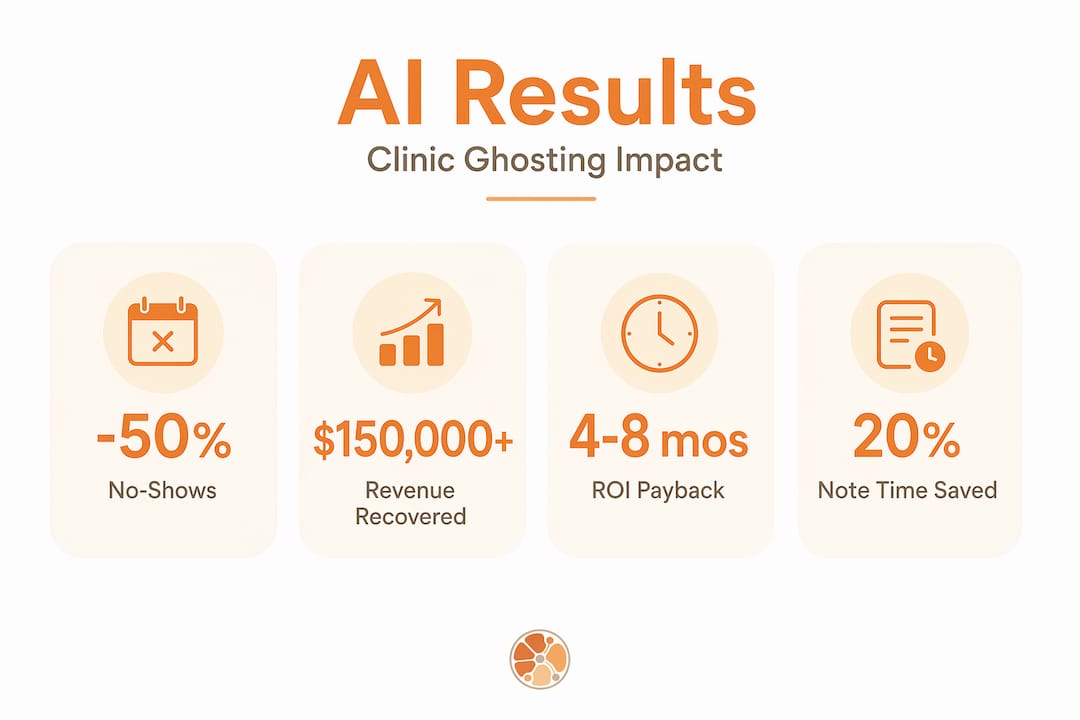
| Metric | Before AI | After AI |
|---|---|---|
| No-show rate | 18 to 20% | 8 to 12% |
| Annual recovered revenue | Baseline | Up to $150,000+ |
| Front desk admin time | 100% | Reduced by up to 60% |
| After-hours charting time | Baseline | Reduced by 30% |
| Post no-show reactivation | Near 0% | 18 to 22% recovery rate |
Beyond scheduling, AI clinical documentation tools now reduce clinician note-writing time by 20% through ambient scribes that capture conversations and generate draft notes for approval. Staff burnout drops when the repetitive cognitive load drops with it.
Looking forward, the next wave of AI in healthcare scheduling involves multi-channel conversational AI that moves fluidly between SMS, voice, and app-based messaging based on patient preference. Integrated care coordination tools will connect scheduling AI with care gap identification, so the system proactively books patients who are overdue for preventive visits, not just responding to existing appointments.
Clinics that adopt these technologies now are not just reducing no-shows. They are building an operational infrastructure that compounds in value as the AI learns their patient population over time.
My take on AI and the ghosting problem
I have seen clinics approach patient ghosting the same way for decades: charge a fee, send a reminder, hope for the best. What I have learned from working with clinics on AI deployment is that this framing misses the actual problem entirely.
Ghosting is not a patient character flaw. It is a system failure. When a patient cannot reach your office after hours to reschedule, when they feel embarrassed about a cost concern and go silent, when life gets complicated and there is no easy path back to their appointment, the system failed them first. AI does not fix patient behavior. It fixes the system.
What I find most encouraging is how effective AI systems integrate quietly into existing workflows. The best deployments I have seen are nearly invisible to patients. The patient just feels like the clinic communicates well. That is the goal.
The misunderstanding I run into most often is the belief that AI needs to be a large, expensive, complex infrastructure project before it delivers value. It does not. A missed-call text-back system and an AI that handles after-hours rescheduling can move the needle on ghosting within weeks of going live. Start with the communication gaps. The predictive analytics can come later.
— Adam
How Pulp AI Studio helps clinics stop losing patients
If the communication gaps in your clinic are the real driver of ghosting, the fix does not have to be complicated. Pulp AI Studio builds exactly the kind of AI-powered engagement infrastructure described in this article, deployed in under two weeks as a scoped build you own.
The missed-call text-back system responds to every missed call within 30 seconds, capturing patients before they call someone else. The after-hours answering service keeps your clinic reachable around the clock, handling rescheduling and patient inquiries when your front desk is closed. For dental and medical practices specifically, the AI receptionist approach shows exactly how these tools reduce administrative load while improving patient retention. The pattern is consistent: fewer missed contacts, fewer ghosted appointments, more revenue recovered.
FAQ
What is the main role of AI in reducing clinic ghosting?
AI reduces clinic ghosting by predicting which patients are at risk of missing appointments, automating personalized multi-touch engagement sequences, and filling cancellations through intelligent waitlist management. Together, these strategies reduce no-show rates from 18 to 20% down to 8 to 12%.
How much can AI reduce patient no-shows?
AI-driven engagement and predictive models reduce no-show rates by 30 to 50%, and clinics can recover over $150,000 annually in revenue that would otherwise be lost to empty appointment slots.
Does AI replace front desk staff in clinics?
No. AI automates repetitive scheduling and reminder tasks, reducing front desk workload by up to 60%, but human staff remain responsible for complex patient interactions, clinical escalations, and relationship-based communication.
How quickly can a clinic see results from AI scheduling tools?
Most clinics see measurable reductions in no-show rates within the first 60 to 90 days of deployment, with multi-stage prediction models showing ROI payback in four to eight months.
Are no-show fees an effective alternative to AI engagement?
No-show fees can damage patient loyalty and do not address the root causes of ghosting. AI-driven outreach that surfaces barriers and offers easy rescheduling produces better long-term retention outcomes than punitive policies.