
 Adam Pichardo
TL;DR:
- Missed call text back automates replies to unanswered calls, recovering up to 45 percent of missed opportunities. Proper setup requires a validated SMS-enabled phone number, compliant consent records, personalized message templates, and a delayed-send configuration. Implementing intent-based scripts and strict follow-up limits enhances engagement while maintaining TCPA compliance.
Missed call text back is an automated SMS response triggered the moment an inbound call goes unanswered on a job site. When you are on a roof, under a sink, or mid-pour on a concrete slab, your phone rings and you cannot answer. That caller is gone within minutes. Automated text back systems close that window by sending an instant, personalized message before the lead dials your competitor. Platforms like GoHighLevel, Twilio, and Pulp AI Studio deploy these workflows in under 30 minutes. The payoff is real: automated SMS responses can recover 25–45 percent of missed calls into booked jobs or quote requests.
What does “text back missed calls job site” actually mean?
The phrase “text back missed calls job site” describes a specific automation category known in the industry as missed call text back (MCTB). The system monitors your business phone line, detects an unanswered call, and fires a pre-written SMS to that caller within seconds. No human involvement required.

Here is why this matters on a job site specifically. Service businesses miss 30–60 percent of inbound calls, and 75 percent of those callers never leave a voicemail. That means three out of four missed callers disappear silently. MCTB is the only reliable way to re-engage them before they move on.
The system is not a chatbot in the traditional sense. Think of it as the AI employee who stays at the front desk while you are out in the field. It greets the caller, asks what they need, and routes them toward a booking link or a quote form. You come back to a warm lead instead of a dead end.
What do you need to set up a missed call text back system?
The core technology stack
Three components make up a working MCTB setup. You need a local business phone number that supports SMS, an automation platform to handle triggers and message delivery, and optionally a CRM to log and track leads. GoHighLevel handles all three natively. Twilio combined with Zapier covers the same ground with more flexibility. Pulp AI Studio builds the full stack for you and has it live within two weeks.
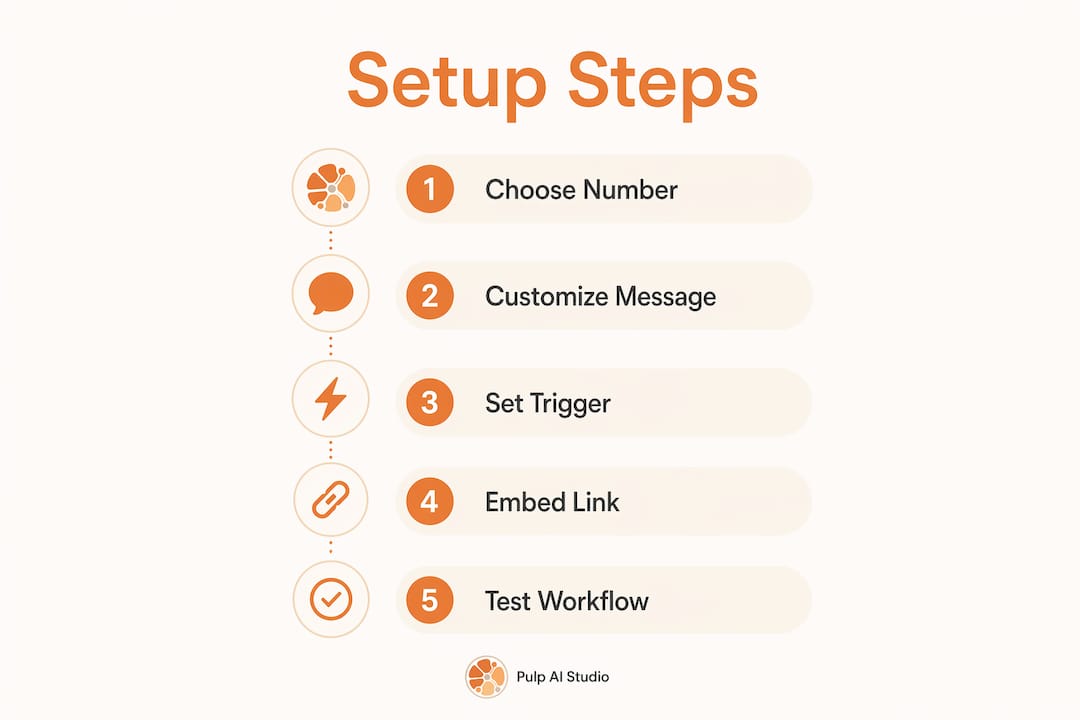
Setup on platforms like GoHighLevel or Twilio takes under 30 minutes for the core workflow. That speed is possible because the trigger logic is simple: missed call detected, delay applied, SMS sent.
Legal compliance you cannot skip
TCPA compliance is not optional. The Telephone Consumer Protection Act requires prior express consent before you send automated marketing texts. That consent record must include the caller’s name, phone number, the consent copy they agreed to, the purpose, date, source, IP address, and verification. Missing any of those fields is a common trigger for lawsuits.
A February 2026 Fifth Circuit ruling clarified that prior express consent can be oral or written, not exclusively written, for automated calls. That nuance matters if your intake form collects verbal consent over the phone. Still, written documentation is the safest standard to maintain.
One more compliance trap: if you use third-party lead generators, consent from those sources often fails TCPA standards because the source and timestamp are not documented. Validate every lead source before texting.
Essential configurations before you go live
Before your first automated reply fires, lock down these four items:
- Message templates: Write two to three versions covering different caller intents (quote request, emergency, general inquiry).
- Send delay: Configure a 20–30 second delay after the missed call to avoid sending an SMS while the caller is still leaving a voicemail.
- Booking or quote link: Embed a direct scheduling link (Calendly, Jobber, or a custom form) inside every outbound message.
- Opt-out handling: Every message must include a clear STOP instruction. Automate the opt-out removal from your contact list immediately.
| Platform | Setup Time | CRM Integration | SMS Templates | Pricing Model |
|---|---|---|---|---|
| GoHighLevel | Under 30 min | Built-in | Fully customizable | Monthly subscription |
| Twilio + Zapier | 30–60 min | Via Zapier | Manual build | Pay-per-message |
| Pulp AI Studio | Under 2 weeks | Included | Done-for-you | Fixed-fee build you own |
| Contractor Engine | 1–2 hours | Limited | Pre-built | Monthly subscription |
How do you set up automated text responses for missed calls?
This is the step-by-step process I recommend for any contractor or service provider starting from scratch.
§ 01 — Choose and configure your business phone number
Use a dedicated local number for your business line, not your personal cell. Port an existing number or provision a new one through your SMS platform. A local area code builds trust with callers in your market. Verify the number is SMS-enabled before building any workflow around it.
§ 02 — Create and customize your message templates
Write in your own voice. A plumbing company sounds different from a landscaping crew, and your SMS should reflect that. Keep the first message under 160 characters so it sends as a single SMS rather than splitting into two. Lead with an apology for missing the call, then immediately ask how you can help. Do not promise a callback. Effective SMS messages ask how to help and provide booking or quote links directly, keeping the conversation moving without creating a phone tag loop.
§ 03 — Set your trigger and send delay
The trigger is the missed call event. Most platforms detect this via webhook or native phone integration. Configuring a send delay of 20–30 seconds prevents your SMS from arriving while the caller is mid-voicemail, which creates confusion and reduces response rates. Set the delay, then test it with a real call from a second phone.
§ 04 — Embed a booking or quote link
The SMS is not the destination. It is the door. Inside every message, include a direct link to your scheduling tool, whether that is Jobber, Housecall Pro, Calendly, or a simple Google Form. The goal is to let the caller self-serve without waiting for you to call back. That single step is what converts a missed call notification into a booked job.
§ 05 — Test the full workflow end to end
Call your business number from a test phone and let it ring to voicemail. Confirm the SMS arrives within 30–60 seconds. Click the booking link inside the message and verify it loads correctly. Check that the lead is logged in your CRM. Run this test after every template change or platform update.
Pro Tip: Build decision trees in your messaging for different lead intents. A caller who texts back “emergency” should get a different response than one who texts “quote.” GoHighLevel and Pulp AI Studio both support conditional branching inside SMS workflows, and that single upgrade can meaningfully lift your conversion rate on high-value urgent jobs.
What SMS scripts actually convert missed callers?
Why “we’ll call you back” kills the lead
Promising a callback is the most common mistake in job site communication via text. Callers move on quickly after a missed call, often within the same 8-minute window. A message that says “we’ll call you back soon” gives them no reason to wait. It also puts the burden back on you to initiate contact, which defeats the purpose of automation.
The better approach: apologize briefly, ask a direct question, and give them a path forward in the same message.
High-converting script examples
Here are three script types that work across different service categories:
- General inquiry script: “Hey, this is [Business Name]. Sorry I missed you! How can I help? Grab a free quote here: [link] or reply with your question.”
- Emergency service script: “Hi, [Business Name] here. Missed your call. If this is urgent, reply URGENT and I’ll prioritize your job. Or book here: [link].”
- Follow-up nudge script (sent 2 hours later if no reply): “Just checking in. Did you get my earlier message? Happy to help when you’re ready: [link].”
Tone, timing, and follow-up frequency
Send the first message within 60 seconds of the missed call. That window is when the caller still has your number on their screen. The tone should be warm but direct. Skip the corporate language. You are a contractor, not a call center.
Follow-up nudges improve engagement when done politely, but over-messaging triggers opt-outs and TCPA risk. One follow-up after two to four hours is the standard. Two follow-ups maximum per missed call event. After that, the lead is cold and further texts become noise.
| Script Type | Best Use Case | Key Element | Avoid |
|---|---|---|---|
| General inquiry | New callers, unknown intent | Direct question + booking link | Vague promises |
| Emergency | Urgent service requests | URGENT keyword trigger | Delayed send |
| Follow-up nudge | No reply after 2–4 hours | Soft check-in + link | Sending after 2 nudges |
| Quote request | Callers who want pricing | Price range or form link | Asking for callback |
Pro Tip: Test two versions of your opening line with a small batch of leads. One version with a question (“How can I help?”) and one with a direct offer (“Get a free quote in 60 seconds: [link]”). Track reply rates over two weeks and keep the winner. This is the fastest way to improve your text messaging for jobs without rebuilding the whole workflow.
What are the most common problems with missed call text back?
Delivery failures and race conditions
The most frequent technical issue is the race condition: your SMS fires while the caller is still leaving a voicemail. The caller hears your voicemail greeting, starts talking, and simultaneously receives a text. That creates confusion and sometimes irritation. The fix is a send delay configured in your automation of at least 20 seconds. Most platforms default to immediate send, so you have to set this manually.
Delivery failures are usually a carrier filtering issue. Carriers flag messages that look like spam, especially those with generic templates and no personalization. Use your business name in every message. Vary your templates slightly across contacts. Avoid all-caps and excessive punctuation.
Managing unresponsive leads without annoying them
Some callers will not reply to your first or second message. That is normal. The mistake is sending a third or fourth message hoping to break through. Automated follow-ups must respect opt-out requests and maintain low frequency to preserve goodwill. If a contact replies STOP, your system must remove them immediately and log the opt-out with a timestamp.
Here is a practical rule: two automated messages per missed call event, spaced two to four hours apart. After that, the lead goes into a manual review queue. You decide whether to call, email, or let it go.
Ongoing compliance and recordkeeping
Consent recordkeeping is the biggest operational risk in any SMS automation setup. You need to store consent records in a way that is retrievable if you ever face a TCPA claim. Most CRM platforms log this automatically if configured correctly. Audit your consent records quarterly. If you switch platforms, export and migrate those records before decommissioning the old system.
Pro Tip: Review your message templates every 90 days using reply rate data from your CRM. If a template gets under a 15 percent reply rate, rewrite the opening line. Small copy changes, like swapping “Can I help?” for “What do you need?”, often produce measurable lifts without touching the rest of the workflow.
- Audit consent records every 90 days
- Log every opt-out with timestamp and source
- Validate third-party lead sources before texting
- Keep template reply rate data in a shared dashboard
- Test delivery on multiple carriers (AT&T, Verizon, T-Mobile) after any template change
Key takeaways
Missed call text back is the highest-return automation a service business can deploy, converting 25–45 percent of missed calls into booked jobs when set up with proper send delays, compliant consent records, and intent-based message branching.
| Point | Details |
|---|---|
| Automate within 60 seconds | Send your first SMS within 60 seconds of a missed call to catch the caller before they dial a competitor. |
| Use send delay logic | Configure a 20–30 second delay to prevent SMS from competing with voicemail and confusing callers. |
| Build intent-based scripts | Create separate message flows for emergencies, quote requests, and general inquiries to lift conversion rates. |
| Maintain TCPA consent records | Store name, phone, consent copy, date, source, and IP for every contact to defend against compliance claims. |
| Cap follow-ups at two messages | Send no more than two automated nudges per missed call event to avoid opt-outs and preserve goodwill. |
What i have learned running these systems across 300+ sites
Here is the honest truth about missed call text back that most guides skip: the technology is the easy part. The hard part is the copy.
I have watched contractors deploy GoHighLevel in an afternoon, configure a technically perfect workflow, and still get a 6 percent reply rate because their opening message read like a corporate auto-reply. “We have received your inquiry and will respond shortly.” That message belongs in a 2009 email inbox, not a 2026 SMS thread.
The contractors who see 30 to 40 percent reply rates write like humans. Short sentences. A real apology. A direct question. A link that actually works on mobile. That combination is not complicated, but it requires you to think about the person on the other end of that missed call, not just the automation logic.
The second thing I have learned: compliance is not a one-time setup task. It is an ongoing process. I have seen businesses get their systems right at launch, then slowly drift out of compliance as they add new lead sources, change platforms, or hand off management to a staff member who does not know the rules. Quarterly audits are not paranoia. They are the cost of running SMS automation responsibly.
The third lesson is about automated text replies as a growth lever, not just a recovery tool. When you set up intent-based branching, your system starts qualifying leads before you ever speak to them. An emergency caller gets routed to your urgent job queue. A quote request gets a pricing form. A general inquiry gets a FAQ link. By the time you pick up the phone, the conversation is already halfway done. That is the real value of efficient job site communication via text. You are not just recovering missed calls. You are running a smarter intake process.
— Adam
How Pulp AI Studio handles this for you
Pulp AI Studio builds your complete missed call text back system and has it live within two weeks, with no technical setup required on your end. The platform sends a 30-second AI auto-reply the moment a call goes unanswered, using intent-based message branching to route emergency callers, quote requests, and general inquiries to the right response automatically. Every workflow ships TCPA-compliant with consent logging built in. The pattern is consistent: reduced ghosting and more closed jobs. If you want a fixed-fee deployment with a two-week turnaround, the sprint package is the fastest path from missed call to booked job.
FAQ
What is missed call text back for a job site?
Missed call text back is an automated SMS sent to a caller within seconds of an unanswered business call. On job sites, it keeps leads engaged while you are working and cannot answer the phone.
How fast should the automated text reply send?
Send the first message within 60 seconds of the missed call, but configure a 20–30 second delay to avoid competing with voicemail. Most platforms default to immediate send and require manual delay configuration.
Is it legal to auto-text people who called my business?
TCPA requires prior express consent before sending automated marketing texts. Callers who initiate contact with your business generally provide implied consent, but you must document it with a timestamp, source, and consent copy to defend any claim.
How many follow-up texts should i send after a missed call?
Two automated follow-ups per missed call event is the standard. Space them two to four hours apart. Sending more risks opt-outs and TCPA violations, and response rates drop sharply after the second message.
Which platform is best for setting up missed call text back?
GoHighLevel and Twilio are the most widely used platforms for this workflow. Pulp AI Studio offers a done-for-you build with a two-week deployment timeline and fixed pricing, which suits contractors who want the system running without managing the technical setup themselves.