
 Adam Pichardo
TL;DR:
- AI reduces ghosting by delivering timely, personalized, and relevant communication at every stage of the lead lifecycle. It enhances qualification, nurtures prospects based on behavior, and ensures multichannel engagement, preventing silent disengagement. Combining AI with clear human handoff rules and respect for informational justice significantly increases show-up rates and revenue recovery.
AI reduces ghosting by delivering prompt, personalized, and context-aware communication at every stage of the lead lifecycle, before a prospect ever decides to go silent. The role of AI in reducing ghosting is not about sending more messages. It is about sending the right message at the right moment, with enough relevance that a lead has no reason to disengage. Tools like Perspective AI, Salesforce’s AI lead nurturing platform, and Conversica have demonstrated measurable results: show-up rates improve by 41% when conversational AI replaces static forms, and candidate ghosting drops 40% when organizations commit to informational justice. For business owners watching leads go cold after the first inquiry, these numbers represent real revenue recovered.
How the role of AI in reducing ghosting starts with conversational qualification
The standard demo-request form is a ghosting machine. A prospect fills it out, waits 24 to 48 hours for a human to respond, and by then has already booked a call with a competitor. Conversational AI fixes this by replacing the form with a live, intelligent dialog that qualifies the lead in real time, the moment interest peaks.

Perspective AI’s 2026 pipeline report is the clearest evidence of this shift. Replacing static forms with AI-driven conversational qualification increases qualified pipeline by 2.5x to 4x. That is not a marginal improvement. It means your sales team is working with a fundamentally different quality of lead before a human ever picks up the phone.
The deeper insight here is what the conversation itself becomes. In traditional qualification, a form captures surface data: name, company, email. Conversational AI surfaces budget ranges, decision-making structures, and timeline pressures indirectly, through natural dialog. The conversation becomes the qualification artifact, not just a routing mechanism. A lead who has already articulated their problem and timeline to an AI is far less likely to ghost a follow-up call, because they feel heard before the call even starts.
78% of B2B SaaS funnels in 2026 now use conversational AI at the top of the funnel. This is not a trend to watch. It is a baseline expectation your prospects already carry from their best vendor experiences.
| Qualification method | Qualified pipeline lift | Show-up rate impact |
|---|---|---|
| Static demo-request form | Baseline | Baseline |
| AI conversational qualification | 2.5x to 4x increase | +41% improvement |
| Human SDR qualification only | Variable, rep-dependent | Variable, rep-dependent |
Pro Tip: Design your conversational AI to ask one indirect question about budget or authority per exchange, not three direct ones. Leads share more when the conversation feels like a dialog, not an interrogation.
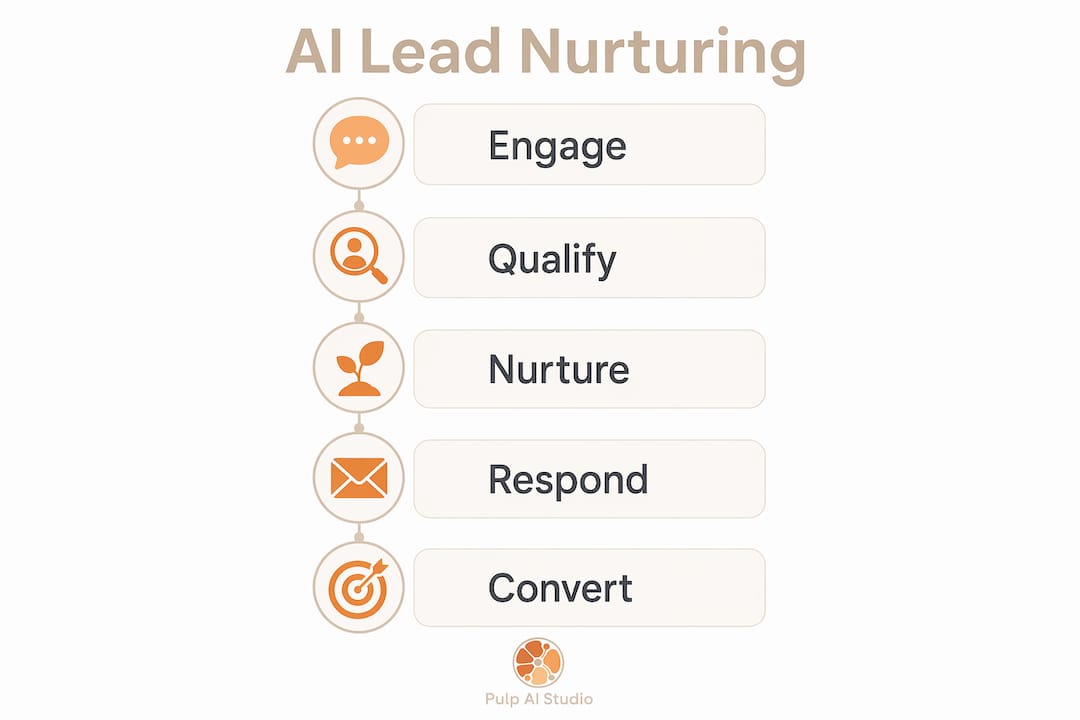
AI lead nurturing strategies that prevent ghosting at every funnel stage
Lead nurturing is where most ghosting actually happens. A prospect downloads a guide, shows genuine interest, and then receives a generic drip sequence that treats them the same as every other contact in the database. They disengage. AI nurturing prevents this by treating each lead as a segment of one.
Salesforce’s 2026 guidance on AI lead nurturing defines the core capability clearly: AI optimizes timing and personalization while retaining human discretion for complex cases. Here is how that plays out in practice across a well-designed nurture program.
-
Intent-based lead scoring. AI scores leads continuously based on behavioral signals: page visits, email opens, content downloads, and time spent on pricing pages. A lead who visits your pricing page three times in two days is not the same as one who opened a single email. AI surfaces that difference and adjusts the nurture sequence accordingly.
-
Personalized follow-up at scale. Generative AI drafts follow-up messages that reference the specific content a lead engaged with, the industry they work in, and the stage of the buying cycle they appear to be in. This is not mail merge. It is contextual relevance that makes a lead feel recognized rather than processed.
-
Behavior-triggered sequence acceleration. When a lead’s behavior signals accelerating intent, such as returning to your site after a week of silence, AI compresses the nurture timeline. Rework’s 2026 guide emphasizes that reply-detection exit conditions and real-time routing to sales upon lead engagement are the difference between a warm handoff and a missed opportunity.
-
Predictive ghosting risk scoring. Some AI platforms flag leads whose engagement velocity is declining before they go fully dark. This gives your sales team a window to intervene with a personalized human touch before the lead disappears entirely.
-
Automated handoff triggers. When a lead crosses a scoring threshold or takes a high-intent action, AI routes them to a human rep instantly, with full context attached. The rep does not start from scratch. They walk into a conversation already warmed up.
Pro Tip: Set your AI nurture sequences to exit automatically the moment a lead replies to any message. Continuing an automated sequence after a human response is one of the fastest ways to destroy trust and accelerate ghosting. Learn more about automated text reply timing to get this right.
What multichannel AI tools do to keep leads from going silent
A lead who does not get an answer on the channel they prefer will not switch channels. They will switch vendors. This is the core problem that multichannel AI communication solves.
60% of customers prefer digital self-service channels and expect responses within minutes, not hours. AI chatbots and virtual assistants make that expectation achievable without requiring a human team to be available around the clock.
Here is what a well-integrated multichannel AI setup actually covers:
- Website chatbots handle initial inquiries, qualify intent, and book meetings without human involvement, even at 2 a.m. on a Sunday.
- SMS AI auto-replies respond to missed calls within 30 seconds, keeping the conversation alive before a prospect reaches a competitor. This is the core mechanism in the setups Pulp AI Studio runs.
- Email AI sequencing personalizes outreach based on CRM data and behavioral triggers, so every follow-up feels written for that specific lead.
- CRM-integrated AI routing ensures that when a lead escalates their intent, the right human rep receives an alert with full conversation history attached.
- Voice AI handles inbound calls during off-hours, captures lead information, and routes urgent requests to on-call staff.
The practical effect is that your business is always present. A lead who calls at 6 p.m. and gets an immediate, intelligent text response is a lead who stays in your funnel. The same lead who reaches voicemail and hears nothing until the next morning is a lead who has already started comparing alternatives. AI-powered dealer engagement models, as explored in AI dealer engagement in 2026, show exactly how this plays out in high-volume inquiry environments.
The human team’s role shifts in this model. AI handles the repetitive, time-sensitive, and routine interactions. Human agents focus on the conversations that require empathy, negotiation, or complex problem-solving. That division is not a reduction in human value. It is a concentration of human effort where it matters most.
Best practices and pitfalls when implementing AI to reduce ghosting
Getting AI communication wrong does not just fail to reduce ghosting. It actively accelerates it. A lead who receives an automated follow-up after they have already replied to a human rep does not feel nurtured. They feel ignored. Here is how to avoid the most common implementation failures.
What works:
- Define exit conditions before launch. Successful AI anti-ghosting programs use explicit exit conditions triggered by replies or behavior changes. If a lead replies, the automated sequence stops. Full stop. Build this into every workflow before you go live.
- Set human judgment boundaries explicitly. Salesforce warns that AI must have clear rules about when to stop and hand off to a human. Define those boundaries at the design stage, not after a lead complains.
- Use real-time scoring for handoff triggers. When a lead’s score crosses a threshold, route them to a human immediately. Delay in handoff is where warm leads go cold.
- Test your sequences as a lead would experience them. Run yourself through the full nurture sequence before it goes live. You will catch tone problems, timing gaps, and missing exit conditions that no internal review catches.
What breaks programs:
| Common pitfall | Why it causes ghosting | Fix |
|---|---|---|
| No reply-detection exit condition | Lead receives automated messages after replying | Add reply-detection trigger to all sequences |
| AI handles complex objections alone | Lead feels misunderstood, disengages | Route objection signals to human reps |
| Generic follow-up content | Lead sees no relevance, stops opening emails | Use behavioral data to personalize each message |
| Delayed handoff after high-intent signal | Lead books with a competitor during the gap | Set instant routing triggers on scoring thresholds |
Informational justice, the principle that prompt, clear, honest communication reduces resentment even when delivering bad news, applies directly here. Clemson University research shows that respectful communication, even a rejection, produces significantly less negative backlash than silence. AI makes it operationally possible to deliver that kind of communication at scale. The risk is when AI delivers the wrong kind of communication at scale, which is why boundaries and exit conditions are not optional features. They are the foundation.
For businesses operating in high-trust environments like clinics and healthcare providers, the stakes are even higher. The role of AI in reducing clinic ghosting follows the same principles but with tighter compliance requirements and higher emotional sensitivity thresholds.
Key takeaways
AI reduces ghosting most effectively when it combines conversational qualification, behavior-triggered nurturing, multichannel responsiveness, and explicit human handoff rules into a single, integrated communication system.
| Point | Details |
|---|---|
| Conversational AI lifts show-up rates | Replacing static forms with AI qualification increases show-up rates by 41% and pipeline by up to 4x. |
| Behavior signals drive nurture timing | AI accelerates or exits sequences based on real-time lead behavior, keeping outreach relevant and timely. |
| Multichannel presence prevents drop-offs | SMS, chatbot, email, and voice AI together ensure no inquiry goes unanswered regardless of the hour. |
| Exit conditions are non-negotiable | Automated sequences must stop the moment a lead replies to prevent trust erosion and accelerated ghosting. |
| Human handoff requires instant routing | High-intent signals must trigger immediate human contact, with full AI-gathered context transferred to the rep. |
Why I think most businesses are solving ghosting backwards
Here is my honest read after working with small business operators on AI communication setups. Most businesses respond to ghosting by adding more touchpoints. Another follow-up email. Another call attempt. Another LinkedIn message. They treat ghosting as a volume problem when it is almost always a relevance problem.
Clemson University’s research makes this clear: ghosting causes lasting damage not because communication stopped, but because the communication that did happen failed to meet basic standards of informational justice. Leads and candidates ghost when they feel like a number in a sequence, not a person in a conversation.
AI does not fix this by sending more messages. It fixes this by making every message feel like it was written for that specific person at that specific moment. That is a fundamentally different problem to solve, and it requires a fundamentally different setup than most businesses currently have.
The businesses I have seen reduce ghosting most dramatically are not the ones with the most sophisticated AI stacks. They are the ones who got two things right: they respond within minutes of first contact, and they stop automated outreach the moment a human conversation begins. Everything else is optimization. Those two behaviors are the foundation.
The future of this space is not AI replacing human communication. It is AI handling the moments humans cannot be present for, so that when a human does show up, the lead is warm, informed, and ready. That is the collaboration model worth building toward.
— Adam
A Plan Run for You, Not Another Tool to Run
Most owners did not lose the lead because a tool was missing. They lost it because nobody had time to run the tool. So we run it for you: a hosted CRM with the AI already wired in, set up and managed for your shop, live in about two weeks, and priced in the same range as the do-it-yourself AI receptionist plans, at one flat monthly price. The pieces most shops start with:
- Voice AI receptionist. Answers, qualifies, and books onto your calendar day or night, connected to the CRM or field software you already use, and hands the call to a person when it needs one. See the after-hours answering service.
- Speed to lead. A new form fill, ad lead, or missed call gets a text back right away, while the customer is still shopping. More on why the first few minutes decide the job.
- Database reactivation. The old leads and past customers already sitting in your system get a conversational text campaign that books the ones who are ready now.
- AI social replies. Facebook and Instagram comments and DMs get answered and routed instead of sitting unread until Monday. The AI chatbot guide covers how those replies work.
Your contacts, your conversation history, and your phone number stay yours to export or port out if you leave. For shops that want the whole system on hardware they own, prompts, logs, and models included, the custom build below is the step up (about 30 days, since there is hardware to set up). Most shops start managed and grow into a rig, not the other way around.
How Pulp AI Studio helps you stop losing leads to silence
If a lead calls your business after hours and reaches voicemail, the odds of them calling back drop significantly. Pulp AI Studio’s missed-call text-back system responds within 30 seconds with an AI-generated message that keeps the conversation alive until your team is available. On the managed setup we run it for you, live in about two weeks, and it works across small businesses, clinics, retailers, and contractors. For shops that want it on hardware they own, the custom build takes about 30 days. The AI handles the first response. Your team handles the close. That division is where ghosting stops and revenue starts.
FAQ
What does AI actually do to reduce ghosting?
AI reduces ghosting by delivering instant, personalized responses at the moments when leads are most likely to disengage, such as after hours, after a missed call, or during a slow follow-up window. It also scores lead behavior to predict disengagement before it happens and triggers human outreach at the right moment.
How does conversational AI differ from a standard contact form?
A standard form captures data and creates a waiting period. Conversational AI qualifies the lead in real time through dialog, surfaces intent and budget signals, and books next steps immediately. Perspective AI’s data shows this approach increases qualified pipeline by 2.5x to 4x compared to form-based qualification.
When should AI hand off to a human during lead communication?
AI should hand off to a human the moment a lead replies to any automated message, signals a complex objection, or crosses a high-intent scoring threshold. Salesforce’s guidance is explicit: continuing automated contact after a prospect signals desire for human interaction is one of the fastest ways to damage trust and lose the lead.
Can small businesses realistically implement AI communication tools?
Yes. Tools like Pulp AI Studio’s missed-call text-back and AI auto-reply systems are designed specifically for small operators: a managed setup that is live in about two weeks and run for you at one flat monthly price. The operational lift is immediate: your business responds to every inquiry within minutes, regardless of whether your team is available.
Does more AI outreach actually reduce ghosting or make it worse?
More outreach without relevance makes ghosting worse. The research from Clemson University confirms that informational justice matters more than contact frequency. AI reduces ghosting when it improves the quality and timing of communication, not simply the volume.