
 Adam Pichardo
TL;DR:
- Missed appointments cost the U.S. healthcare system about $150 billion annually, mainly due to poor patient communication. Automated SMS platforms improve attendance, engagement, and operational efficiency by enabling two-way interactions and demographic-based messaging. Effective implementation requires thoughtful messaging design, timely escalation protocols, and regular performance review to maximize benefits.
Missed appointments cost the U.S. healthcare system an estimated $150 billion annually, and most of those losses trace back to one fixable gap: inadequate patient communication. The benefits of clinic text-back systems go far beyond sending a simple reminder. These tools, which the industry formally calls automated SMS patient communication platforms, engage patients on the channel they actually use, respond to replies, and reduce the manual work your front desk handles every day. This article breaks down exactly what you gain when you deploy one, with evidence behind every claim.
Key takeaways
| Point | Details |
|---|---|
| Fewer missed appointments | Behaviorally informed SMS reminders cut no-shows by roughly one-third, saving clinics thousands of dollars each month. |
| Two-way texting drives follow-through | Patients who can reply to messages are far more likely to enroll in care programs and complete screenings than those who receive one-way reminders. |
| Staff time recovered daily | Automating appointment communications saves front-desk teams up to two hours per day, freeing staff for higher-value patient interactions. |
| Demographics shape message design | Age, language, and insurance status predict response rates, so segmenting your patient list significantly improves results. |
| Implementation quality determines ROI | Timing, message framing, and clear escalation protocols matter more than the technology alone. |
1. Real reduction in missed appointments
This is where the numbers speak for themselves. Behaviorally informed SMS reminders reduce missed hospital appointments by approximately one-third, with one NSW Government study reporting a 33.7% reduction and financial savings exceeding $119,000 across four clinics. That is not a marginal improvement. That is a structural change in how a clinic performs.
The reason this works is behavioral, not just logistical. Patients forget. They get busy. A well-timed text cuts through that inertia in a way a letter mailed three weeks earlier simply cannot. The channel matches how people actually communicate in 2026.
Compare that to phone call reminders. A meta-analysis of reminder methods shows SMS reminders and telephone reminders produce comparable improvements in outpatient attendance, with SMS slightly behind telephone in consistency but offering dramatically lower cost per contact and no staffing dependency. You get most of the result at a fraction of the effort.
Pro Tip: Layer two SMS reminders per appointment: one sent 72 hours before and a second sent the morning of. This timing sequence consistently outperforms single reminders in attendance studies.
2. Better patient engagement through two-way communication
One-way reminders are the first generation of this technology. Two-way text-back systems are the current generation, and the gap between them is significant.
When a patient can reply “Can I reschedule?” and get an immediate response, you have changed the dynamic entirely. Instead of a patient simply not showing up, you now have a conversation. That conversation produces useful data, fills the appointment slot with someone else, and builds patient trust in your clinic.
Real-world evidence supports this. Automated post-discharge texts connected 25% of patients to a public benefits hotline, while a comparable flyer-based group saw zero calls. Enrollment in benefits programs reached 18%. Paper flyers went nowhere. The immediacy of SMS, combined with the ability to act from the message itself, creates follow-through that passive communication never achieves.
Here is what effective two-way text-back design covers:
- Appointment confirmation and rescheduling handled automatically without staff involvement
- Screening reminders with reply options that route patients directly to scheduling
- Care navigation where patients text questions and receive protocol-driven answers before escalation
- Automatic flagging of replies that need human review, so nothing falls through the cracks
Pro Tip: Define clear boundaries upfront on what your text-back system will handle versus what routes to a human. A patient asking about medication dosage needs clinical staff. A patient asking about parking hours does not. The escalation protocol design is where systems either save time or create new chaos.
3. Front desk time savings and operational efficiency
Clinic staff spend a meaningful portion of their day on phone calls that could be automated. Appointment confirmations, reminder calls, post-visit follow-ups, and directions queries all consume time that trained staff could spend on clinical support.
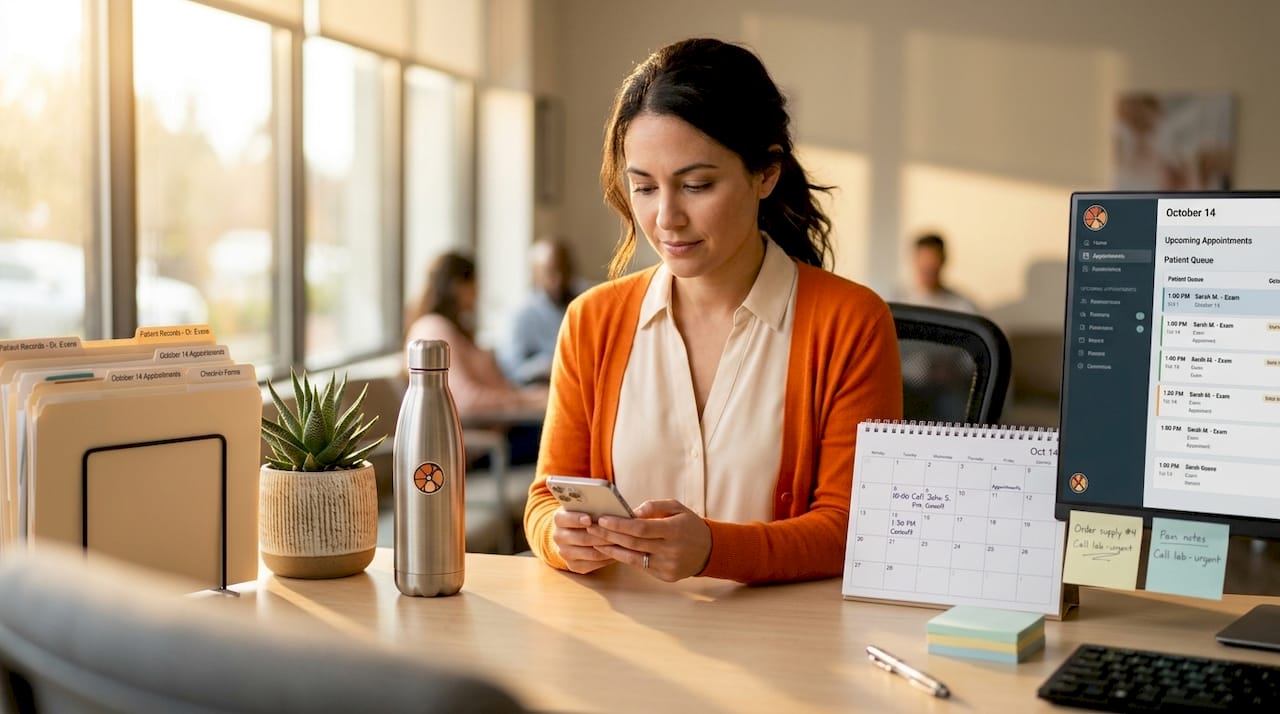
The numbers are concrete. A 50% response rate to 3,000 daily automated messages, alongside staff time savings of two hours per day in accounts teams, shows what happens when text automation handles volume communication. That is two hours per team member per day returned to higher-value work.
The operational benefits stack up across several areas:
- Phone line congestion drops when routine inquiries shift to SMS, reducing hold times for patients with urgent needs
- Administrative accuracy improves because automated systems log every message with timestamps, creating a reliable communication trail
- CRM integration allows your system to personalize messages at scale using patient data, without manual customization for each contact
- Response tracking gives your team visibility into which patients have confirmed, which have not responded, and which need a follow-up call
This last point matters more than most administrators realize. When you can see at a glance which patients are unresponsive after two automated texts, your staff knows exactly who to call. You stop wasting calls on patients who already confirmed.
4. Higher completion rates for screenings and care programs
Text-back systems do not only reduce no-shows for standard appointments. They also move the needle on preventive care and chronic disease management, which is where clinics often struggle most.
A 2026 JMIR cohort study found that three weekly SMS reminders significantly improved colorectal cancer screening completion in federally qualified health centers, specifically targeting populations that historically underutilize preventive services. This is text messaging benefits for clinics operating at a population health level, not just appointment management.
The mechanism is consistent with what we know about behavior change. Repeated, low-friction prompts reduce the psychological distance between intention and action. A patient who meant to schedule a screening but kept putting it off gets a message, taps a link, and books in 45 seconds. That friction reduction is the entire product.
For clinic managers running chronic disease programs, post-procedure follow-ups, or vaccination campaigns, this same principle applies. The technology is the same. The design of your message content is what changes.
5. Patient preferences and demographic considerations
Not every patient responds the same way to the same message. Treating your patient population as a monolith is one of the fastest ways to underperform with any communication tool, including text-back systems.
Here is a practical segmentation framework based on the research:
- Age-based message design. Younger patients tend to prefer brief, action-oriented texts with a direct link. Older patients often respond better to messages that include a phone number as a fallback option. Tailored reminder preferences by age measurably improve both response and screening rates.
- Language matching. Sending English-only messages to a primarily Spanish-speaking patient panel is a design failure. Modern text-back platforms support multi-language delivery, and using a patient’s preferred language is one of the clearest ways to signal respect and build trust.
- Insurance status and health literacy. Patients on public insurance often face more logistical barriers to keeping appointments. Messages framed around practical support (“Reply HELP if you need transportation assistance”) outperform generic reminders for this group.
- Reminder fatigue management. More messages are not always better. Patients who receive excessive contacts disengage or opt out. Cap reminders at two to three per appointment and monitor opt-out rates as a performance signal.
Segmenting patient populations and personalizing communication based on demographic factors drives better results than uniform messaging. This is not a nice-to-have. It is the difference between a system that performs and one that gets ignored.
6. How text-back systems compare to other communication tools
Before you commit resources to any clinic communication tool, you want to know what you are actually getting relative to the alternatives. Here is a direct comparison.
| Communication method | Cost per contact | Staff time required | Two-way capability | Engagement rate |
|---|---|---|---|---|
| Phone call reminder | High | Significant | Yes | Moderate |
| Email reminder | Low | Minimal | Limited | Low to moderate |
| Paper flyer | Low upfront | Minimal | No | Very low |
| Patient portal message | Low | Minimal | Yes | Low (portal login barrier) |
| SMS text-back system | Low | Minimal | Yes | High |
The patient portal comparison is worth a moment. Portals seem like the modern answer to patient communication, and they are genuinely useful for certain functions. But they require the patient to log in. Most do not. SMS meets patients where they already are, on a screen they check dozens of times a day.
For features to prioritize when evaluating text-back solutions, focus on these non-negotiables: automated scheduling integration, two-way reply capability, message personalization using patient data, defined escalation flows for replies that need clinical review, and performance reporting. If a platform cannot show you delivery rates, response rates, and opt-outs, you cannot improve it.
Message framing is also where clinics leave results on the table. Loss-aversion framed reminders highlighting the cost of a missed appointment produce attendance improvements of 19 to 34%. “Your appointment is reserved and will be released if not confirmed” performs better than “Don’t forget your appointment.”
Pro Tip: Establish a 90-day review cycle for your text-back system performance. Pull delivery rates, response rates, no-show rates, and opt-outs. Compare them month over month. A system that worked well at launch will drift without optimization, and the metrics will tell you where to adjust before the problem becomes visible in your schedule.
My take on where this technology actually delivers
I’ve watched clinics adopt text-back systems expecting a plug-and-play fix, and I’ve seen both sides of that expectation. The technology works. The evidence is solid. But here is what most implementation guides will not tell you: the system is only as good as the thinking behind it.
What I’ve learned is that the biggest wins come not from automating reminders, but from handling urgent patient texts automatically through well-designed escalation flows that keep staff in control without requiring them to touch every message. When that works, staff stop dreading the phone queue and start trusting the system.
The harder challenge is messaging diversity. I’ve seen clinics deploy beautiful automation to a patient panel where 40% prefer Spanish and another 20% are over 65 with limited smartphone comfort. A generic English text-blast in that environment does almost nothing. The tech is not the constraint. The willingness to invest in message design and population segmentation is.
My honest recommendation: before you evaluate vendors, map your patient population. Know your demographic split. Know your current no-show rate by appointment type. Then build your text-back strategy around that data. The clinics that reduce ghosting with AI are not the ones who bought the most sophisticated platform. They are the ones who built a clear communication strategy first and let the technology execute it.
— Adam
A Plan Run for You, Not Another Tool to Run
Most owners did not lose the lead because a tool was missing. They lost it because nobody had time to run the tool. So we run it for you: a hosted CRM with the AI already wired in, set up and managed for your shop, live in about two weeks, and priced in the same range as the do-it-yourself AI receptionist plans, at one flat monthly price. The pieces most shops start with:
- Voice AI receptionist. Answers, qualifies, and books onto your calendar day or night, connected to the CRM or field software you already use, and hands the call to a person when it needs one. See the after-hours answering service.
- Speed to lead. A new form fill, ad lead, or missed call gets a text back right away, while the customer is still shopping. More on why the first few minutes decide the job.
- Database reactivation. The old leads and past customers already sitting in your system get a conversational text campaign that books the ones who are ready now. Related: why leads go quiet and how to restart them.
- AI social replies. Facebook and Instagram comments and DMs get answered and routed instead of sitting unread until Monday. The AI chatbot guide covers how those replies work.
Your contacts, your conversation history, and your phone number stay yours to export or port out if you leave. For shops that want the whole system on hardware they own, prompts, logs, and models included, the custom build below is the step up (about 30 days, since there is hardware to set up). Most shops start managed and grow into a rig, not the other way around.
See how Pulp AI Studio handles this for clinics
If you are managing a clinic and the communication gaps described above sound familiar, we set up exactly this kind of system. Our missed call text-back service runs on the managed setup above as a HIPAA-compliant configuration with a signed BAA, encrypted in transit and at rest, live in about two weeks (the compliance paperwork can stretch that a little). It is designed specifically for the operational realities of small and mid-size healthcare providers. Practices that want PHI on hardware they control can step up to a custom build, live in about 30 days. We also offer automated medical answering services that integrate text-back with after-hours coverage, so patient inquiries get answered around the clock without adding staff. If you are not sure where to start, that service page is a practical first read.
FAQ
How much can a text-back system reduce missed appointments?
Behaviorally informed SMS reminders reduce missed appointments by approximately one-third, with documented financial savings exceeding $119,000 across four clinics in one government study.
Are SMS reminders better than phone call reminders?
Both methods improve attendance, but SMS reminders require no staff time per contact and scale without additional cost. Phone calls show slightly more consistent effect sizes in meta-analyses, but the cost-to-result ratio strongly favors SMS for routine reminders.
What makes a two-way text-back system different from a one-way reminder?
A two-way system allows patients to reply, reschedule, ask questions, or confirm, and routes those replies through defined workflows. This turns a passive notification into an interactive exchange that drives follow-through and reduces the number of calls your front desk handles.
How should clinics handle patients who do not respond to texts?
Monitor non-response after two automated messages and flag those patients for a personal phone call. Tracking response rates by segment also helps identify whether message design, timing, or language is causing low engagement rather than patient disinterest.
Does patient age affect how well text-back systems work?
Yes. Tailored preferences by age and insurance status measurably affect screening and appointment response rates. Clinics that segment messaging by demographic group consistently outperform those using uniform communication strategies.