
 Adam Pichardo
TL;DR:
- AI-driven customer service automates dealership inquiries, reducing gaps by capturing over half of off-hours leads with high conversion rates. It requires CRM integration and continuous tuning to ensure context is maintained, avoiding fragmentation and trust erosion. Successful deployment leads to increased appointments, revenue, and improved customer experience through proactive communication and proper escalation procedures.
AI-driven customer service automation is defined as the use of machine learning, natural language processing, and integrated workflow tools to handle dealership inquiries, scheduling, and follow-up without human intervention at every step. The industry term for this is agentic AI, and it is reshaping how dealers close service gaps. Understanding how AI reduces dealer customer service gaps starts with one fact: 56 to 60% of leads arrive after hours, when your service advisors have gone home. That is not a minor leak in your pipeline. That is the majority of your inbound opportunity going unanswered. AI voice agents, chatbots, and CRM-integrated conversation layers are the tools that stop that bleed, and this guide covers exactly how to deploy them correctly. (An answering service built for car dealerships covers that after-hours majority in under a minute per lead.)
How AI reduces dealer customer service gaps after hours
The after-hours problem is the most expensive gap in dealership operations, and it is the one most dealers underestimate. AI-powered chat captures 35% of conversations outside business hours, converting high-intent shoppers who would otherwise hit voicemail and call your competitor next. That number represents real revenue sitting on the table every night your phones go dark.
Here is what the data actually looks like in practice:
- AI chat conversion rates reach 45.6% on after-hours and weekend traffic, which is higher than most trained human BDC agents achieve during business hours.
- AI reduces customer defection by 30 to 40% compared to voicemail-based systems, and it shortens scheduling time from 8 minutes to 2 minutes.
- 42% of all dealership inquiries occur outside business hours, meaning nearly half your daily lead volume needs a non-human response path.
Traditional voicemail is not a neutral fallback. It is an active trust-destroyer. A customer who calls at 7:45 PM about a recall notice and hears a generic voicemail greeting is already mentally dialing the next dealer on their list. AI voice agents and SMS auto-reply systems change that dynamic completely. They respond in seconds, ask qualifying questions in natural language, and book the appointment before the customer has time to reconsider.
The key technical requirement here is contextual understanding. An AI that responds with “I didn’t understand that” three times in a row is worse than voicemail. The best-performing AI solutions for dealerships use intent recognition trained specifically on automotive service language, so when a customer says “my check engine light came on,” the system routes that correctly to service scheduling, not sales. The service-lane side of dealership AI, including when to hand off to an advisor, is covered in a separate field note.

Pro Tip: Set your AI to send an SMS confirmation within 30 seconds of every after-hours interaction. That single touchpoint dramatically reduces no-shows because the customer has a written record of the appointment before they wake up the next morning.
Why CRM integration determines whether AI actually works
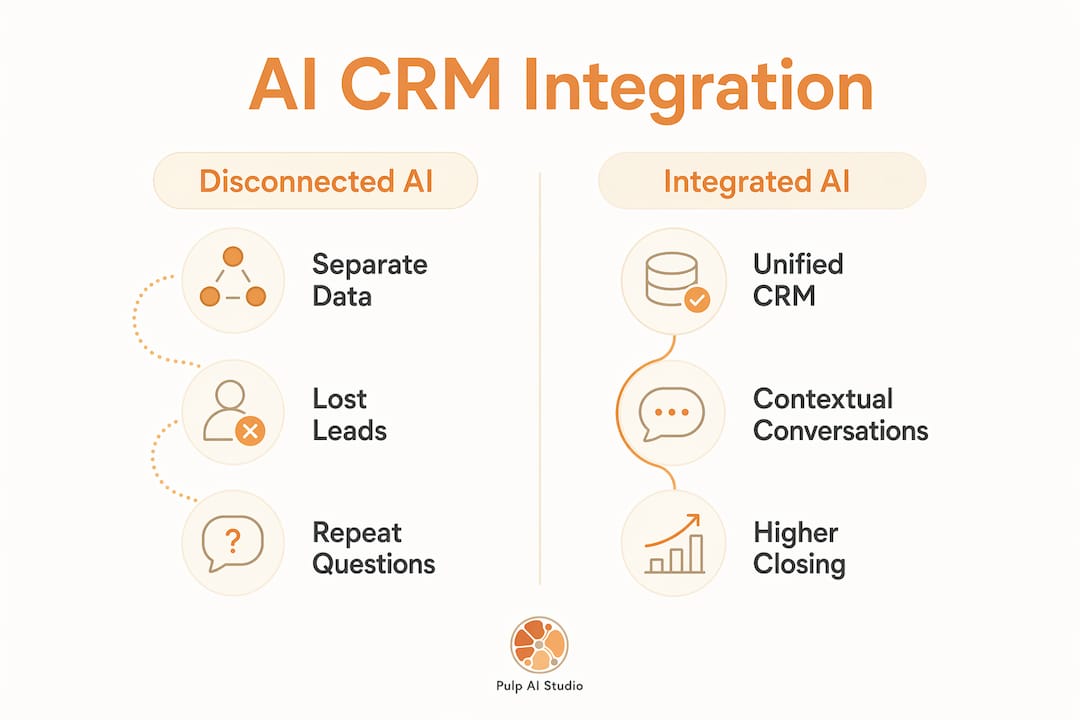
AI without CRM integration is a disconnected answering machine. The real power of AI in customer service comes from what the industry calls a conversation layer, a unified data structure that ties every inbound message, outbound follow-up, scheduled appointment, and human handoff to a single customer record inside your CRM and DMS.
Disconnected AI tools cause repeat questions and lost leads because each touchpoint starts from zero context. A customer who described their transmission issue to your AI chatbot on Monday should not have to repeat that description to your service advisor on Wednesday. When they do, trust erodes. That erosion is silent and cumulative.
| Disconnected AI setup | Integrated AI conversation layer |
|---|---|
| Each tool holds separate data | One CRM record captures all interactions |
| Customers repeat themselves at handoff | Advisor receives full context before picking up |
| No visibility on lead ownership | Clear ownership assigned at first contact |
| Duplicate follow-up messages | Unified scheduling prevents double-booking |
| Manual history reconstruction | Automatic timeline in CRM |
Operational continuity comes from tying all interactions to the same CRM conversation layer, which prevents the fragmented customer experiences that kill retention. Think of it as giving your AI employee a memory. Without integration, the AI is smart but amnesiac. With it, the AI remembers every conversation, every preference, and every open issue.
The practical setup requires three connections: your AI platform must write to your CRM in real time, read from your DMS for vehicle history, and trigger your scheduling system to block calendar slots. Platforms like TECOBI and Flai are built with these connections in mind. If your current AI vendor cannot demonstrate all three, you have a gap inside your gap solution.
Pro Tip: Before going live, run a test conversation from an unknown number and trace every data point it creates in your CRM. If any field is blank or the appointment does not appear in your scheduling system, fix the integration before you open it to real customers.
Common pitfalls that make AI hurt more than help
Poor AI implementation is not neutral. 1 in 5 consumers found no benefit from AI customer service interactions, and the primary reason is that the AI was designed to deflect rather than resolve. Deflection-first AI is a cost-cutting strategy disguised as a customer service upgrade, and customers recognize it immediately.
The most damaging pitfalls in dealership AI deployments fall into four categories:
- No warm handoff path. When a customer’s issue exceeds the AI’s capability and there is no clear escalation to a human, the customer is stranded. Safe fail paths with warm handoffs that include full customer context prevent negative experiences and maintain ownership continuity in AI-human workflows.
- Set-it-and-forget-it deployment. Successful AI requires continuous tuning, including regular review of routing logic, intent recognition accuracy, and escalation triggers. Dealers who deploy AI and never revisit the configuration see performance degrade within 60 to 90 days.
- Misaligned tone. An AI that sounds like a legal disclaimer does not build trust. Your AI’s language should match your dealership’s brand voice, including the level of formality your customers expect.
- Skipping the pilot phase. Rolling out AI across all departments simultaneously multiplies the risk of every configuration error. Start with one department, typically service scheduling, measure results for 30 days, then expand.
The principle behind improving dealer interactions here is simple: AI should resolve issues at the point of contact, not redirect customers into a loop. Cost-cutting driven AI that blocks human access damages retention at a rate that far exceeds whatever labor cost it saves.
Pro Tip: Build an escalation trigger for any conversation where the customer uses words like “frustrated,” “angry,” “wrong,” or “complaint.” Route those immediately to a human advisor with the full conversation transcript attached. That one rule prevents the majority of AI-generated complaints.
Real dealership results that prove the model works
The business case for AI in dealership customer service is no longer theoretical. The numbers from 2026 deployments are specific enough to build a financial model around.
Freeman Lexus handles more than 1,100 inbound service calls monthly. After deploying an AI BDC platform, the dealership booked 376 appointments and generated approximately $100,000 in profit impact in a single month. That is not a pilot result. That is a repeatable operational outcome.
Bay Area CDJR ran a 30-day AI deployment and booked 304 appointments via AI, generating an estimated $83,000 in profit. The AI handled the full scheduling workflow, including confirmation, reminder, and rescheduling, without a human touching the interaction until the customer arrived at the service drive.
“AI users report a 46% increase in lead-to-close ratio, which means the same number of inbound leads produces nearly half again as many closed deals when AI manages the initial engagement and follow-up sequence.” — How AI is transforming dealership service departments
The pattern across these deployments is consistent. AI absorbs the high-volume, repetitive scheduling and follow-up work. Human advisors focus on the conversations that require judgment, empathy, and product knowledge. 77% of dealerships report that AI improves workflow stability and customer interactions, which means the benefit is not isolated to a few early adopters. It is a documented operational shift across the industry.
Measuring ROI post-deployment requires tracking three metrics: appointment show rate, lead-to-close ratio, and average time-to-schedule. If your AI is working correctly, all three improve within the first 30 days. If only one improves, you have an integration or configuration issue worth investigating.
How AI enhances service beyond the first conversation
The first contact is where most dealers focus their AI investment. The bigger opportunity is everything that happens after. AI that manages the full service cycle, from intake through approval to pickup, creates a customer experience that feels attentive without requiring your staff to manually send a dozen messages per repair order.
Here is where AI delivers measurable value beyond initial contact:
- Multi-point inspection approvals. Customers with AI-driven photo and video MPIs approve 41% of recommended work, compared to 17% without. The AI presents the recommendation with visual evidence and a clear approval button via SMS. That 24-point gap in approval rate translates directly to additional revenue per repair order.
- Proactive status updates. An AI that sends “Your vehicle is in the shop and we expect it ready by 3 PM” at 10 AM eliminates the majority of inbound status calls. Those calls consume advisor time and create anxiety when they go unanswered.
- Recall outreach. AI can identify customers with open recalls from your DMS, send personalized outreach, and book the appointment without a human making a single call. This is one of the highest-ROI applications in the service department.
- No-show reduction. Automated SMS reminders sent 24 hours and 2 hours before an appointment consistently reduce no-show rates. The role of AI in reducing ghosting applies directly to service appointments, where a no-show costs the dealership a blocked bay and a lost labor hour.
- Post-service follow-up. An AI-triggered satisfaction check sent 24 hours after pickup catches dissatisfied customers before they write a negative review. It also creates a natural re-engagement touchpoint for future service needs.
The underlying principle is that AI should act as an agentic partner, handling routine communication tasks while freeing your advisors for the conversations that require human judgment. The AI employee does not get tired, does not forget to send the reminder, and does not skip the follow-up because the day got busy. That consistency is the product.
Key takeaways
AI reduces dealer customer service gaps most effectively when it combines 24/7 availability, CRM-integrated conversation layers, and continuous performance tuning into a single operational system.
| Point | Details |
|---|---|
| After-hours coverage is the priority | Over half of dealership leads arrive after hours; AI captures and converts them before competitors respond. |
| CRM integration is non-negotiable | A unified conversation layer eliminates repeated questions, lost leads, and fragmented customer histories. |
| Warm handoffs protect trust | Every AI deployment needs a clear escalation path to a human with full conversation context attached. |
| Continuous tuning sustains results | Set-it-and-forget-it AI degrades within 60 to 90 days; schedule monthly configuration reviews. |
| Post-contact AI multiplies revenue | AI-driven MPI approvals and proactive status updates increase work acceptance and reduce no-shows measurably. |
What I’ve learned from watching dealers get this wrong
I’ve watched a lot of dealerships buy AI and then wonder why nothing changed. The honest answer is almost always the same: they treated AI like a phone system upgrade rather than an operational discipline.
Here is the way to think about it. Your AI is not a product you install. It is a process you run. The dealers who see Freeman Lexus-level results are not using better software. They are reviewing conversation logs weekly, adjusting escalation triggers when they see patterns, and training their advisors to pick up where the AI left off without making the customer feel like they fell through a crack.
The human touch argument gets misused constantly. Some managers resist AI because they believe their customers want to talk to a person. That is partially true. Customers want to talk to a person when the issue is complex, emotional, or requires judgment. They do not want to talk to a person to confirm an oil change appointment at 8 PM on a Friday. Matching the right interaction type to the right handler, AI or human, is the actual skill here.
I also think the conversation around customer service automation benefits gets too focused on cost savings. The real value is speed. A customer who gets a response in 30 seconds is a fundamentally different customer than one who gets a response in 8 hours. Speed signals competence. It signals that your operation is organized and attentive. That perception carries through the entire service relationship.
Invest in proper integration before you invest in more AI features. One well-integrated AI that writes cleanly to your CRM and hands off with full context is worth ten disconnected tools that each do one thing adequately. Start narrow, prove the model, then expand. That is the discipline that separates the dealers who get ROI from the ones who get a case study in what not to do.
— Adam
A Plan Run for You, Not Another Tool to Run
Most owners did not lose the lead because a tool was missing. They lost it because nobody had time to run the tool. So we run it for you: a hosted CRM with the AI already wired in, set up and managed for your shop, live in about two weeks, and priced in the same range as the do-it-yourself AI receptionist plans, at one flat monthly price. The pieces most shops start with:
- Voice AI receptionist. Answers, qualifies, and books onto your calendar day or night, connected to the CRM or field software you already use, and hands the call to a person when it needs one. See the after-hours answering service.
- Speed to lead. A new form fill, ad lead, or missed call gets a text back right away, while the customer is still shopping. More on why the first few minutes decide the job.
- Database reactivation. The old leads and past customers already sitting in your system get a conversational text campaign that books the ones who are ready now. Related: why leads go quiet and how to restart them.
- AI social replies. Facebook and Instagram comments and DMs get answered and routed instead of sitting unread until Monday. The AI chatbot guide covers how those replies work.
Your contacts, your conversation history, and your phone number stay yours to export or port out if you leave. For shops that want the whole system on hardware they own, prompts, logs, and models included, the custom build below is the step up (about 30 days, since there is hardware to set up). Most shops start managed and grow into a rig, not the other way around.
How Pulp AI Studio closes your dealer service gaps fast
Pulp AI Studio sets up exactly the kind of AI infrastructure described in this article and runs it for you on the managed setup: live in about two weeks at one flat monthly price, connected to the DMS and CRM you already use. The Missed Call Text Back and AI Auto-Reply system captures every after-hours lead with a 30-second response, routes it correctly, and writes the interaction to your CRM before your team arrives in the morning. For dealers who want the system on hardware they own, the custom AI chatbot build goes live in about 30 days and connects to your existing scheduling and DMS workflows without a six-month integration project, with an optional managed plan to keep it tuned. Book a demo and see the setup live before you commit.
FAQ
How does AI handle after-hours dealership leads?
AI voice agents and SMS auto-reply systems respond to inbound inquiries within seconds, qualify the customer’s need, and book service appointments without human involvement. Over 56% of dealership leads arrive after hours, making this the highest-impact use case for AI deployment.
What is an AI CRM conversation layer?
An AI CRM conversation layer is a unified data structure that connects every customer interaction, from first contact through appointment and follow-up, to a single record in your CRM and DMS. It prevents repeated questions and lost leads by giving every human advisor full context at handoff.
How long does it take to see ROI from dealership AI?
Most dealerships see measurable results within 30 days of deployment, including improved appointment show rates and lead-to-close ratios. Freeman Lexus and Bay Area CDJR both reported significant profit impacts within their first month of AI operation.
What happens when AI cannot resolve a customer issue?
A properly configured AI escalates the conversation to a human advisor with the full transcript attached, a process called a warm handoff. Skipping this step is the most common cause of AI-related customer complaints and trust damage.
Does AI replace service advisors?
AI handles repetitive, high-volume tasks like scheduling, reminders, and status updates. 77% of dealerships report that AI improves workflow stability precisely because it frees advisors to focus on complex, trust-building conversations that require human judgment.