
 Adam Pichardo
TL;DR:
- AI communication tools automate personalized, multi-channel engagement for RV dealers, boosting conversions and response speed.
- They require careful data management, compliance oversight, and integration to maximize effectiveness and legal safety.
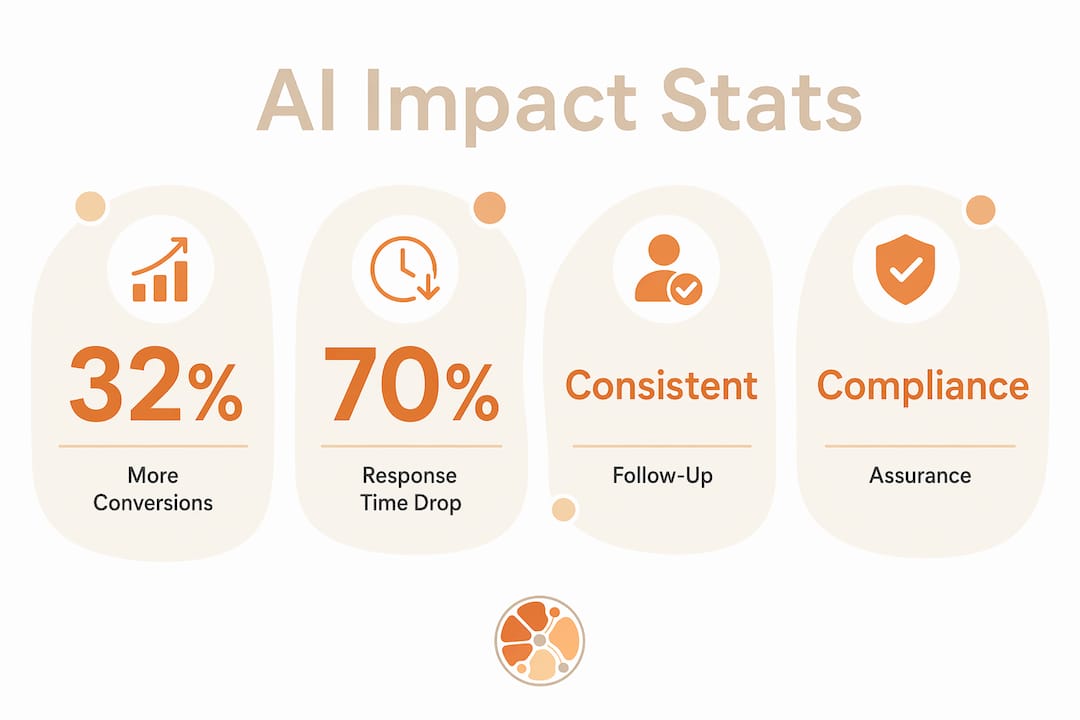
AI communication tools are defined as software systems that automate, personalize, and prioritize customer messaging across phone, text, email, and chat channels. For RV dealers, these tools solve a specific and costly problem: leads go cold while staff are occupied, and the buying window closes fast. AI-powered CRM tools help RV dealers respond faster, prioritize leads, and automate follow-up cadence, resulting in up to 32% increased conversions and 70% reduced response times. That is the core reason why RV dealers need AI communication tools. Speed and consistency, not just technology, determine who closes the deal. (The same automotive answering service setup we run for car stores is scoped for RV and powersports dealers too.)
Why RV dealers need AI communication tools for lead response
The RV sales cycle is long. A customer might visit your website three times, call once, and send two texts before they ever walk through your door. If any one of those touchpoints goes unanswered for more than a few hours, they move to the next dealership on their list. 52% of dealers now use AI for 24/7 customer engagement to respond within minutes instead of hours. That figure tells you the industry has already shifted. The dealers not using AI are the ones losing leads to the ones who are.

The challenge is not willingness. It is bandwidth. A sales team of four cannot monitor every inbound channel while also walking the lot, handling paperwork, and managing trade-in appraisals. AI fills that gap by acting as the first responder on every channel simultaneously. Think of it as the AI employee who never clocks out, never misses a message, and never forgets to follow up. The same first-responder model is covered for car stores in our field note on conversational AI for dealerships.
Here is what that looks like in practice:
- Lead prioritization by engagement signal. AI tools score incoming leads based on behavior, such as pages visited, time on site, and message frequency, then surface the hottest prospects to your sales team first.
- Automated follow-up cadence. Instead of relying on a salesperson to remember to send a third follow-up email, the system sends it automatically at the right interval.
- 24/7 response coverage. A prospect who submits a form at 10 PM on a Sunday gets a reply within seconds, not Monday morning.
- CRM integration for context. When the AI hands off to a human, the salesperson already sees the full conversation history, the lead score, and the customer’s stated interests.
The OliviaAI platform from voAIce Corporation replaces inconsistent human follow-up by autonomously managing phone, text, email, and web chats with full conversational context. That is not a chatbot answering FAQs. That is a system extending engagement across the full customer lifecycle, from first inquiry through service reminders, and recovering opportunities that would otherwise disappear.
Pro Tip: Integrate your AI communication tool directly with your dealership management system (DMS) or CRM from day one. Real-time data access means the AI quotes accurate pricing and availability, not stale information that erodes trust.
What compliance responsibilities come with AI messaging?
Here is the part most dealers skip when they are excited about the technology. AI-generated messages are not a legal gray area. There is no AI exemption under FTC regulations. Every claim your AI makes about pricing, financing terms, or vehicle condition is a dealership claim. You own it, legally and reputationally.
That means the compliance burden does not shrink when you add AI. It shifts. You are now responsible for monitoring what the AI says, not just what your salespeople say. The Telephone Consumer Protection Act (TCPA) adds another layer: consent tracking for text messages must happen in real time, and opt-outs must be honored immediately. A system that texts a customer who opted out is a liability, regardless of whether a human or an algorithm sent the message.
Here is a practical framework for staying compliant:
- Treat AI like a supervised employee. Dealers must treat AI like a salesperson requiring training, supervision, and review of output. Set clear rules for what the AI can and cannot say, and audit those rules regularly.
- Keep detailed logs of every AI interaction. Document what the system said, when it said it, and what data it used. These logs are your defense if a regulatory complaint arises.
- Build human review gates for high-risk interactions. Any conversation involving a price quote, financing terms, or a warranty claim should route to a human before the AI sends a final response.
- Verify data freshness continuously. If your AI pulls pricing from a feed that updates weekly, it can quote a price that no longer exists. Connect it to live inventory data or build in a disclaimer for any price-sensitive message.
- Audit opt-out handling monthly. Run a test: submit an opt-out request and confirm the system stops messaging within the required window. Document the test.
Pro Tip: Maintain a dedicated compliance log separate from your general CRM notes. If the FTC or a state attorney general ever requests documentation of your AI monitoring procedures, a clean, timestamped log is your strongest protection.
The AI claims pipeline concept is worth internalizing. Every AI promise is a legally binding dealer claim requiring fresh, verified data and human oversight. Build your workflow around that reality from the start, not after a complaint forces you to.
How does AI improve the quality of dealer messaging?
Speed gets the lead in the door. Quality keeps them engaged. These are two different problems, and the best AI communication tools for RV dealers solve both. A fast reply that sounds robotic or generic can actually damage trust more than a slow reply that feels human. AI tools that understand conversational context and service history deliver more relevant, personalized, and trustworthy interactions that customers prefer.
The difference between a generic AI message and a contextual one is significant. Generic: “Thanks for your interest. A representative will contact you soon.” Contextual: “Hi Sarah, I saw you were looking at the 2025 Airstream Classic 33FB. We have two in stock right now. Would a Saturday morning walkthrough work for you?” The second message uses the customer’s name, references the specific unit she viewed, confirms availability, and proposes a next step. That is not magic. That is CRM integration doing its job.
Traffic Log Pro’s AI communication features include quick message refinement, AI-suggested replies, grammar correction, and professional tone adjustment integrated directly into the CRM platform. These tools are available at no additional cost to dealers and help maintain OEM compliance while reducing admin load. That is a concrete example of AI improving message quality without adding complexity or cost.
Here is what quality-focused AI communication looks like in practice:
- Tone adjustment. The system detects whether a customer is frustrated, excited, or uncertain and adjusts the reply tone accordingly.
- Grammar and clarity correction. When a salesperson drafts a quick reply, AI polishes it before it sends, catching errors that erode professionalism.
- Contextual reply suggestions. Based on the customer’s message and their history in the CRM, the AI suggests two or three response options the salesperson can send with one click.
- Multi-channel context tracking. If a customer called yesterday and texted today, the AI knows both interactions and references them, so the customer never has to repeat themselves.
AI messaging tools that integrate with CRM and maintain multi-channel conversation context outperform simple chatbots or templated emails for complex dealership communication. The gap between a basic autoresponder and a context-aware AI platform is the difference between checking a box and actually building a relationship.
What are best practices for integrating AI into dealership workflows?
Deployment strategy determines whether AI communication tools pay off or create new headaches. The dealers who get the most out of these tools start narrow and expand deliberately. They do not try to automate everything at once.
NADA highlights that AI-enabled workflows increase Customer Satisfaction Index (CSI) scores by enabling consistent, personalized communication based on structured dealership information. The key word is structured. AI performs best when it has clean, organized data to work with. Garbage in, garbage out applies here more than anywhere else.
The table below maps common AI features to the recommended integration level for most RV dealerships:
| AI Feature | Integration Level | Primary Benefit |
|---|---|---|
| Missed-call text-back | Immediate, day one | Captures leads outside business hours |
| Automated lead follow-up | Week one, tied to CRM | Prevents lead decay across long buying cycles |
| AI-suggested reply drafts | Week two, sales team | Improves message quality and reduces response time |
| Tone and grammar polish | Week two, all staff | Maintains professional communication standards |
| Autonomous multi-channel engagement | Month two, after data audit | Replaces inconsistent human follow-up at scale |
Start with lead management and sales communication. That is where the ROI is clearest and fastest. A missed call that gets an instant text-back converts at a dramatically higher rate than one that goes to voicemail. Once that system is running cleanly, layer in automated follow-up sequences tied to your CRM. Then add quality tools like tone adjustment and suggested replies for your sales team.
Sustained, prioritized follow-up over the multi-visit, multi-decision RV buying cycle delivers the biggest operational gains, with AI tools automating next-best-step engagement and preventing lead drop-off. RV purchases are not impulse buys. A customer might take six weeks from first inquiry to signed contract. An AI system that maintains consistent, relevant contact throughout that window is worth more than any single fast reply.
Balance automation with human judgment. Do not let the AI make final decisions on pricing exceptions, trade-in values, or complaint resolution. Those moments require a human who can read the room. Use AI to handle volume and consistency, and reserve your team’s attention for the conversations that require real judgment. You can learn more about how dealership AI communication fits into broader workflow design in Pulp AI Studio’s breakdown of the topic.
Key takeaways
AI communication tools give RV dealers a measurable competitive edge by combining speed, personalization, and compliance into a single operational layer.
| Point | Details |
|---|---|
| Speed drives conversions | AI response within minutes instead of hours produces up to 32% more conversions for RV dealers. |
| Compliance is non-negotiable | FTC and TCPA rules apply fully to AI-generated messages; dealers must monitor, log, and audit AI output. |
| Context beats speed alone | AI tools that track service history and multi-channel interactions build more trust than fast but generic replies. |
| Start narrow, then expand | Deploy missed-call text-back and lead follow-up first, then layer in quality and autonomous features. |
| Human oversight stays essential | AI handles volume and consistency; human review gates protect against compliance risk and relationship damage. |
The part most dealers underestimate
I have watched dealers get excited about AI communication tools for the wrong reason. They focus on the “wow” of instant replies and then underinvest in the setup that makes those replies actually useful. The technology is not the hard part. The data is.
Here is the way to think about it. An AI system is only as good as the information it can access. If your CRM has duplicate records, stale pricing, and no service history attached to customer profiles, the AI will send fast, confident, wrong messages. That erodes trust faster than a slow reply ever could. The dealers I see getting real ROI from these tools spent the first two weeks cleaning their data before they turned the AI on. That is not glamorous, but it is the work that makes everything else function.
The other thing I want to be direct about: AI is not a replacement for your sales team. It is the AI employee who handles the first five minutes of every conversation so your best people can focus on the last five minutes, the ones that close the deal. Technology value peaks when it converts fragmented data into consistent personalized follow-ups that improve customer satisfaction. That is not a passive outcome. It requires deliberate setup, ongoing supervision, and a willingness to treat the AI like a team member who needs feedback and correction.
The future I see coming is fully autonomous platforms that manage the entire customer lifecycle without human initiation at each step. OliviaAI is already moving in that direction. The dealers who build the operational habits now, clean data, compliance logs, human review gates, will be the ones who can hand more of the workflow to AI without losing control of quality or legal standing. The ones who skip those habits will find autonomous AI creates autonomous liability.
— Adam
A Plan Run for You, Not Another Tool to Run
Most owners did not lose the lead because a tool was missing. They lost it because nobody had time to run the tool. So we run it for you: a hosted CRM with the AI already wired in, set up and managed for your shop, live in about two weeks, and priced in the same range as the do-it-yourself AI receptionist plans, at one flat monthly price. The pieces most shops start with:
- Voice AI receptionist. Answers, qualifies, and books onto your calendar day or night, connected to the CRM or field software you already use, and hands the call to a person when it needs one. See the after-hours answering service.
- Speed to lead. A new form fill, ad lead, or missed call gets a text back right away, while the customer is still shopping. More on why the first few minutes decide the job.
- Database reactivation. The old leads and past customers already sitting in your system get a conversational text campaign that books the ones who are ready now. Related: why leads go quiet and how to restart them.
- AI social replies. Facebook and Instagram comments and DMs get answered and routed instead of sitting unread until Monday. The AI chatbot guide covers how those replies work.
Your contacts, your conversation history, and your phone number stay yours to export or port out if you leave. For shops that want the whole system on hardware they own, prompts, logs, and models included, the custom build below is the step up (about 30 days, since there is hardware to set up). Most shops start managed and grow into a rig, not the other way around.
How Pulp AI Studio helps RV dealers respond faster and close more
If you are ready to stop losing leads to voicemail and after-hours silence, Pulp AI Studio sets up and runs exactly the kind of AI communication infrastructure described in this article. Our missed-call text-back and AI auto-reply system gets your dealership responding within 30 seconds, around the clock, without adding headcount. The managed setup is live in about two weeks and connects directly to your existing workflow and DMS. For dealers who want a more tailored solution, we also offer custom AI chatbot builds designed specifically for small to medium dealerships: about 30 days to live, and you own the rig. Either way, the goal is to reduce ghosting and close more deals before the competition even picks up the phone.
FAQ
What are AI communication tools for RV dealers?
AI communication tools for RV dealers are software systems that automate lead response, follow-up messaging, and customer engagement across text, email, phone, and chat. They integrate with CRM platforms to prioritize leads and maintain conversational context across the buying cycle.
How much do AI communication tools improve RV dealer conversions?
AI-powered CRM tools produce up to 32% increased conversions and reduce response times by up to 70% for dealerships. The gain comes from faster first contact and consistent follow-up across the multi-week RV buying cycle.
Are RV dealers legally responsible for what AI says to customers?
Yes. There is no AI exemption under FTC regulations, meaning every AI-generated claim about pricing, financing, or inventory is a dealer claim. TCPA consent and opt-out rules also apply fully to AI-sent text messages.
What is the best first AI tool for a small RV dealership?
A missed-call text-back system is the highest-ROI starting point for most small dealerships. It captures leads that would otherwise go to voicemail and responds within seconds, which is the window where conversion probability is highest. You can explore retail automation options to find the right fit for your operation.
How do AI tools personalize messages for RV customers?
AI tools personalize messages by pulling data from CRM records, including prior conversations, units viewed, and service history, then generating replies that reference specific customer details. Platforms like OliviaAI and Traffic Log Pro maintain this context across phone, text, and email so customers never have to repeat themselves.