
 Adam Pichardo
TL;DR:
- AI voice agents answer after-hours calls instantly and identify caller intent using natural language processing. Combining AI with missed-call SMS recovery captures more leads and improves appointment booking, ensuring callers get prompt follow-up. Small businesses should focus on clear escalation paths, legal compliance, and integration to fully benefit from automated after-hours call management.
AI voice agents are the front-line answer to after-hours job calls, picking up instantly, understanding what callers need through natural language processing, and acting without a human in the room. For small business owners, this means a plumber’s midnight emergency call gets routed to an on-call tech, a contractor’s quote request gets logged with full details, and a clinic’s after-hours inquiry gets a callback scheduled before the next morning. Understanding how AI handles after hours job calls is no longer a luxury topic for enterprise IT teams. It is a practical decision every small business owner and manager needs to make now, before the next missed call walks straight to a competitor.
How AI handles after-hours job calls: core capabilities
AI voice agents answer calls immediately with no hold, no voicemail prompt, and no menu tree. The caller speaks naturally, and the system understands intent through conversational AI. That is the first and most important shift from traditional after-hours setups.
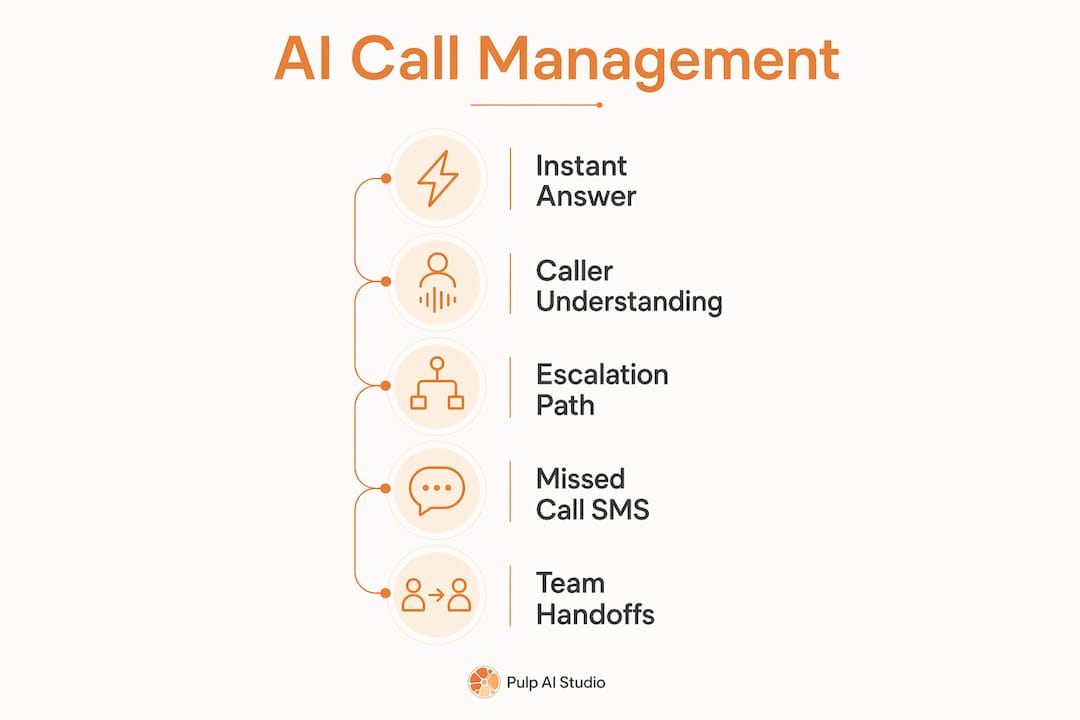
Here is what a capable AI voice agent does during a typical after-hours job call:
- Answers instantly. No hold music. No “press 1 for service.” The agent greets the caller and listens.
- Identifies intent. Natural language processing classifies the call as a routine inquiry, a scheduling request, or an emergency without the caller choosing from a menu.
- Resolves routine requests. FAQs, service area questions, pricing ranges, and job status updates get answered on the spot.
- Books appointments. The agent connects to your calendar and locks in a time without human input.
- Escalates with context. When a call needs a human, the agent routes with full details so the on-call tech or manager never has to ask the caller to repeat themselves.
- Creates a structured lead card. Every call produces a record with the caller’s name, number, issue description, and any next steps, ready for dispatch the next morning.
The escalation logic is where most small businesses get this wrong. They set up an AI agent to answer calls but give it no clear path for emergencies. A good system, like Dialpad AI Agents, classifies calls into urgent and routine categories and routes accordingly. Think of it as the AI employee who knows when to handle something alone and when to call the boss.
Pro Tip: When evaluating AI voice agent providers, test the escalation path first. Call in with a simulated emergency and see how fast the system routes to a live person. If it takes more than two steps, the logic is too shallow for real job calls.

After-hours coverage is more than a script. It includes structured operational handoffs so no caller data is lost between the AI agent and your morning team.
How can AI recover missed after-hours calls?
Even the best AI voice agent misses roughly 10% of inbound calls due to simultaneous volume or connectivity issues. That is where a missed-call text-back system becomes the second layer of your after-hours strategy.
A missed-call text-back sends an automated SMS within 60 seconds of a missed call. The message acknowledges the missed call, asks about the caller’s need, and offers to schedule a callback. The results are concrete: 18–34% of missed callers re-engage when they receive a text within that window, and 5–18% convert to booked appointments. That is revenue that would otherwise walk to the next contractor on Google.
| Strategy | Recovery rate | Appointment conversion |
|---|---|---|
| AI voice agent only | Baseline | Baseline |
| Missed-call SMS within 60 seconds | 18–34% of missed callers | 5–18% booked |
| AI voice agent + SMS text-back | Highest combined rate | Maximum lead capture |
The SMS workflow typically runs in three steps:
- Step 1 (0–60 seconds). Automated text acknowledges the missed call and asks what the caller needs.
- Step 2 (5–10 minutes). If no reply, a follow-up text offers a direct booking link or callback time.
- Step 3 (next morning). Unresponsive leads get flagged in the daily call digest for a staff follow-up.
The most common mistake small businesses make is slow response. A text sent 20 minutes after a missed call performs far worse than one sent in under 60 seconds. The caller has already moved on. AI automation solves this because it does not depend on a staff member noticing a missed call log.
Pro Tip: Before deploying a full AI voice agent, pilot the missed-call SMS system alone. It costs less, deploys faster, and gives you real data on how many after-hours callers you are currently losing. Use that data to justify the voice agent investment.
Combining AI answering with SMS recovery creates a contact strategy that catches callers at two points. The voice agent handles the live call. The SMS system catches the ones who slipped through. Together, they form a complete after-hours job assistance layer.
What compliance rules apply to AI after-hours calls?
The FCC’s february 2024 ruling under the Telephone Consumer Protection Act, commonly called TCPA, classified AI-generated synthetic voice calls as prerecorded or artificial voice calls. That classification carries real legal weight.
For small businesses using AI voice agents, the key compliance points are:
- Prior express consent is required for outbound marketing calls. If your AI agent calls leads back without their request, that is a marketing call and requires documented consent.
- Identification is mandatory. The AI agent must identify itself and provide a callback number at the start of any call covered by TCPA.
- Opt-out mechanisms are required for marketing communications. Any outbound AI call for marketing purposes must include a clear way for the recipient to opt out.
- Inbound answering carries fewer restrictions. When a customer calls you and your AI agent answers, that interaction is generally not treated as telemarketing under TCPA. The compliance burden is lower, but legal caution is still advised.
The practical takeaway is that inbound after-hours answering by AI is the lower-risk side of this equation. Your AI agent picking up a caller’s inbound job inquiry is not the same as your AI agent cold-calling a prospect list. Most small businesses using AI for after-hours job call management are operating on the inbound side, which is where the legal exposure is minimal.
Document your consent practices anyway. If your SMS text-back system sends outbound messages to numbers that did not explicitly opt in, that is where TCPA exposure grows. Work with a legal advisor to confirm your SMS consent flow before scaling.
How to implement AI for after-hours job call management
Getting AI into your after-hours workflow is a five-part process. Each part builds on the last.
Choosing the right AI voice agent
Look for providers that offer natural language understanding, not just keyword detection. The agent should handle open-ended questions like “I need someone to fix my furnace tonight” without requiring the caller to use specific phrases. Dialpad AI Agents and similar platforms handle inbound calls through genuine conversational AI. Confirm the provider integrates with your existing phone system before signing anything.
Connecting your calendar and CRM
An AI agent that cannot book appointments is just an expensive voicemail. The system needs to connect with calendars and CRM to log calls, schedule jobs, and update contact records automatically. Most platforms support integrations with Google Calendar, Microsoft Outlook, and common CRM tools. Set this up before going live.
Building your escalation paths
Define two call categories before launch: routine and emergency. Routine calls get logged and scheduled. Emergency calls get routed immediately to an on-call staff member with the full call context attached. For contractors, an emergency might be a burst pipe or a power outage. For a clinic, it might be a patient reporting chest pain. The AI agent needs clear rules for each category.
Setting up the SMS recovery layer
After-hours AI answering and missed-call SMS text-back work best together. Configure the SMS system to trigger within 60 seconds of any unanswered call. Write the message in plain language. “Hey, we missed your call. What do you need help with? Reply here or pick a time: [link]” outperforms any corporate-sounding template.
Training your team on AI handoffs
Your morning staff needs to know how to read a structured lead card. Run a short training session showing them what the daily call digest looks like and how to prioritize follow-ups. The AI does the overnight work. Your team closes the job. That handoff only works if both sides understand the process.
Pro Tip: Start with an AI-powered customer service system built around SMS chatbots before adding a full voice agent. The chatbot handles text-based after-hours inquiries at a lower cost, and the data you collect tells you exactly which call types need voice handling.
For clinics and medical practices, the implementation path looks similar but with tighter compliance requirements. Pulp AI Studio’s guide on AI handling clinic inquiries covers the specific workflow differences worth reviewing before you build.
Key Takeaways
AI voice agents combined with missed-call SMS text-back form the most complete after-hours job call system a small business can deploy today.
| Point | Details |
|---|---|
| Instant answering | AI voice agents pick up immediately with no hold, resolving routine calls without human input. |
| SMS recovery layer | Missed-call texts sent within 60 seconds recover 18–34% of callers who would otherwise go to a competitor. |
| Escalation logic matters | Define emergency vs. routine call categories before launch so urgent calls reach on-call staff instantly. |
| Compliance is manageable | Inbound AI answering carries lower TCPA risk than outbound AI calls, but SMS consent flows need documentation. |
| Integration drives ROI | Connecting AI agents to your calendar and CRM turns answered calls into booked jobs automatically. |
What I have learned from watching small businesses get this wrong
Most small business owners I talk to think after-hours AI is about answering the phone. It is not. It is about what happens after the call ends.
The businesses that get real results from automated job call management are the ones that obsess over the handoff. They build structured lead cards. They set up a daily call digest that their dispatcher reads at 7 a.m. They define exactly what counts as an emergency before the system goes live. The businesses that struggle are the ones that plug in an AI agent, assume it will figure things out, and then wonder why their morning team has no idea what happened overnight.
The other thing I see consistently underestimated is the SMS layer. Voice AI gets all the attention, but the missed-call text-back is often where the real revenue recovery happens. A caller who hung up before the AI agent answered is not a lost lead. They are a warm prospect who just needs a text within 60 seconds. That is a solvable problem, and it is cheaper to solve than most people expect.
The compliance piece is real but not scary for inbound operations. Where I see businesses get into trouble is when they start using AI for outbound follow-up calls without checking their consent documentation. Keep your AI on the inbound side until you have a legal review of your outbound flow.
The opportunity here for small businesses is genuine. You can now offer the same after-hours coverage that a large service company with a 24-hour call center provides, at a fraction of the cost, and be fully operational within two weeks. That is a competitive shift worth taking seriously.
— Adam
Pulp AI Studio’s scoped after-hours AI builds
Pulp AI Studio builds custom AI chatbots for small businesses. The setup covers missed-call text-back, AI auto-replies, and structured lead capture so your team walks in each morning with a full picture of overnight inquiries. For businesses in healthcare, the medical after-hours answering service handles after-hours patient calls with the same logic. Every build goes live within two weeks. If you are losing jobs to competitors because your phones go dark after 5 p.m., that is the problem Pulp AI Studio fixes directly.
FAQ
What does an AI voice agent actually do on an after-hours call?
An AI voice agent answers the call instantly, identifies the caller’s need through natural language processing, resolves routine requests, books appointments, and routes emergencies to on-call staff with full call context attached.
How fast should a missed-call text-back be sent?
The text should go out within 60 seconds of a missed call. Sending within that window recovers 18–34% of missed callers, while delays of even a few minutes drop that rate significantly.
Does TCPA compliance apply to AI agents answering inbound calls?
Inbound after-hours answering by AI is generally not classified as telemarketing under TCPA, so the compliance burden is lower. Outbound AI calls for marketing purposes require prior express consent and opt-out mechanisms.
How long does it take to set up an AI after-hours call system?
Deployment timelines vary by provider. Pulp AI Studio, for example, delivers a fully functioning AI answering and SMS text-back setup within two weeks.
What is the difference between AI answering and a missed-call text-back?
AI answering handles live inbound calls in real time. Missed-call text-back catches callers who hung up before the agent answered, re-engaging them via SMS within 60 seconds to recover leads that would otherwise be lost.