
 Adam Pichardo
TL;DR:
- AI chatbots for small businesses automate customer responses, qualify leads, and book appointments around the clock.
- The most effective platforms include Massively AI, Tidio, and ManyChat, with many offering AI in their base prices.
An AI chatbot for small business is an automated assistant that answers customer questions, qualifies leads, and books appointments around the clock without any developer support. Platforms like Massively AI, Tidio, and HubSpot Chatbot have made this technology accessible to owners with no technical background. The core promise is simple: your business keeps responding to customers even when you are closed, on a job, or just unavailable. This guide covers how these tools work, which platforms stand out, what they cost, and how to deploy one without wasting time or money.
What does an AI chatbot for small business actually do?
An AI chatbot is the closest thing to a tireless front desk employee. It reads your website, learns your products and services, and then answers customer questions in your brand voice, 24 hours a day. Modern platforms handle far more than simple FAQ replies.
Here is what a well-configured bot covers for a small business:
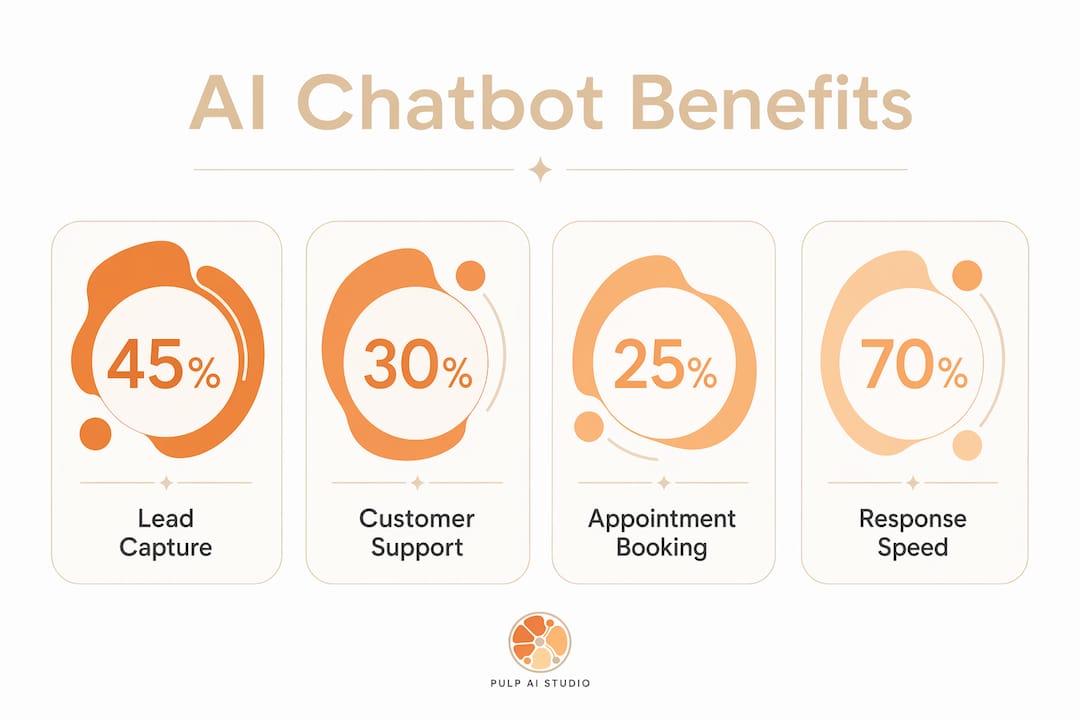
- Answers routine questions about hours, pricing, services, and location without human involvement. AI chatbots handle 70–80% of routine questions autonomously. That means your staff fields only the calls that genuinely need a human.
- Qualifies leads by asking the right questions upfront, so you know which inquiries are serious before you pick up the phone.
- Books appointments directly inside the chat window, syncing with your calendar.
- Recovers abandoned carts for retail and eCommerce owners by following up automatically. (Running a store with a POS and live inventory? The retail chatbot setup guide covers that build in depth.)
- Operates across channels including your website, Instagram, Facebook Messenger, and SMS from a single setup.
The multi-channel reach is where things get interesting. A customer who messages your Instagram page at 11 PM gets the same quality response as someone who fills out your contact form at noon. Massively AI, for example, deploys across website chat, Instagram, and Facebook Messenger from one configuration. You set it up once and it works everywhere.
Pro Tip: Do not try to automate every conversation at launch. Pick one channel where you lose the most leads, deploy there first, and expand once you see results.

AI chatbots also reduce the workload on your staff in a measurable way. AI-powered chatbots handle customer service and lead qualification, freeing your team to focus on higher-value work like closing sales and delivering services. For a small operation with two or three employees, that time savings is significant.
Which platforms are the best chatbot for small business in 2026?
The chatbot market has matured quickly. The platforms below represent the most relevant options for small business owners in 2026, compared across the factors that matter most: setup complexity, pricing, AI capability, and channel support.
| Platform | Setup complexity | AI included in base price | Channel support | Best for |
|---|---|---|---|---|
| Massively AI | Very low (no code) | Yes, $39/month | Website, Instagram, Facebook Messenger | Fast launch, multi-channel |
| Tidio | Low | Paid add-on | Website, email | eCommerce stores |
| HubSpot Chatbot | Medium | Paid add-on | Website, CRM | CRM-heavy teams |
| Intercom Fin | Medium to high | Paid add-on | Website, email, app | Website support |
| ManyChat | Low | Paid add-on | Instagram, Facebook, SMS | Social media focus |
A few things stand out in this comparison. Massively AI includes AI features in its $39/month Business plan without surprise add-ons. That matters because many platforms advertise a low base price and then charge separately for the AI features that make the bot actually useful.
Tidio is favored for ease of setup and quick launch, especially in small eCommerce stores handling repetitive product questions. It combines live chat with AI agents and uses natural language understanding to handle common queries. The catch is that the AI tier costs extra.
Intercom’s Fin AI chatbot suits website integration, while ManyChat leads on social media channels like Instagram and Facebook. If your customers primarily reach you through social, ManyChat is the stronger fit. If your website is the main entry point, Intercom or Massively AI make more sense.
G2’s Summer 2026 Small-Business Grid Report identifies Jotform AI Agents, Smartsupp, Tidio, and Fin as highest in user satisfaction for foundational problem-solving. Satisfaction scores reflect how well a tool solves the core job. Recommendation scores reflect whether the tool fits your specific operation. Those two numbers often diverge, which is why reading reviews carefully matters.
Pro Tip: Before you commit to any platform, check whether AI features are included in the plan you can afford. A $19/month plan that charges $50/month extra for AI is not actually $19/month.
Massively AI is built by a conversational AI company with 10+ years of experience and is trusted by brands like eBay and Starbucks. That enterprise-grade foundation is now packaged for small business owners at a fraction of the cost. It is a meaningful credential when you are trusting a bot to represent your business to customers.
How to implement an AI chatbot without making common mistakes
Getting a chatbot live is not the hard part. Getting it to work well is. These steps reflect what actually separates successful deployments from abandoned ones.
-
Define one goal before you touch any platform. Starting with a single, specific goal like lead generation or automating FAQs leads to better results than trying to automate all communication at once. Write down the one problem you want the bot to solve in the first 30 days.
-
Let the bot train on your existing content. No-code platforms like Massively AI scrape your website to train the chatbot automatically, avoiding long setup times. You do not need to build a question-and-answer database by hand. Just point the platform at your URL and it reads up to 50 pages of your content.
-
Check for hidden AI fees before you sign up. Many platforms charge additional AI add-on fees that surprise buyers after the first billing cycle. Read the pricing page carefully and ask support whether the plan you choose includes natural language AI or just keyword matching.
-
Test the bot as a customer would. Ask it your ten most common questions. Ask it something off-script. See where it breaks. Fix those gaps before you go live.
-
Set a review schedule. Your products, prices, and services change. Your bot’s knowledge needs to keep up. A monthly content refresh takes 15 minutes and prevents the bot from giving outdated answers.
-
Use a no-code platform if you are not technical. Many small business owners overestimate the technical skills required. Modern platforms let non-technical users deploy sophisticated bots within minutes. You do not need a developer, an IT team, or a coding background.
The biggest mistake owners make is launching a bot with no clear success metric. If you cannot answer “how will I know this is working in 60 days,” you are not ready to deploy. Pick a number: leads captured per week, support tickets reduced, or appointments booked per month.
What does an AI chatbot cost, and what return should you expect?
Pricing for AI chatbot platforms follows a tiered subscription model. Most small business plans fall in the $30–$50 per month range for plans that include meaningful AI capability. Here is a realistic breakdown.
| Cost factor | What to expect |
|---|---|
| Base subscription | $30–$50/month for business-grade AI plans |
| AI add-on fees | $0 with Massively AI; $20–$100/month extra with others |
| Setup time | 5–10 minutes on no-code platforms; days with custom builds |
| Staff time saved | Significant reduction in repetitive inquiry handling |
| Lead conversion impact | Higher capture rate from after-hours and weekend inquiries |
The affordable AI chatbot solution argument is strongest when you calculate what you currently lose to missed inquiries. A contractor who misses three calls on a Saturday and loses one job has already lost more than a year of chatbot subscription fees. The math is not complicated.
Realistic expectations matter here. A chatbot does not replace your sales process. It handles the front end: answering questions, capturing contact details, and routing serious leads to you. The role of automated text replies in business growth is well documented for small operators. Speed of response is one of the strongest predictors of lead conversion, and a bot responds instantly, every time.
The ROI case is clearest for businesses with high inquiry volume and limited staff. Retailers, clinics, contractors, and service businesses all fit this profile. If you get more than 20 customer inquiries per week and currently handle them manually, a chatbot pays for itself quickly.
Key Takeaways
An AI chatbot for small business delivers the highest return when deployed with a clear goal, trained on existing content, and chosen from a platform that includes AI in the base price.
| Point | Details |
|---|---|
| Define one goal first | Pick lead capture, FAQ automation, or appointment booking before choosing a platform. |
| AI in base price matters | Platforms like Massively AI include AI at $39/month; others charge it as a costly add-on. |
| No-code setup is real | Tools like Massively AI train on your website in minutes with no developer needed. |
| Multi-channel reach multiplies value | One setup covering website, Instagram, and SMS captures leads across every entry point. |
| Measure results from day one | Track leads captured or tickets reduced weekly to confirm the bot is earning its cost. |
Why I think most small businesses are still thinking about this wrong
Here is the way I see it after working with over 300 small business sites: most owners either want to automate everything at once or they dismiss chatbots entirely because they tried a clunky keyword bot years ago and it embarrassed them.
Both reactions miss the point. The technology has moved. Today’s AI chatbots are not decision trees with canned responses. They read your content, understand context, and respond in a way that sounds like your business. The gap between a 2019 chatbot and a 2026 AI chatbot is roughly the same as the gap between a flip phone and a smartphone.
The owners who get the best results treat the bot like a new hire on probation. They give it one job, watch how it performs, correct its mistakes, and expand its responsibilities over time. That is the right mental model. The role of AI in reducing ghosting is real and measurable. Leads that get an instant response are far less likely to move on to a competitor.
My honest warning: watch the pricing structure. I have seen owners sign up for a $29/month plan, get excited, and then discover the AI features they actually need cost $79/month extra. Read the pricing page twice. If the AI capability is an add-on, factor that into your real monthly cost before you commit.
The businesses that benefit most are not the ones with the biggest budgets. They are the ones that pick a focused use case, deploy fast, and treat the bot as a living tool they actively maintain. If you can do those three things, the return is real.
— Adam
How Pulp AI Studio builds AI chatbots for small businesses
Pulp AI Studio works with small business owners, retailers, clinics, and contractors who need a working AI chatbot without a six-week timeline. The model is straightforward: a scoped custom chatbot build matched to your specific business, deployed and handed off within two weeks. You own the setup, with an optional managed plan. If you are also losing leads to missed calls after hours, the missed-call text-back sprint pairs directly with chatbot deployment for full coverage.
FAQ
What is an AI chatbot for small business?
An AI chatbot for small business is an automated assistant that answers customer questions, qualifies leads, and books appointments without human involvement. It runs 24/7 across channels like your website, Instagram, and SMS.
How long does it take to set up a small business chatbot?
No-code platforms like Massively AI go live in 5–10 minutes by reading your existing website content automatically. No developer or manual data entry is required.
What is the best chatbot for small business in 2026?
Massively AI, Tidio, and ManyChat are among the top-rated options depending on your channel priorities. Massively AI leads for multi-channel no-code deployment with AI included in the base price.
How much does an AI chatbot cost for a small business?
Most business-grade AI chatbot plans cost $30–$50 per month. Watch for platforms that charge AI features as a separate add-on, which can significantly raise the real monthly cost.
Can an AI chatbot replace my customer service team?
A chatbot handles 70–80% of routine questions autonomously but is not a full replacement for human staff. It manages the front end of customer communication and routes complex issues to your team.