
 Adam Pichardo
TL;DR:
- Retail support automation leverages AI, rules, and templates to handle high-volume, rules-based customer inquiries across multiple channels, reducing response times significantly. Implementing targeted automation on order status, returns, and loyalty inquiries, combined with grounded AI and structured handoff protocols, enhances efficiency and customer satisfaction. Proper planning, clear escalation paths, and continuous metrics tracking are essential to avoid common pitfalls and maximize ROI.
Retail customer service reply automation is the practice of using AI, rules-based triggers, and pre-built response templates to answer customer questions across email, live chat, SMS, and social channels without requiring a human agent for every interaction. The industry term for this is conversational automation, and it sits at the center of how modern retailers cut response times from hours to seconds. Tools like Gorgias, Intercom, and iPlum have made this accessible to stores of every size, not just enterprise chains with dedicated IT teams. If you run a retail business and your support inbox fills up faster than your team can clear it, this guide is your practical starting point.
How to automate retail customer service replies effectively
Retail customer service automation combines three core components: AI-generated answers, automation rules with triggers, and macro-based templates. Each component handles a different layer of your customer communication. AI answers handle open-ended questions by generating contextual responses from your product data and policies. Automation rules fire pre-set actions when specific conditions are met, such as sending a shipping update when an order status changes. Macros are saved reply templates your system or agents can deploy instantly for recurring question types.

The practical result is that your support operation stops being purely reactive. Instead of one agent typing the same return policy explanation forty times a day, the system handles it automatically and routes genuinely complex issues to the right person. Automation reduces agent work on repetitive questions, delivers consistent instant replies, and increases overall team productivity. That last point matters more than most retailers realize. Consistency is a trust signal. When every customer gets the same accurate answer about your return window, you eliminate the variance that generates follow-up complaints.
Gorgias, Intercom, and iPlum each approach this differently. Gorgias is built specifically for ecommerce and connects directly to Shopify, BigCommerce, and Magento order data. Intercom focuses on AI-to-human collaboration with structured handoff workflows. iPlum specializes in SMS and phone-based auto-replies, which is particularly useful for brick-and-mortar retailers who still receive high call and text volume. Understanding which tool fits your channel mix is the first decision you need to make before configuring anything.
Which customer interactions are best suited for automation?
The biggest gains from automation come by targeting high-volume, rules-based contacts rather than attempting to automate everything at once. This is the principle that separates retailers who see real ROI from those who spend months configuring a system that frustrates customers. Start with the questions your team answers the same way every single time.
The highest-impact categories for retail support automation include:
- Order status and tracking. Customers want to know where their package is. This question has a definitive, data-driven answer every time. Automation handles it perfectly.
- Return and exchange initiation. Customers need to know your policy, the return window, and how to start the process. A rules-based flow covers this without human involvement.
- Loyalty program inquiries. Point balances, tier status, and redemption rules are structured data. Automation retrieves and presents them instantly.
- Store hours and location details. Static information that should never require a human agent.
- Product availability checks. When connected to your inventory system, automation answers this in real time.
OneSupport’s retail platform demonstrates this scope clearly, automating order status, return initiation, tracking, and loyalty inquiries to deflect contacts and free agents for complex issues. The deflection effect is significant. When you remove these high-volume, low-complexity tickets from your queue, your human agents spend their time on the interactions that actually require judgment, empathy, and product expertise.
The numbers support this approach. Azeon AI reduced repeat retail support contacts by 35%, improved customer satisfaction scores from 3.7 to 4.8, and reclaimed over 2,000 agent hours monthly after deploying retail support automation. That is not a marginal improvement. Reclaiming 2,000 hours a month is the equivalent of adding more than a full-time employee to your team without hiring anyone.
Multi-channel coverage matters here too. Your customers contact you through email, live chat, SMS, Instagram DMs, and Facebook Messenger. Automation that only covers one channel creates gaps. The most effective retail support automation setups apply consistent rules and responses across all active channels so a customer gets the same answer whether they text you or email you.
What tools and technologies power retail reply automation?
The customer service automation tools available in 2026 fall into three architectural categories: platform-native automation, standalone AI chatbots, and phone or SMS auto-reply systems. Each serves a different part of your communication stack.
| Tool / Platform | Best For | Key Capability |
|---|---|---|
| Gorgias | Ecommerce email and chat | Macros, order data integration, checkout triggers |
| Intercom | AI-to-human handoff workflows | Structured escalation notes, feedback loops |
| iPlum | SMS and missed-call auto-reply | Business hours logic, configurable text responses |
| Retail-AI-Agent | Returns policy automation | Grounded policy evaluation, zero hallucination |
Gorgias macros are the fastest entry point for most retailers. Gorgias macros enable instant replies to common ecommerce questions including order tracking, and the chat widget deploys via a simple site footer snippet. You can configure triggers for specific behaviors, such as a customer sitting idle at checkout for more than 90 seconds, which fires a proactive message offering help. This kind of trigger-based automation catches abandonment before it happens.
iPlum solves a problem that pure software platforms often miss: the phone call and text message channel. iPlum auto-text replies fire automatically when a customer texts or calls during or outside business hours, with configurable logic that aligns responses to your actual availability. A customer who texts your store at 9 PM gets an immediate acknowledgment with your hours and a promise of follow-up, rather than silence. Silence is where leads go to die.
Retail-AI-Agent represents the more technical end of the spectrum. This tool-based architecture grounds AI replies in CSV product data and written policy rules, separating policy decision logic from language generation entirely. The result is zero-hallucination automated returns evaluations. The system checks the policy file first, then generates the customer-facing response. This architecture is worth understanding even if you do not build it yourself, because it illustrates why grounded AI outperforms generic chatbots for policy-sensitive retail interactions.
Pro Tip: Before selecting a platform, map your top ten most common support questions and identify which channels they arrive through. The tool that covers your highest-volume channel with the deepest integration wins, regardless of feature count.
You can also explore retail automation platform comparisons to see how different technology stacks perform across real retail deployments before committing to a vendor.
How to implement automated replies step by step
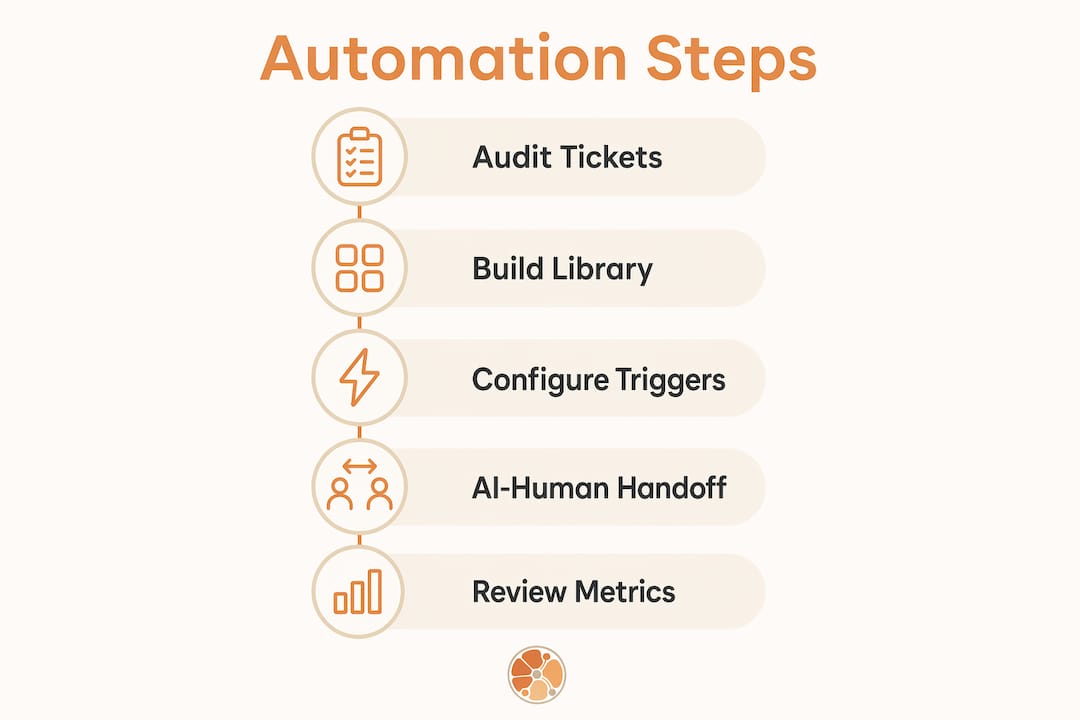
A systematic deployment prevents the most common failure mode in retail support automation: launching a half-configured system that confuses customers and frustrates agents. Follow this sequence.
Step 1: Audit and categorize your current support tickets. Pull 90 days of support history and tag every ticket by question type. You are looking for the top ten question categories by volume. These are your automation targets. Do not guess. The data will surprise you, and the surprises are where the biggest time savings hide.
Step 2: Build your response library. For each high-volume category, write a definitive answer. Keep it short, accurate, and policy-aligned. These become your macros in Gorgias, your intent responses in Intercom, or your auto-text templates in iPlum. One good answer per question type, reviewed by whoever owns that policy in your business.
Step 3: Configure triggers and routing rules. Set the conditions that fire each automated response. Order status questions trigger a lookup and reply. Return requests trigger a policy response plus a link to your returns portal. Anything involving a complaint, a damaged item, or a billing dispute routes immediately to a human agent with a structured handoff note attached.
Step 4: Design your AI-to-human handoff protocol. This step is where most retailers underinvest. Effective AI-human handoffs require explicit triggers, structured notes, clear routing, and a customer-facing message before the transfer happens. The handoff note must include the customer’s question, what the AI already told them, and why escalation was triggered. An agent who receives a handoff note with full context resolves the issue faster and does not ask the customer to repeat themselves.
Step 5: Set your success metrics and review cadence. Track four numbers: customer satisfaction score (CSAT), repeat contact rate, average first response time, and agent hours saved per week. Review them monthly for the first quarter. Azeon AI’s retail deployment used exactly this kind of metric tracking to identify which automation flows were working and which needed refinement, which is how they reached a 35% reduction in repeat contacts.
| Metric | What It Measures | Target Benchmark |
|---|---|---|
| CSAT score | Customer satisfaction with support interaction | 4.5 or above (5-point scale) |
| Repeat contact rate | Customers who contact again about same issue | Below 15% |
| First response time | Time from contact to first reply | Under 5 minutes for automated channels |
| Agent hours saved | Weekly hours reclaimed from repetitive tickets | Track week-over-week improvement |
Pro Tip: Run your automation in shadow mode for one week before going live. Shadow mode means the system generates responses but does not send them. Your team reviews the drafts and flags errors before any customer sees a bad reply.
What challenges arise and how do you fix them?
Over-automation is the most common and most damaging mistake in retail support automation. It happens when retailers automate too many contact types before their response library is accurate, or when they remove human escalation paths entirely. The result is customers receiving confident, wrong answers from a system that cannot recognize its own errors.
The specific failure modes to watch for:
- Escalation without context transfer. The AI hands off to a human agent but sends no handoff note. The agent asks the customer to start over. The customer leaves a one-star review.
- After-hours automation misaligned with business hours. A customer receives an automated reply at 2 PM on a Tuesday saying “We’ll get back to you during business hours.” This creates confusion and signals disorganization.
- Generic AI replies on policy-sensitive questions. A chatbot that generates a return policy answer from general training data rather than your actual policy will give wrong information with complete confidence.
Integrating after-hours automated replies with proper business hours logic prevents the second failure mode entirely. Your system should know your hours and adjust its messaging accordingly. A customer who contacts you at 11 PM should receive a message that acknowledges the time, sets a clear expectation for follow-up, and does not imply someone is available right now.
“The handoff note is the most critical output of any AI-to-human collaboration workflow. Poor handoffs cause time waste and bad customer experience.” — Intercom
Managing customer expectations through autoresponder messages is underrated as a retention tool. When a customer knows their message was received and understands when they will hear back, they are far less likely to send three follow-up messages or post a complaint on social media. The role of automated text replies in customer retention is direct: acknowledgment buys patience.
Grounding your AI in explicit data solves the third failure mode. Separating policy evaluation from language generation means the system checks your actual return policy file before generating any customer-facing text. The AI cannot hallucinate a policy that does not exist in your data. This architecture requires more setup than a generic chatbot, but it is the only approach that is safe for policy-sensitive retail interactions. If you want the full build sequence, from training data to POS integration, follow the retail AI chatbot setup guide.
Gather agent feedback every two weeks during your first three months of deployment. Your agents see the failure modes before your metrics do. They know which automated replies are generating confused follow-up calls. That feedback loop is how you refine your automation from functional to genuinely good.
Key takeaways
Retail customer service reply automation delivers the highest ROI when it targets high-volume, rules-based contacts, uses grounded AI for policy questions, and pairs every escalation with a structured handoff note.
| Point | Details |
|---|---|
| Target rules-based contacts first | Automate order status, returns, and loyalty inquiries before attempting complex issue resolution. |
| Ground AI in your actual policies | Use structured data files and policy rules to prevent wrong automated answers on returns and refunds. |
| Design handoffs before going live | Every escalation needs a structured note so human agents never ask customers to repeat themselves. |
| Track four core metrics | Monitor CSAT, repeat contact rate, first response time, and agent hours saved weekly. |
| Align automation to business hours | Configure after-hours logic so customers receive accurate expectations, not false availability signals. |
Where most retailers get the balance wrong
I have worked with enough small retail operators to say this plainly: the automation conversation almost always starts in the wrong place. Most owners want to know which tool to buy. The better question is which ten questions your team answers the same way every day.
When you start there, the tool choice becomes obvious. If 60% of your support volume is order status questions coming through email and SMS, you need Gorgias connected to your order management system and iPlum handling your text channel. If your biggest pain point is after-hours missed calls turning into lost sales, you need a missed-call text-back system running before you configure anything else.
The retailers I have seen get the most out of AI for retail support are not the ones who deployed the most sophisticated technology. They are the ones who mapped their actual contact patterns, automated the obvious stuff first, and built clean escalation paths for everything else. The AI employee analogy holds here. You would not hire a new staff member and give them zero training, no policy manual, and no one to ask for help. Your automation setup deserves the same onboarding rigor.
The personal touch does not disappear when you automate. It gets concentrated. When your team is no longer typing the same tracking update for the fortieth time that day, they have real capacity to handle the customer who is genuinely upset, genuinely confused, or genuinely in need of a human conversation. That is where your brand reputation is actually built. Automation clears the path to those moments.
— Adam
A Plan Run for You, Not Another Tool to Run
Most owners did not lose the lead because a tool was missing. They lost it because nobody had time to run the tool. So we run it for you: a hosted CRM with the AI already wired in, set up and managed for your shop, live in about two weeks, and priced in the same range as the do-it-yourself AI receptionist plans, at one flat monthly price. The pieces most shops start with:
- Voice AI receptionist. Answers, qualifies, and books onto your calendar day or night, connected to the CRM or field software you already use, and hands the call to a person when it needs one. See the after-hours answering service.
- Speed to lead. A new form fill, ad lead, or missed call gets a text back right away, while the customer is still shopping. More on why the first few minutes decide the job.
- Database reactivation. The old leads and past customers already sitting in your system get a conversational text campaign that books the ones who are ready now. Related: why leads go quiet and how to restart them.
- AI social replies. Facebook and Instagram comments and DMs get answered and routed instead of sitting unread until Monday. The AI chatbot guide covers how those replies work.
Your contacts, your conversation history, and your phone number stay yours to export or port out if you leave. For shops that want the whole system on hardware they own, prompts, logs, and models included, the custom build below is the step up (about 30 days, since there is hardware to set up). Most shops start managed and grow into a rig, not the other way around.
How Pulp AI Studio helps retail businesses automate replies
We set up AI auto-reply and missed-call text-back on the managed setup above, live in about two weeks and run by us at one flat monthly price. For retail businesses, this means a customer who calls after hours gets an immediate text response rather than silence, and a customer who texts with a common question gets an accurate reply before they contact a competitor. The pattern is consistent: an immediate reply means fewer leads lost to competitors and more inquiries that turn into sales. For retailers who want a custom AI chatbot built to their specific policies and product catalog on hardware they own, the custom build is the step up, live in about 30 days. Most shops start managed and grow into a rig. You can also explore after-hours answering automation to cover the contact window most retailers currently leave completely unattended.
FAQ
What does it mean to automate retail customer service replies?
It means using AI, pre-built templates, and rules-based triggers to answer common customer questions across email, chat, and SMS without a human agent handling each one. The industry term is conversational automation.
Which questions should I automate first?
Start with order status, return policy, tracking updates, and store hours. These are high-volume, rules-based contacts with definitive answers that automation handles accurately every time.
How do I prevent my AI from giving wrong answers?
Ground your AI in explicit data files and written policy documents rather than relying on general training. The Retail-AI-Agent architecture separates policy evaluation from language generation, which eliminates hallucinated policy responses.
What happens when automation cannot resolve an issue?
The system escalates to a human agent with a structured handoff note that includes the customer’s question, what was already communicated, and why escalation was triggered. Effective handoff design is what prevents customers from repeating themselves.
How quickly can I see results from retail support automation?
Deployments like Azeon AI’s retail implementation show measurable results within the first month, including a 35% reduction in repeat contacts and CSAT improvements from 3.7 to 4.8 on a five-point scale.