
 Adam Pichardo
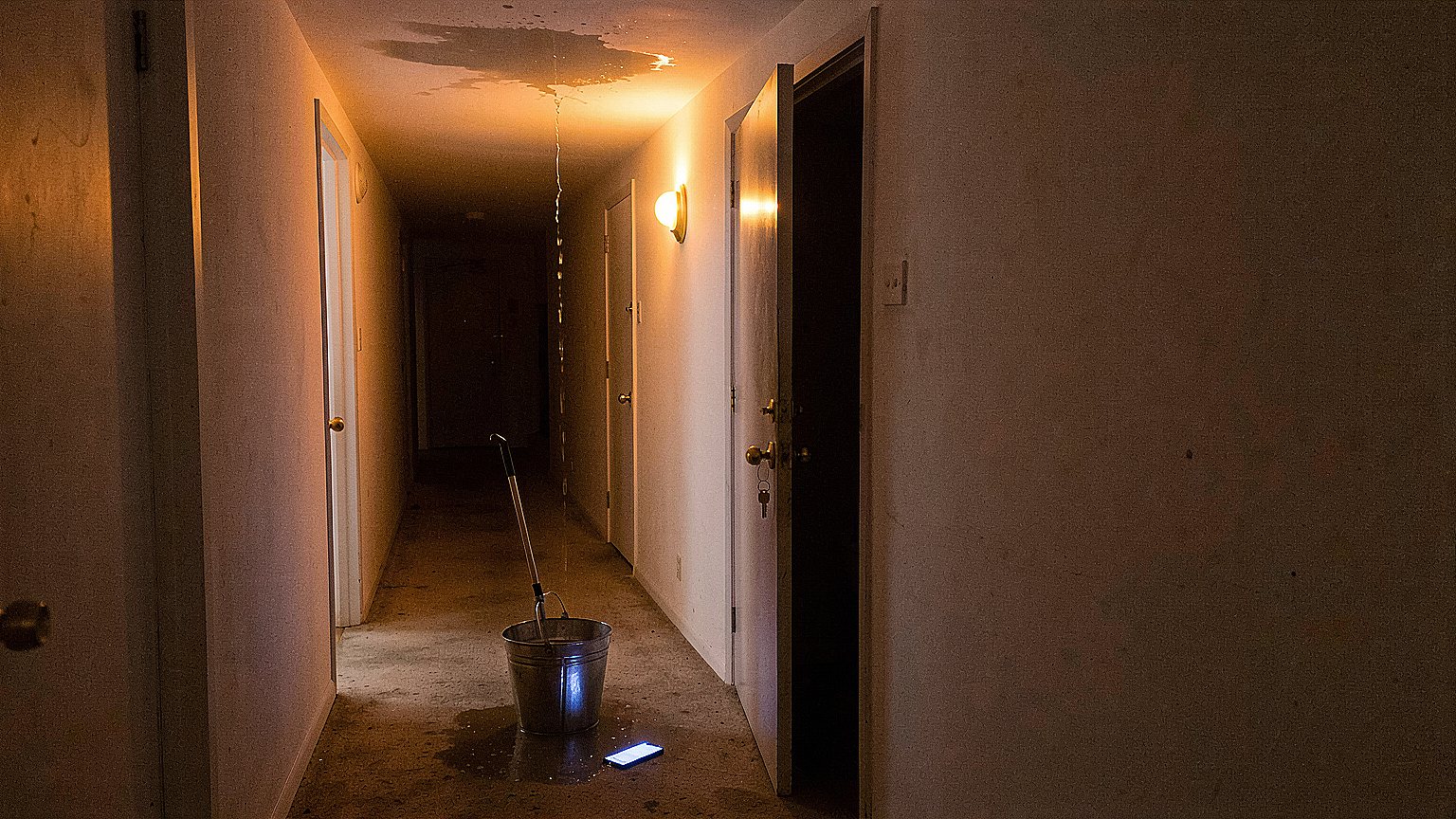
It is 2:14 in the morning and there is water coming through a ceiling in unit 204. The tenant calls the office number on the lease. If they get voicemail, they try again, then send a portal request nobody will read for six hours. Meanwhile the water keeps coming, and it is working its way toward unit 104.
That call is the most expensive one a property manager gets, and it almost always arrives when nobody is at a desk. It is also where AI for property management earns its keep first. Most of the talk about AI in this industry is about listing copy, owner reports, and leasing bots. Those are fine. But the job that protects the building, the renewal, and your on-call person's sleep is answering that phone and deciding, correctly, what happens next.
So this note is mostly about that decision: what counts as an emergency maintenance request, how fast the law expects you to move, and the rules I would put in front of any AI that answers for a portfolio.
I build these systems, so weigh my bias. I am also not a lawyer. Nothing here is legal advice, repair deadlines change by state and city, and every source is linked at the bottom so you can check it against your own leases with your own counsel.
Key Takeaways
The short version, before the detail.
| Point | Details |
|---|---|
| Start with the phone | After-hours maintenance calls are the highest-stakes job AI can take on in property management, and the easiest to measure. |
| An emergency has a test | A request is an emergency if it threatens safety, is causing active damage, makes the unit unlivable, or leaves it unsecured. Everything else waits for morning. |
| Life safety comes first | Fire, gas, and carbon monoxide calls get "leave and call 911" before any maintenance question. The agent never dispatches ahead of that. |
| Broken AC depends on where you are | In Las Vegas in July it can be a life-safety problem with a 48-hour legal clock. Texas has no statewide right to AC at all. |
| The clock usually starts at notice | Nevada, Arizona, Texas, and Florida all tie repair timelines to notice from the tenant, so a timestamped record of what was reported matters. |
| Keep a human in the loop | AI can answer, sort, and page. People own spending limits, legal questions, and anything about who gets to rent. |
What Can AI Actually Do for Property Management?
AI for property management covers five practical jobs: answering tenant calls and texts, sorting maintenance requests, replying to rental inquiries, drafting routine messages and reports, and helping staff find information in leases and files. It does not replace the judgment calls: spending an owner's money, handling a legal dispute, or deciding who gets a unit.
Adoption is no longer the question. The AI Insights 2026 survey from IREM and AppFolio, covering 3,662 real estate management professionals, puts AI use at 58%, up from 45% in 2025 and 21% in 2023. AppFolio sells AI software, so read that with some salt, but the direction is hard to argue with.
What is lagging is the part that matters. In the same survey, 85% of AI users report a productivity gain but only 48% report a positive effect on NOI or profitability. Only 8% of companies have a written AI policy, and 74% of employees have had no formal training. Buildium's own industry report found just 8% of respondents had fully automated any workflow. Most teams are using a chatbot to write faster. Few have handed AI a job with an outcome attached.
If the mechanics are new to you, start with how AI receptionists work. Here is how I sort the jobs by how much rope to give the AI.
| Job | What AI does | Who stays in charge |
|---|---|---|
| After-hours maintenance calls | Answers, runs triage, pages the vendor, texts the tenant, logs the work order | Your on-call manager, for escalations and spending limits |
| Routine tenant questions | Answers from your published info: office hours, payment options, where to send things | Your office, for anything not on the approved list |
| Rental inquiries | Replies fast, shares listing facts, books showings | Leasing staff, for anything that touches who qualifies |
| Drafting and reports | First drafts of notices, owner updates, and summaries | A person reads every one before it goes out |
| Applicant screening decisions | Nothing without a compliance review | Your broker and counsel |
The leasing side has its own playbook, covered in the AI receptionist for real estate note. The rest of this one stays on maintenance.
Why Start With After-Hours Calls?
Because the coverage gap is enormous and the failure is expensive. An office open 40 hours a week is closed for the other 128. Most tenants will never read your coverage plan, but they will find out what it is the night the water heater lets go.
When I went through the websites of 52 Las Vegas-area property management firms in July, 31 listed office hours with no after-hours line. Three more pushed everything to a maintenance portal. That is a shortlist I built for outreach, not a census, so don't read it as a market statistic. It does match what I hear: the plan is often voicemail, a portal, or somebody's personal cell.
Three things make this the right first job.
- Water does not wait. The EPA's guidance is to dry water-damaged areas within 24 to 48 hours to prevent mold. A leak found at 9am after running since 2am has already spent a good part of that window, and the unit below may be involved too.
- Maintenance drives renewals. In Buildium's 2026 Renters' Survey of 1,500 U.S. renters, those satisfied with maintenance were 57% more likely to plan on renewing, and 24% named maintenance as their top source of stress. Submitting a request and waiting for the fix ranked as the most stressful part of renting.
- On-call burns people out. Most after-hours calls do not need anyone awake. If the on-call manager's phone only rings for real emergencies, that job stops being the reason good people quit.
It is also easy to measure. You can count answered calls, time to first response, and how many calls actually needed a human. You can't say that about a chatbot drafting emails faster.
What Is Considered an Emergency Maintenance Request?
An emergency maintenance request is a problem that threatens someone's safety, is causing active damage to the property, makes the unit unlivable, or leaves it unsecured. Fire, gas smells, burst pipes, sewage backups, no heat in freezing weather, and a broken exterior lock all qualify. A dripping faucet, a slow drain, or a broken blind can wait for business hours.
That four-part test is the core of any triage script, and I would turn it into four questions in this order:
- Is anyone in danger right now? Fire, smoke, gas, carbon monoxide, sparking, a medical problem, an intruder.
- Is the property being damaged right now? Water still moving, sewage, a roof open to the weather.
- Can someone safely live here tonight? No heat in a freeze, no AC in dangerous heat, no water to the unit, the only toilet out.
- Can the unit be secured? A broken exterior door lock, a smashed ground-floor window, a door that won't close.
A yes to the first question is a 911 call. A yes to any of the others is a dispatch. Four noes make a work order for the morning. Here is how that plays out on the calls you actually get.
| Tenant reports | Tier | What happens |
|---|---|---|
| Fire, smoke, or a burning smell | 911 first | Tell them to get out and call 911. Alert the on-call manager. |
| Gas smell | 911 first | Tell them to leave now, without touching switches, and call 911 or the gas company from outside. Alert the on-call manager. |
| Carbon monoxide alarm | 911 first | Tell them to get everyone out and call 911 from outside. Alert the on-call manager. |
| Sparking outlet or panel | 911 first | Tell them to stay clear and call 911 if there is smoke or heat. Page the electrician. |
| Someone trapped in an elevator | 911 first | Call 911 if anyone is hurt or in distress. Page the elevator company and the on-call manager. |
| Water coming through a ceiling, burst pipe | Dispatch now | Walk them to the shutoff if it is safe. Page the plumber. Flag the unit below. |
| Sewage backing up | Dispatch now | Tell them to stop using water. Page the plumber. |
| No heat in freezing weather | Dispatch now | Confirm the thermostat and breaker. Page HVAC. |
| No AC in dangerous heat | Dispatch now | Ask if anyone feels ill. If so, 911. Otherwise page HVAC. |
| Exterior door or ground-floor window won't secure | Dispatch now | Page the locksmith or maintenance lead. |
| Only toilet in the unit won't work | Dispatch now | Page the plumber if it can't be cleared with a plunger. |
| Lockout | Your policy | Verify the tenant against the unit. Send the locksmith or give self-help options, per your policy. Log it for billing. |
| Power out in one unit | Check first | Check for a utility outage and the breaker. Dispatch if it is just this unit and it won't reset. |
| No hot water | Usually morning | One unit: first call in the morning. Whole building: page the on-call manager tonight. |
| Refrigerator or stove out | Morning | Priority work order. Note food loss if your policy covers it. |
| Dripping faucet, slow drain, broken blind | Morning | Standard work order in your system. |
| Noise, parking, a neighbor dispute | Not maintenance | Log it for the office. Call police for anything threatening. |
Treat that as a starting point, not a standard. Your list has to match your leases, your owners, and your climate. Write it down, put it in the resident handbook, and give every tenant the same answer. A shared definition is what stops a tenant from getting one answer from the AI and another from your office.
Is a Broken AC an Emergency?
It depends on where the unit is, how hot it is, and whether the lease or local law requires cooling. In Las Vegas or Phoenix in July, a dead AC can be a true emergency. In a mild climate in April it is a next-day repair. Many places have no legal requirement to provide AC at all, but if you supply it, you generally have to keep it working.
The state differences here are sharp, and they are the reason a generic national script fails:
- Nevada. Air-conditioning is listed as an essential service in NRS 118A.380 when the rental agreement or the chapter requires the landlord to supply it.
- Arizona. The Attorney General's office says landlords must fix a broken AC within five days of written notice where temperatures create a health and safety risk, and within ten days otherwise. The same release says Phoenix and Tucson units cannot exceed 82 degrees in habitable rooms.
- Texas. The State Law Library says no state law specifically gives tenants a right to climate control, though the duty to repair might require fixing a broken unit, and cities including Dallas and Houston have their own ordinances.
The triage move for heat and cold is the same either way. Build the rule around the outdoor temperature, so the script says something like "above 95 degrees outside, no AC is a dispatch." Then ask one question: is anyone in the unit feeling sick? If yes, that is a 911 call, not a work order. Ask it of every caller rather than asking about ages or medical conditions, which keeps the rule the same for everyone.
No heat works the same way, and some cities spell it out. New York City's HPD rules set a heat season from October 1 to May 31, with at least 68 degrees inside during the day when it is below 55 outside, and at least 62 degrees overnight regardless of the outside temperature.
How Fast Does a Landlord Have to Fix an Emergency?
There is no single national deadline. Timelines come from state law and local code, and they usually start when the tenant gives notice, often written notice. Here is what the text says in a few states, read as of October 2026. Check your own state, and check this with counsel.
| Where | The clock | Watch for |
|---|---|---|
| Nevada | Remedy the breach or use best efforts within 48 hours of receiving written notice, excluding Saturdays, Sundays, and legal holidays | Covers heat, AC, running water, hot water, electricity, gas, and a functioning door lock, where the unit is unfit for habitation. Tenant remedies include buying the service and deducting it from rent, or comparable housing. |
| Arizona | Five days after notice for breaches materially affecting health and safety; ten days for other material noncompliance | Self-help repairs have their own rules and limits. |
| Texas | A reasonable time, with a rebuttable presumption that seven days is reasonable | The presumption turns on the severity of the condition, among other factors, so a serious problem may call for less. |
| Florida | Seven days after written notice before a tenant may terminate for material noncompliance | Section 83.51 sets the heat and water duties. Rent can abate if the tenant stays in a unit that has lost value. |
Two things are worth pulling out of that table.
First, these are legal outer limits, not service standards. Nobody's tenant is going to be happy that you restored water within the statutory window. Your standard should be what keeps the renewal and the building, and in most portfolios that means a human response within minutes and a vendor on the way tonight.
Second, notice is everything. Whether a text or a transcript counts as written notice under your state and your lease is a question for your attorney. Operationally, though, you want a timestamped record of what the tenant reported, what you did about it, and who acknowledged it. A good after-hours system creates that record on every call. Voicemail and a personal cell don't.
What Should an After-Hours Triage Call Sound Like?
Short, calm, and in a fixed order. Safety comes before the unit number. Someone standing in a gas smell should not be spelling their address. Here is the opener pattern I would start from, as a structural template, not language your counsel has blessed:
"Thanks for calling [Company]. This is the automated assistant and this call is recorded. Before anything else: is anyone in danger right now, or do you smell gas or smoke? ... Okay, good. Tell me what's going on, and I'll get it to the right person."
Disclosing the AI and the recording up front is my default everywhere, for the reasons I laid out in the note on AI calls and the law. After that, the agent needs to come away with the same fields your office would want at 9am:
- Property and unit. Confirmed against your rent roll, so the call is tied to a real tenancy and the right vendor list.
- Name and callback number. Confirmed by reading them back.
- Issue category and severity. Using the four questions above, with the tenant's own words in the transcript.
- Active or stopped. Is the water still running? Did the breaker reset? Has it happened before?
- What they already tried. Shutoff valve, breaker, thermostat batteries. This saves a truck roll more often than you'd think.
- Access. Permission to enter, pets, gate codes, and anyone who needs a heads-up before a vendor knocks.
- Photos. A follow-up text asking for one picture can tell a vendor what to bring.
Before hanging up, the agent says what happens next, and the same thing goes out by text: who was contacted, the case reference, and what to do if things get worse. Be careful with the promise. "We've paged the on-call plumber and you'll hear from us as soon as they confirm" is honest. "A plumber will be there in 30 minutes" is a commitment the AI cannot keep.
Calls also drop. A tenant in a flooding bathroom may hang up halfway through, so a missed-call text back should pick the thread up before the case disappears.
How Should Vendor Dispatch and Escalation Work?
Paging a vendor is the easy part. The hard part is what happens when the vendor doesn't answer at 2am, and that is where most after-hours setups quietly fall apart. A real setup needs four things.
- A vendor matrix by property and loss type. Plumbing, HVAC, electrical, locksmith, restoration, and a primary and backup for each. Different owners and regions often mean different vendors.
- An acknowledgment window. The page goes out with loss type, address, unit, and tenant callback. If nobody confirms in the time you set, say 10 minutes, it moves on by itself.
- An escalation ladder. Primary vendor, backup vendor, on-call manager, then the owner or broker if your policy says so. The last step always reaches a human. A case should never just expire.
- Spending limits by owner. Many management agreements set a repair limit, often with emergency exceptions. The system should know each owner's number, and anything above it goes to a person. AI should never be the one authorizing spend it can't see the limit on.
When the sun comes up, every case should already be sitting in the queue your team opens first, whether that is AppFolio, Buildium, Yardi, or a shared inbox: work order, transcript, what was dispatched, and who acknowledged. If your team has to reconstruct the night from voicemails, you bought an answering machine.
Your vendors are fighting the same phone from the other side, which is why we also set this up for HVAC companies and restoration companies.
What Should AI Never Do for a Property Manager?
This list matters more than the feature list. Any AI answering for you should have these written in as hard rules, and you should test each one.
- Never hold someone on the line during a life-safety event. Fire, gas, and CO get "get out and call 911" immediately. No intake first.
- Never give legal advice. A tenant asking "can I withhold rent?" or "is this grounds to break my lease?" gets routed to a person, not an answer.
- Never promise an arrival time or an outcome that a human has not confirmed.
- Never tell a tenant to do something unsafe. Pointing them to a shutoff valve is fine if they can reach it safely. Standing in water near a panel is not.
- Never make or hint at a decision about who can rent. Stick to listing facts and booking showings. No opinions on neighborhoods, who a building is "good for," or whether someone would qualify.
- Never ask about protected characteristics, and never change the service someone gets based on them. Everyone gets the same triage.
- Never trap a caller. Saying "person" should reach one on anything urgent, and the path has to work at 3am.
On fair housing specifically, the ground has been moving, so be careful what you rely on. HUD published guidance on AI in tenant screening and housing advertising in May 2024, which said housing providers stay responsible for tasks they outsource. In September 2025 HUD's fair housing office withdrew numerous earlier guidance documents, and in January 2026 it proposed removing its disparate impact rule. I could not confirm whether the 2024 AI documents survived that, so don't lean on them either way. The Fair Housing Act itself did not go anywhere, and private claims can still be brought in court. Keeping AI out of qualification decisions is the simple way to stay out of that fight.
Texts carry their own rules too. Replying to a tenant who just called you is a very different thing from blasting a list, and the note on texting old contacts covers where that line sits.
AI or a Property Management Answering Service?
A property management answering service can mean a few different things. Here is an honest comparison of the four setups I see most.
| Setup | Works well when | Where it breaks |
|---|---|---|
| Voicemail or portal only | A handful of units, an owner who checks often | The tenant with water in the ceiling has no one to reach, and your first notice may be the next morning |
| On-call staff with a shared cell | Small portfolios, people who know every building | Every call wakes someone, including the ones that could wait, and turnover follows |
| Live answering service | You want a human voice and the script is simple | Often takes a message rather than running your dispatch, and quality varies by agent and call volume |
| AI voice agent | Rules can be written down, volume spikes in storms, and you want every call logged | Unusual situations and emotional callers need a clean handoff to a person, and it needs testing before it goes live |
A live service is still the right answer for some portfolios, especially if your residents strongly prefer a person. Many teams end up with a blend, with AI handling the first pickup and triage and a person taking the escalations. I went deeper on the tradeoffs in AI voice agent vs answering service, and the version for any business is our after-hours answering service. Whichever you compare, ask each provider the same questions:
- Does it dispatch from my vendor list, or take a message?
- What happens when the vendor doesn't acknowledge?
- Where does the record end up by morning, and in what format?
- What is the path to a human at 3am, and can I test it?
- What do the gas-smell and CO calls sound like? Play me one.
- Can it handle callers in the languages my residents speak?
How Do You Roll It Out Safely?
Don't start by pointing every line at a new system. A careful rollout looks like this.
- Write the emergency definition first. Use the four questions and the table above, adjusted for your climate and leases. Get owners and your attorney to look at it.
- Build the vendor matrix. Primary, backup, and spending limit for every property and loss type. Plenty of portfolios discover this has never been written down.
- Run scripted test calls. Gas smell, CO alarm, a burst pipe, a lockout, a tenant who is angry, one who is crying, one who won't give a unit number. Fix what fails before a real tenant finds it.
- Start with after-hours overflow only. Forward calls after closing and leave the daytime alone. Tell residents what is changing.
- Read every transcript for the first two weeks. You are looking for misclassified calls in both directions: emergencies that got a work order, and faucets that woke someone up.
- Track a few numbers. Calls answered, time to first response, percentage escalated to a human, vendor acknowledgment time, and false alarms. Compare them to whatever you can reconstruct from before.
The aim is an on-call phone that rings less and matters more, with a clean record of everything that came in overnight.
A Plan Run for You, Not Another Tool to Run
Writing the triage rules, mapping vendors, and reading transcripts is a real job, and it usually lands on the same person already carrying the on-call phone. Most owners did not lose the lead because a tool was missing. They lost it because nobody had time to run the tool. So we run it for you: a hosted CRM with the AI already wired in, set up and managed for your shop, live in about two weeks, and priced in the same range as the do-it-yourself AI receptionist plans, at one flat monthly price. The pieces most shops start with:
- Voice AI receptionist. Answers, qualifies, and books onto your calendar day or night, connected to the CRM or field software you already use, and hands the call to a person when it needs one. See the after-hours answering service.
- Speed to lead. A new form fill, ad lead, or missed call gets a text back right away, while the customer is still shopping. More on why the first few minutes decide the job.
- Database reactivation. The old leads and past customers already sitting in your system get a conversational text campaign that books the ones who are ready now. Related: why leads go quiet and how to restart them.
- AI social replies. Facebook and Instagram comments and DMs get answered and routed instead of sitting unread until Monday. The AI chatbot guide covers how those replies work.
Your contacts, your conversation history, and your phone number stay yours to export or port out if you leave. For shops that want the whole system on hardware they own, prompts, logs, and models included, we also do custom builds (about 30 days, since there is hardware to set up). Most shops start managed and grow into a rig, not the other way around.
For property managers, that setup is laid out on our after-hours answering service for property management page, including how triage, vendor dispatch, and work orders fit together. If you would rather talk it through, book fifteen minutes.
Sources
- Nevada NRS 118A.380: Failure of landlord to supply essential items or services
- Arizona A.R.S. 33-1361: Noncompliance by the landlord
- Arizona A.R.S. 33-1363: Self-help for minor defects
- Arizona Attorney General: landlord obligations on air conditioning (May 2025)
- Texas Property Code 92.056: Landlord liability, notice, and time for repair
- Texas State Law Library: Tenants' rights to AC and heating
- Florida Statutes 83.51: Landlord's obligation to maintain premises
- Florida Statutes 83.56: Termination of rental agreement
- NYC HPD: Heat and hot water information
- EPA: A Brief Guide to Mold, Moisture and Your Home
- AppFolio: AI Adoption in Real Estate 2026 (IREM and AppFolio AI Insights)
- Buildium: The tech shifts property managers can't ignore in 2026
- Buildium: Findings from the 2026 Renters' Survey
- CohnReznick: HUD offers Fair Housing Act guidance on AI applications
- Spencer Fane: HUD moves to dismantle its disparate impact framework
- Consumer Finance Monitor: HUD proposes to remove its disparate impact rule
- HousingWire: Fair housing embedded in duties amid federal changes
This note is written by an operator who builds these systems, not by an attorney, and it is not legal advice. Landlord-tenant law changes by state, city, and session, and statutes were read as of October 2026. Confirm your own obligations with counsel. In a real emergency, call 911.
FAQ
What Is Considered an Emergency Maintenance Request?
An emergency maintenance request is a problem that threatens safety, is causing active property damage, makes the unit unlivable, or leaves it unsecured. Fire, gas smells, burst pipes, sewage backups, no heat in freezing weather, and broken exterior locks all qualify. Dripping faucets, slow drains, and broken blinds can wait for business hours.
Is a Broken AC an Emergency?
It depends on the location, the temperature, and whether the lease or local law requires cooling. In extreme heat it can be a true emergency, and Nevada lists air-conditioning as an essential service where the landlord is required to supply it. In mild weather it is usually a next-day repair. If anyone in the unit feels ill from the heat, call 911.
Is No Hot Water an Emergency?
For one unit it is usually an urgent next-morning repair, not a middle-of-the-night dispatch. If a whole building has lost hot water, page the on-call manager that night. Some rules are stricter: New York City requires hot water 365 days a year, and Nevada lists hot water as an essential service where the landlord must supply it.
Is a Lockout an Emergency Maintenance Request?
Usually not, unless someone is at risk, but it should be handled on the spot under your written policy. Verify the tenant against the unit, then send the locksmith or share self-help options, and log the call for billing. A broken exterior lock is different: that is a security issue and should be dispatched.
What Can AI Do for Property Management?
AI can answer tenant calls and texts, sort maintenance requests, page on-call vendors, reply to rental inquiries, book showings, and draft routine messages and reports. People should keep control of spending limits, legal questions, and any decision about who qualifies to rent.
Can AI Replace a Property Management Answering Service?
For many portfolios, yes for first pickup and triage, as long as a person takes the escalations. AI can run your dispatch rules and log every call, while a live answering service is the better fit if your residents strongly prefer a human voice. Many teams use a blend of the two.
What Does Pulp AI Studio Set Up for Property Managers?
We set up and run an AI voice receptionist that answers after-hours tenant calls, triages emergencies, pages your on-call vendors, texts the tenant back, and leaves work orders in the queue your team reviews in the morning, with handoff to your on-call manager when a call needs a person.