
 Adam Pichardo
TL;DR:
- Consistent outreach, combining speed and persistence, significantly increases the likelihood of winning service jobs.
- AI-powered automation helps small businesses maintain a reliable outreach cadence and respond instantly to inquiries.
Consistent outreach wins service jobs because speed and persistence together determine who gets hired, not who does the best work. Businesses that respond very quickly are significantly more likely to qualify a lead than those who wait longer. The average contractor takes several hours to respond. That gap is where jobs disappear.
Here is what consistent outreach depends on:
- Speed: Reply before the homeowner moves to the next name on their list
- Frequency: Most service sales close between the fifth and twelfth contact
- Personalization: Reference the specific job, not a generic template
- Automation: Systems fire follow-ups without relying on memory
- Human touch: A real voice or personal message closes what automation opens
What the data says about outreach impact on service jobs
The research on outreach effectiveness is unusually consistent, and the numbers are hard to argue with.
| Metric | Finding |
|---|---|
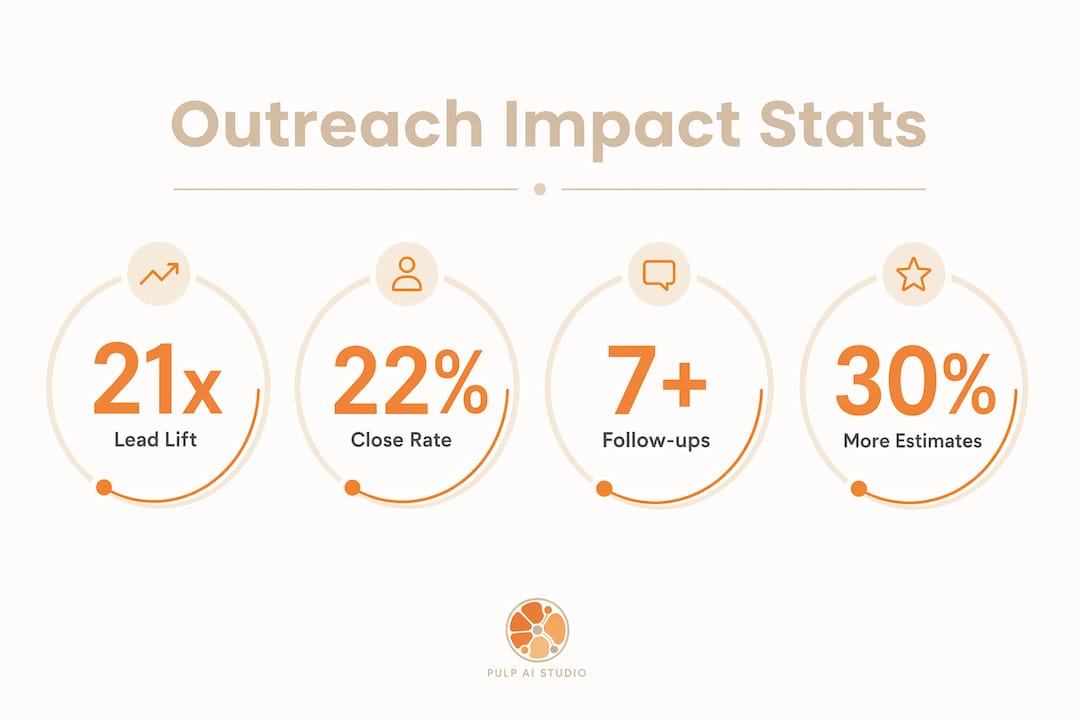
| Lead qualification lift | 21x more likely when responding within 5 minutes vs. 30 minutes |
| Sales requiring 5+ follow-ups | Most service sales close between the 5th and 12th contact |
| Salespeople who quit after one attempt | 44% stop after one try; 92% stop before the fourth |
| 7-touch follow-up advantage | Contractors using 7+ touch sequences close 25–30% more estimates than those using 1–2 touches |
| No-show reduction | Automated reminders cut no-shows by 30–50% in most service businesses |
| Customer retention cost | Retaining a customer costs 5 to 7 times less than acquiring a new one |
Service-tech leaders treat communication as infrastructure, not a soft skill. When outreach is weak, revenue and trust erode together. Prospect silence almost never means rejection. It usually means the lead is busy, comparing quotes, or waiting on a budget conversation. The contractor who shows up again on day 7 wins the job the others wrote off.
How small businesses can build a consistent outreach system
A reliable outreach system runs on triggers, not memory. The moment a lead submits a form, calls, or requests a quote, a defined sequence should fire automatically.
Best practices for consistent outreach:
- Set a four-touch cadence: day 1 confirmation, day 3 check-in, day 7 value-add message, day 14 final ask
- Alternate channels: text for speed and open rate, email for detail and documentation
- Keep every message under five sentences with a clear next step or question
- Vary message content at each touchpoint so follow-ups add new information rather than repeating the same ask
- Use a CRM task or automated sequence as the trigger, never a mental note
- Prioritize high-value estimates for longer persistence (10+ touches over 30 days)
- Track your estimate-to-close rate so you can measure whether the cadence is working
Pro Tip: Personalization does not require extra time. Merge the prospect’s first name, the specific service they requested, and a concrete availability window into your automated template. That combination reads human even when a system sends it.
Balancing automation with authenticity is the real skill. Generic “just checking in” messages get ignored. A text that says “Hi Marcus, following up on your HVAC quote from Tuesday. We have Thursday morning open if you want to lock it in” takes seconds to send and converts at a meaningfully higher rate.
How AI-powered automation keeps your outreach consistent
AI handles the parts of outreach that break down under volume: the 11 PM inquiry, the lead that came in during a job site visit, the follow-up that was supposed to go out on day 3 but got buried. Think of it as a front-desk employee who never sleeps and never forgets a callback.

Pulp AI Studio sets up and runs exactly this kind of system for small service businesses. When a call goes unanswered, the caller receives an SMS reply within 30 seconds. The AI qualifies the lead, handles the conversation, and sends the owner an instant alert. Leads that used to go to voicemail stay warm. The managed setup is live in about two weeks. Shops that want it on hardware they own can step up to a custom build, about 30 days, and own the rig outright.
What AI-powered outreach automation does for your business:
- Responds to every inquiry instantly, regardless of time of day
- Asks qualifying questions and captures job details before a human ever picks up the phone
- Fires follow-up sequences on schedule without manual input
- Flags hot leads for immediate human follow-up
- Reduces missed opportunities from after-hours calls that previously went to voicemail
The human element stays where it matters most: complex conversations, pricing negotiations, and closing. AI handles the volume and the timing. Together, they cover the full outreach cadence without burning out your team.
Pro Tip: Set your AI to send a personalized on-my-way notification 30–45 minutes before a technician arrives. That single message reduces no-shows and lifts customer satisfaction scores with no additional labor.
Real-world results from consistent outreach in service industries
The pattern holds across trades. A GTA roofing owner running roughly $1.8M in annual revenue had a close rate of 22% on estimates. After building a four-touch follow-up cadence over 14 days, his close rate climbed to 34% in 60 days with no new ad spend and no new hire. The only change was a system that kept showing up.
An HVAC contractor tracked his own follow-up data for six months. Leads contacted once converted at 12%. Leads contacted three times converted at 23%. Leads contacted seven or more times converted at 34%. Same pricing, same service quality.
What these deployments have in common:
- A defined cadence with specific timing, not improvised follow-up
- Text as the primary channel for speed and open rates
- Messages that add new information at each touchpoint
- A clear call to action in every message
- KPIs tracked weekly: estimate-to-close rate, response time, and follow-up completion rate
Measurement matters as much as execution. If you are not tracking your close rate by number of follow-up touches, you cannot see where the system is leaking. Most businesses discover the majority of their unbooked estimates simply went silent after one or two contacts. That is a process problem, and it is solvable.
Key Takeaways
Consistent outreach wins service jobs because speed and persistence together convert leads that silence would otherwise lose.
| Point | Details |
|---|---|
| Speed determines qualification | Responding within 5 minutes makes a business 21x more likely to qualify a lead than waiting 30 minutes. |
| Persistence closes deals | Most service sales close between the 5th and 12th contact; 44% of salespeople give up after only one attempt, and 92% stop before the fourth attempt. |
| Automation sustains cadence | A 7-touch follow-up sequence closes 25–30% more estimates than a 1–2 touch approach. |
| Retention beats acquisition | Keeping a customer costs 5 to 7 times less than acquiring a new one. |
| AI fills the response gap | Automated systems handle after-hours inquiries and follow-up sequences without manual input. |
A Plan Run for You, Not Another Tool to Run
Most owners did not lose the lead because a tool was missing. They lost it because nobody had time to run the tool. So we run it for you: a hosted CRM with the AI already wired in, set up and managed for your shop, live in about two weeks, and priced in the same range as the do-it-yourself AI receptionist plans, at one flat monthly price. The pieces most shops start with:
- Voice AI receptionist. Answers, qualifies, and books onto your calendar day or night, connected to the CRM or field software you already use, and hands the call to a person when it needs one. See the after-hours answering service.
- Speed to lead. A new form fill, ad lead, or missed call gets a text back right away, while the customer is still shopping. More on why the first few minutes decide the job.
- Database reactivation. The old leads and past customers already sitting in your system get a conversational text campaign that books the ones who are ready now. Related: why leads go quiet and how to restart them.
- AI social replies. Facebook and Instagram comments and DMs get answered and routed instead of sitting unread until Monday. The AI chatbot guide covers how those replies work.
Your contacts, your conversation history, and your phone number stay yours to export or port out if you leave. For shops that want the whole system on hardware they own, prompts, logs, and models included, we also do custom builds (about 30 days, since there is hardware to set up). Most shops start managed and grow into a rig, not the other way around.
FAQ
How quickly should a service business respond to a new lead?
Under 5 minutes. Businesses responding within 5 minutes are 21 times more likely to qualify the lead compared to those responding at 30 minutes.
How many follow-ups does it take to win a service job?
Most service sales close between the 5th and 12th contact. Contractors using 7+ touch sequences close 25–30% more estimates than those using 1–2 touches.
Does automation replace the human element in outreach?
No. AI handles volume, timing, and after-hours response; human follow-up handles complex conversations and closing. The two work best together, not as substitutes.
What KPIs should I track for outreach effectiveness?
Track your estimate-to-close rate, average response time, and follow-up completion rate by cadence step. These three numbers show exactly where leads are dropping out.
How does Pulp AI Studio help with consistent outreach?
Pulp AI Studio sets up and runs AI answering systems that reply to missed calls within 30 seconds, qualify leads automatically, and alert the owner instantly. The managed setup is live in about two weeks at one flat monthly price. Custom builds you own outright take about 30 days.