
 Adam Pichardo
TL;DR:
- Most buyer defections result from poor service, communication delays, and unmet expectations.
- Responding quickly and automating follow-ups help dealerships retain more customers and revenue.
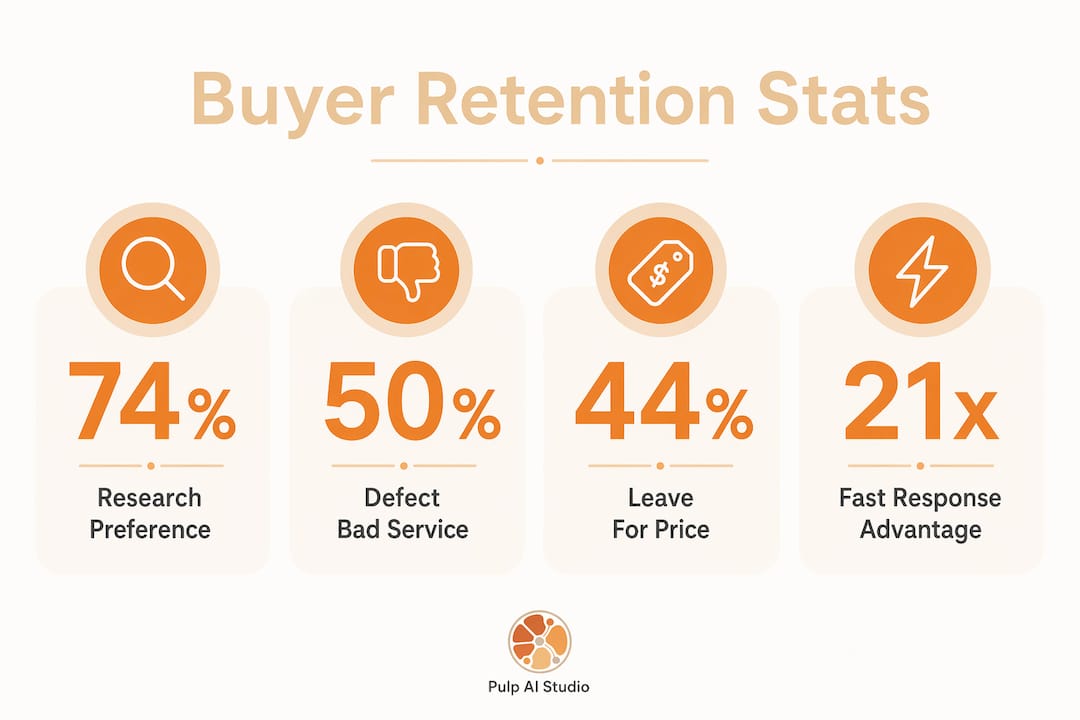
Buyer defection is defined as the moment a customer who visited your dealership chooses to purchase or service their vehicle somewhere else. 50% of customers leave due to a bad dealership experience, and 44% leave because of lower prices elsewhere. That split tells you something critical: price is not the primary problem. Service convenience and timely communication are. Dealers who stop losing buyers to competing dealers do so by fixing the experience, not by racing to the bottom on price. The strategies in this article address the real defection drivers, from slow lead response to untapped aftersales opportunities, with practical steps you can apply starting this week.
Why buyers choose competing dealerships
Buyer defection rarely comes down to one bad moment. It builds from a pattern of friction, slow responses, and unmet expectations across the entire purchase and ownership cycle.
Price sensitivity and cross-shopping behavior
74% of buyers prefer to complete their research and purchase with a single dealership. That preference is real, but it is fragile. The same study shows 31% of buyers rank price above loyalty when making a final decision. That means nearly one in three buyers will walk if they find a better-listed price online before you have had a chance to build a relationship with them. Transparent, real-time pricing on your website is not optional anymore. It is the entry fee to being considered.
Communication delays and appointment friction
Buyers today expect the same speed from a dealership that they get from an e-commerce checkout. When a customer submits an inquiry at 8:00 PM and hears nothing until the next morning, they have already visited two other dealer websites. Service appointment scheduling is an equally common pain point. Customers who cannot book online or who wait on hold abandon the process entirely. These are not edge cases. They are the daily reality for dealerships that have not updated their communication workflows.
The rise of neutral buyer sentiment
Neutral satisfaction is nearly as damaging as outright dissatisfaction. Net Promoter Scores show a score of -22 for neutral customers versus -19 for dissatisfied ones. That gap is almost nothing. A buyer who leaves your dealership feeling “fine” is statistically just as likely to defect as one who left frustrated. Most dealers celebrate the absence of complaints. The data says that is a mistake.
The key defection drivers, ranked by frequency, are:
- Service experience failures: Long wait times, poor communication, and unresolved issues
- Price transparency gaps: Buyers who find inconsistent or hidden pricing online before visiting
- Appointment inconvenience: No online booking, limited hours, or slow confirmation
- Missed follow-up: Inquiries that go unanswered or receive a generic response hours later
- Lack of aftersales engagement: No proactive outreach after a purchase or service visit
How can dealers improve convenience and service experience to retain buyers?
Convenience is now the primary retention lever. Dealers who build their service model around the customer’s schedule, not the dealership’s, retain more customers at lower cost than those who compete on price alone.
Build a mobile and flexible service model
Mobile service models and integrated aftersales engagement are proven profit drivers. Retained customers cost considerably less to serve than newly acquired ones. Mobile oil changes, pickup and delivery for service appointments, and loaner vehicles for longer jobs remove the biggest friction point in the service relationship: the customer’s time. Dealers who offer these options report measurably higher return rates for subsequent service visits.
Make inventory and pricing visible in real time
Buyers scan multiple websites before contacting a single dealer. If your inventory page shows outdated stock or withholds pricing, buyers move on. Real-time inventory feeds connected directly to your DMS, with accurate pricing and available trim levels displayed publicly, reduce the number of shoppers who leave to “check one more place.” That one extra check is often where you lose them.
Capture tire sales and instant trade appraisals
Two-thirds of dealership service customers buy tires elsewhere, and nearly 30% do not know their dealership sells tires at all. That is a direct revenue and loyalty loss hiding in plain sight. Promoting tire sales at every service touchpoint, from the appointment confirmation text to the service advisor conversation, recaptures that spend. Instant trade-in appraisals offered during service visits convert service loyalty into vehicle sales. A customer who came in for an oil change and leaves with a trade-in offer in hand is far more likely to buy their next vehicle from you.
- Promote tire availability at every service touchpoint, including digital confirmations and waiting room signage
- Offer instant trade appraisals during service check-in using a tablet-based tool your advisor can run in under two minutes
- Enable online service booking with real-time slot availability, not a “request a callback” form
- Send appointment reminders via SMS 24 hours and 2 hours before the scheduled time
- Follow up after every service visit with a satisfaction check and a next-service reminder
Pro Tip: Dealers who integrate tire sales into their service advisor’s standard check-in script recover a significant share of the tire revenue that currently walks out the door to quick-lube chains and big-box retailers.
What role does speed and quality of lead response play in preventing buyer loss?
Speed of response is the single most controllable variable in lead conversion. The data on this is unambiguous.
Responding within 5 minutes is 21 times more effective than waiting 30 minutes. Yet 41.2% of automotive leads are mishandled or inadequately followed up. That means four out of every ten leads your dealership generates are effectively handed to a competitor. The mishandling comes from missed calls, delayed contact, and incomplete lead logging in the CRM.
Why a single follow-up call is not enough
Most dealerships rely on a salesperson to call a new lead once or twice and then move on. That approach fails for two reasons. First, buyers are often unavailable when that first call comes in. Second, a buyer who does not answer is not necessarily uninterested. They may be at work, driving, or simply not ready to talk. A multi-step follow-up sequence that includes an immediate SMS, a follow-up call within the hour, and a personalized email the next morning recovers a large share of leads that a single call misses.
| Follow-up method | Typical response rate | Best use case |
|---|---|---|
| Single phone call | Low | Warm, same-day inquiries |
| SMS within 5 minutes | High | All inbound leads, after-hours contacts |
| Multi-step sequence (SMS + call + email) | Highest | Cold leads, missed calls, weekend inquiries |
| Voicemail only | Very low | Not recommended as primary contact method |
Pro Tip: Automated text follow-up sent within 30 seconds of a missed call keeps the lead warm until a salesperson is available. That 30-second window is where most dealerships lose the buyer to whoever responds first.
Implementing digital lead management platforms that integrate with your CRM and DMS enables personalized, automated responses across multiple channels. The goal is not to replace your sales team. It is to make sure no lead goes cold while your team is busy with another customer.
How can digital tools and AI technology help retain more customers?
Digital adoption directly correlates with buyer satisfaction. Buyers who complete over 50% of their vehicle purchase process online report the highest satisfaction levels of any buyer segment. High satisfaction is the strongest predictor of repeat purchase and referral behavior. Dealers who build digital workflows into their sales and service processes are not just keeping up. They are building a structural advantage over dealers who still rely on phone-only communication and paper-based service check-ins.
AI-powered engagement and communication
AI-powered dealer engagement tools handle the communication tasks that fall through the cracks in a busy dealership. After-hours inquiries, missed calls, and weekend leads are the highest-risk moments for buyer defection. An AI system that replies to a missed call with a personalized SMS within 30 seconds, handles the initial conversation, and alerts the sales manager functions like a front-desk employee who never sleeps. The buyer stays engaged. The lead stays warm.
The practical benefits of AI-driven communication for dealerships include:
- Instant response to every inbound contact, regardless of time of day or staffing levels
- Consistent follow-up sequences that do not depend on individual salesperson discipline
- Automatic lead logging into the CRM so nothing is lost between shifts
- Omnichannel coverage across SMS, email, and web chat from a single system
- Dealer-owned data that stays in your system, not locked inside a third-party platform
Dealers who integrate AI into dealership communication workflows report faster lead response times and fewer leads lost to competitors who simply answered first. The technology is not complex to deploy. The barrier is usually the decision to act, not the implementation itself.
Protecting your customer data and relationships
Data ownership is a retention issue that most dealers overlook. When your customer data lives inside a third-party platform you do not control, that platform can change its terms, raise its fees, or limit your access. Dealers who own their customer data outright can build personalized outreach campaigns, track service history, and identify at-risk customers before they defect. Whatever AI tool you pick, confirm you can export your contacts, conversation history, and phone number if you ever leave, or run it on infrastructure you own outright. California Telecom’s AI Executive Agent is one example of how AI communication tools can be deployed to support dealership engagement without surrendering data control to a third party.
What mistakes do dealers make when trying to prevent buyer loss?
The most common mistakes are not dramatic failures. They are quiet habits that erode retention over months and years.
Treating neutral as acceptable
The neutrality trap is the most dangerous mistake in dealership retention. A customer who rates their experience a 7 out of 10 is not a satisfied customer. They are a customer in transition. Neutral sentiment carries a Net Promoter Score nearly as negative as outright dissatisfaction. Dealers who celebrate “no complaints” are measuring the wrong thing. The goal is to create experiences that generate active promoters, not passive acceptors.
Ignoring the service-to-sales gap
Service customers are 2.5 times more likely to buy their next vehicle at the same dealership. Most dealerships fail to convert that advantage because the service and sales departments operate as separate silos. A customer who has serviced their vehicle with you for three years and is approaching the end of their loan term is a high-probability buyer. Without a system that flags that customer and triggers a proactive outreach from the sales team, that opportunity disappears.
The most common avoidable mistakes in dealer retention:
- Accepting satisfaction scores in the 6–8 range as success without investigating the root cause
- Failing to train service advisors to introduce the sales team during service visits
- Relying on salespeople alone to manage lead follow-up without automated backup
- Not promoting aftersales services like tires, accessories, and protection packages at point of sale
- Losing warranty-expiry customers to independent shops without offering a competitive alternative
Key takeaways
Dealers who retain more customers do so by fixing the experience and response speed, not by cutting prices.
| Point | Details |
|---|---|
| Experience beats price | 50% of defections stem from bad service experience, making convenience the top retention lever. |
| Respond within 5 minutes | Responding in under 5 minutes is 21 times more effective than waiting 30 minutes. |
| Neutral is not good enough | Net Promoter Scores show neutral customers defect at nearly the same rate as dissatisfied ones. |
| Service customers are buyers | Service customers are 2.5 times more likely to repurchase, but only if you bridge service to sales. |
| Automate the gaps | 41.2% of leads are mishandled. Automated SMS and AI follow-up recover leads that salespeople miss. |
What I’ve learned about retention that most dealers won’t admit
The uncomfortable truth about buyer defection is that most of it is preventable, and most dealers know it. The problem is not a lack of information. It is a lack of urgency. Dealers spend enormous energy on conquest marketing, chasing new buyers with advertising spend, while the customers they already have quietly drift to a competitor down the road.
I have seen dealerships transform their retention numbers not by overhauling their entire operation, but by fixing two things: response speed and the service-to-sales handoff. When a missed call gets a text reply within 30 seconds and a service customer approaching lease-end gets a proactive call from the sales team, the math changes fast. Those are not expensive fixes. They are process fixes.
The dealers who will win in 2026 are not the ones with the biggest advertising budgets. They are the ones who treat every existing customer as their most valuable asset and build systems, not just intentions, around keeping them. Mobile servicing, AI-powered communication, and real-time inventory transparency are not future investments. They are current requirements. Dealers who wait for those tools to become industry standard will find that the dealers who adopted them early have already locked up the loyalty of the customers they were hoping to win back.
Retention is not a department. It is a culture. And culture starts with the decision to measure the right things, respond faster than anyone else, and never let a neutral experience slide by without asking why.
— Adam
A Plan Run for You, Not Another Tool to Run
Most owners did not lose the lead because a tool was missing. They lost it because nobody had time to run the tool. So we run it for you: a hosted CRM with the AI already wired in, set up and managed for your shop, live in about two weeks, and priced in the same range as the do-it-yourself AI receptionist plans, at one flat monthly price. The pieces most shops start with:
- Voice AI receptionist. Answers, qualifies, and books onto your calendar day or night, connected to the CRM or field software you already use, and hands the call to a person when it needs one. See the after-hours answering service.
- Speed to lead. A new form fill, ad lead, or missed call gets a text back right away, while the customer is still shopping. More on why the first few minutes decide the job.
- Database reactivation. The old leads and past customers already sitting in your system get a conversational text campaign that books the ones who are ready now. Related: why leads go quiet and how to restart them.
- AI social replies. Facebook and Instagram comments and DMs get answered and routed instead of sitting unread until Monday. The AI chatbot guide covers how those replies work.
Your contacts, your conversation history, and your phone number stay yours to export or port out if you leave. For shops that want the whole system on hardware they own, prompts, logs, and models included, the custom build below is the step up (about 30 days, since there is hardware to set up). Most shops start managed and grow into a rig, not the other way around.
How Pulp AI Studio helps dealerships keep more buyers
For dealerships that want the whole system on hardware they own, we also do custom builds, the step up from the managed setup above. The flagship is a missed call text-back system that sends an SMS reply within 30 seconds of any unanswered call, handles the initial conversation with the buyer, and alerts your team instantly, connected to the DMS or CRM you already use. A custom build is live in about 30 days, and you own the rig outright: prompts, logs, and models included. For dealerships that need coverage beyond business hours, the after-hours AI answering service keeps leads warm around the clock. The person you speak with on day one is the same person building your system.
FAQ
Why do buyers choose competing dealerships over mine?
50% of buyers defect due to a bad service experience, and 44% leave for lower prices elsewhere. Service convenience and communication speed are the primary defection drivers, not price alone.
How fast should a dealership respond to a new lead?
Responding within 5 minutes is 21 times more effective than waiting 30 minutes. Automated SMS follow-up sent within 30 seconds of a missed call is the most reliable way to hit that window consistently.
What is the neutrality trap in dealer satisfaction scores?
The neutrality trap is the false belief that a neutral customer experience is acceptable. CDK Global research shows neutral customers carry a Net Promoter Score of -22, nearly identical to dissatisfied customers at -19.
How can service visits convert into vehicle sales?
Service customers are 2.5 times more likely to buy their next vehicle from the same dealership. Proactive trade-in appraisals during service check-in and coordinated handoffs from service advisors to the sales team are the most direct conversion methods.
What does AI-powered follow-up actually do for a dealership?
An AI follow-up system sends an immediate SMS when a call is missed, handles the buyer’s initial questions, logs the contact in the CRM, and alerts the sales team. That process recovers leads that would otherwise go cold before a salesperson is available to call back.