
 Adam Pichardo
TL;DR:
- Automating dealership inquiries using AI, CRM integrations, and multi-channel workflows increases response speed and customer engagement. This approach improves lead-to-appointment conversions by up to four times while saving significant staff hours weekly. Proper setup, transparency, and continuous optimization are essential for maximizing automation benefits.
To automate dealership inquiry responses means deploying AI-powered conversational agents, SMS gateways, and CRM-connected workflows that reply to every inbound lead within minutes, across every channel, without a human lifting a finger. The payoff is concrete: sub-5-minute lead response lifts lead-to-appointment conversion to 28–32%, a 4x improvement over dealerships that respond hours later. Tools like AutoRaptor AI Voice Agent and Lokam AI BDC have made this level of speed achievable for any store, not just the high-volume groups. When you combine those tools with proper CRM integration and multi-channel follow-up, the result is a system that works at 2 a.m. just as well as it does at noon. Cloud-based automation saves staff roughly 15 hours weekly, time your team can redirect toward closing deals rather than chasing cold leads. If you'd rather have that stack set up and run for you, our automotive answering service gets it live in about two weeks, connected to the dealer CRM you already use.
What tools do you need to automate dealership inquiry responses?
The foundation of any automated inquiry management system is a clean connection between your lead sources, your CRM, and your communication channels. Without that connection, automation fires messages into a void with no context and no follow-up logic.

Core software stack
The platforms most commonly integrated for car dealership automation include:
- CRM and DMS platforms: CDK Global, DealerSocket, VinSolutions, and Elead are the four most widely deployed systems. Your automation layer must write lead records back to whichever platform your store runs, or you will create two parallel databases that drift apart within weeks.
- AI conversational agents: Tools like Lokam AI BDC and AutoRaptor AI Voice Agent handle qualification, FAQ responses, and appointment booking. AutoRaptor captures every inbound call 24/7, logs the lead, and schedules the test drive without human intervention. That means zero revenue leakage from missed calls after hours.
- Communication gateways: You need an SMS gateway (Twilio and Bandwidth are the two most common), a WhatsApp Business API connection for customers who prefer messaging apps, and a cloud telephony provider for voice. WhatsApp appointment scheduling has become a practical option for dealerships serving markets where WhatsApp is the dominant messaging channel.
- Inventory database connector: Real-time vehicle availability data must feed directly into your AI agent. Without it, the system quotes a vehicle that sold yesterday, which destroys trust immediately.
- Calendar integration: AI checks rep availability in real time using calendar free/busy data and inventory filters, so it only offers appointment slots that actually exist.
Compliance and branding requirements
Dedicated dealership phone numbers are non-negotiable. Using personal cell numbers for automated SMS reduces professionalism and creates compliance exposure under TCPA regulations. Every outbound automated message should originate from a branded number registered to the dealership, with opt-out language included per carrier requirements.
| Integration Layer | Purpose | Example Tools |
|---|---|---|
| CRM / DMS | Lead record creation and routing | CDK, VinSolutions, DealerSocket, Elead |
| AI Conversational Agent | Qualification, FAQ, appointment booking | Lokam AI BDC, AutoRaptor AI Voice Agent |
| Communication Gateway | SMS, voice, WhatsApp delivery | Twilio, Bandwidth, WhatsApp Business API |
| Inventory Connector | Real-time vehicle availability | OEM feeds, DMS inventory API |
| Calendar System | Rep availability and scheduling | Google Calendar, Outlook, DMS scheduler |
How to set up automated inquiry workflows step by step
Configuration is where most dealerships stall. They buy the software, connect the CRM, and then publish a single generic auto-reply that says “Thanks for your inquiry, someone will be in touch.” That is not automation. That is a digital voicemail.
Here is how to build a system that actually qualifies and converts.
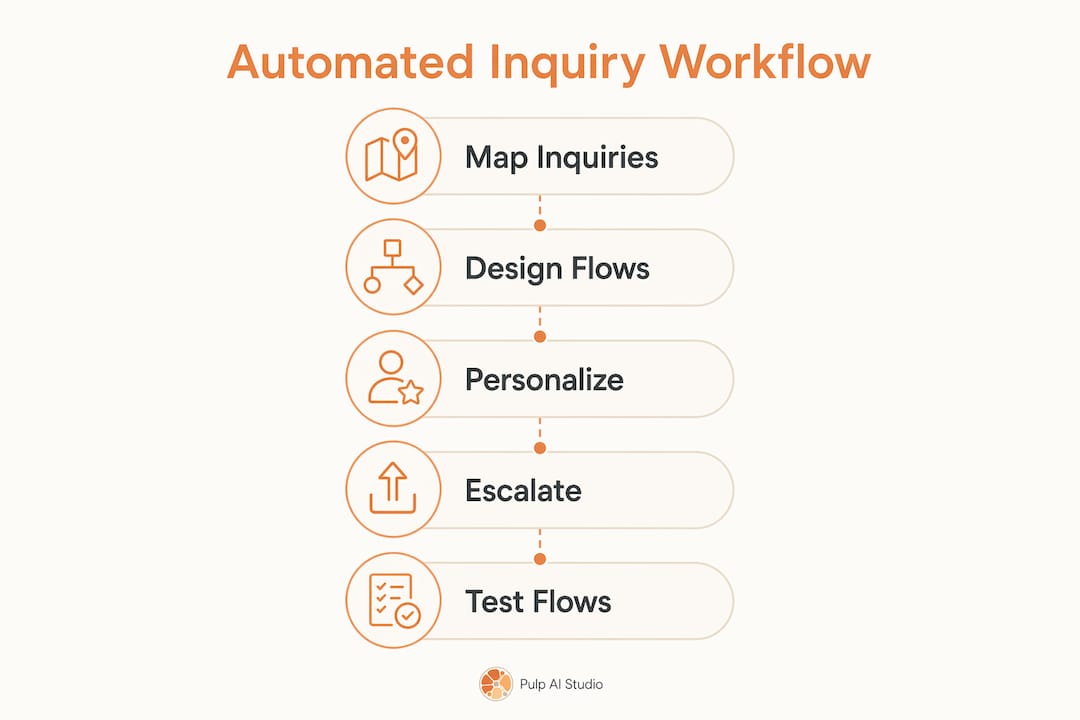
§ 01 — Map your inquiry types before writing a single message.
Separate your inbound leads into four buckets: sales inquiries, financing questions, service requests, and general questions. Each bucket needs its own qualification flow because the data you need from a financing prospect (credit range, down payment, trade-in value) is completely different from what you need from a service customer (vehicle year, mileage, symptom description). Mixing these flows produces irrelevant questions that frustrate customers.
§ 02 — Design qualification flows that gather decision-relevant data.
A sales qualification flow should collect vehicle preference, budget range, trade-in status, and purchase timeline within the first two messages. Keep questions conversational, not form-like. “Are you looking to trade anything in, or is this a straight purchase?” outperforms “Do you have a trade-in vehicle? Yes/No.” The former sounds like a person. The latter sounds like a survey.
§ 03 — Build multi-channel response cadences with timing rules.
Multi-channel follow-up across SMS, email, and voice significantly increases response and appointment rates compared to single-channel outreach. A practical cadence looks like this:
- SMS reply within 30 seconds of lead submission, referencing the specific vehicle inquired about.
- Email follow-up at 5 minutes with a personalized summary and inventory link.
- AI voice call at 15 minutes if no SMS response received.
- Second SMS at 2 hours if still no engagement.
- Human BDC rep review and outreach at 4 hours for unresponsive leads.
§ 04 — Personalize every message with live data.
Contextual messaging that references VINs, trims, and BDC team names converts significantly better than generic canned replies. Your AI should pull the exact vehicle the customer clicked on, the current price, and the name of the BDC manager assigned to that lead. “Hi Sarah, I’m Alex from Riverside Ford’s BDC team. I see you were looking at the 2024 F-150 XLT in Carbonized Gray. It’s still available. Want to schedule a quick look?” That message closes. “Thanks for your interest in our inventory” does not.
§ 05 — Configure escalation triggers.
AI handles appointment setting and availability checks well, but it should escalate to a human rep the moment a customer mentions a specific objection, asks about a price match, or requests to speak with someone. Set keyword triggers for phrases like “best price,” “competitor,” “talk to a person,” and “not interested.” When those phrases appear, the AI acknowledges the request, logs the flag, and routes the conversation to the next available rep within two minutes.
§ 06 — Test every workflow before going live.
Run every inquiry type through the full flow using test leads. Verify that the CRM record is created correctly, the right rep is assigned, the messages contain accurate inventory data, and the escalation triggers fire on cue. A broken flow that sends a customer the wrong vehicle or the wrong price does more damage than no automation at all.
Pro Tip: Set your AI conversational model to a temperature of approximately 0.4. This setting, recommended for dealership AI agents, balances natural-sounding personality with a controlled qualification flow. Too high and the AI goes off-script. Too low and it sounds like a robot reading a script.
What are best practices for keeping a human touch while automating?
Automation without personality is just spam at scale. The dealerships that convert best treat their AI as a first-contact specialist, not a replacement for their sales team. For where that first-contact role ends and the BDC takes over, see what conversational AI handles at a dealership.
Here is what that looks like in practice:
- Reference the specific vehicle, not the category. “The Camry XSE you looked at” beats “one of our Toyota sedans” every time. Live inventory data makes this possible without any manual effort.
- Identify AI communication clearly. Customers who discover mid-conversation that they were talking to a bot without knowing it feel deceived. A simple “I’m an AI assistant for [Dealership Name]” at the start of the conversation builds trust rather than eroding it.
- Use automation for volume, humans for heat. Automation augments your team rather than replacing it, freeing reps to focus on high-intent buyers who are ready to negotiate. Your AI handles the 80% of inquiries that need information. Your people handle the 20% that need persuasion.
- Send post-test-drive follow-ups within two hours. Timely follow-up within 2 hours after a test drive is critical to capturing buyer enthusiasm before it cools. Automate this reminder so it fires without relying on a rep to remember.
- Balance rep workload through smart routing. Lead routing based on brand specialization and calendar availability prevents one rep from drowning in leads while another sits idle. Burned-out reps miss follow-ups. Balanced reps close deals.
“The AI employee doesn’t replace your best closer. It makes sure your best closer only talks to people who are actually ready to buy.”
This is the mental model that separates dealerships using automation well from those using it poorly. The goal is not to remove humans from the process. The goal is to make sure humans only enter the process at the moment their skills are actually needed.
How to troubleshoot common pitfalls in dealership response automation
Most automation failures trace back to three root causes: incomplete coverage, stale data, and ignored metrics. Each one is fixable.
Pro Tip: Audit your lead sources quarterly. New OEM portals, third-party listing sites, and social channels appear constantly. If your automation pipeline does not ingest a lead source, every inquiry from that channel goes unanswered.
The most common problems and their fixes:
- Uneven lead distribution. When your routing logic sends all high-value leads to the same two reps, those reps burn out and response quality drops. Configure load balancing rules that cap each rep’s active lead count and redirect overflow to the next available team member.
- Stale inventory data. If your inventory connector syncs once a day, your AI will quote vehicles that sold hours ago. Push for real-time or near-real-time sync, ideally every 15 to 30 minutes. Customers who receive accurate availability information are far more likely to book an appointment.
- Robotic message tone. Generic phrasing like “Your inquiry has been received and will be processed” signals automation immediately and reduces engagement. Review your message scripts monthly. Read them out loud. If you would not say it to a customer in person, rewrite it.
- Opt-out mishandling. Every automated SMS program must honor opt-out requests immediately and permanently. Failing to do so violates TCPA regulations and exposes the dealership to significant legal risk. Your platform should handle this automatically, but verify it during your initial testing phase.
- No performance review cadence. Automation is not a set-and-forget system. Review AI response rates, escalation rates, appointment booking rates, and message open rates at least monthly. Scripts that worked in January may underperform in July when inventory mix and customer priorities shift.
The lead ingestion pipeline that normalizes data from OEM sources, third-party portals, website forms, inbound calls, and social channels into unified CRM records is the single most important infrastructure piece to get right. When that pipeline is clean, every downstream automation step works. When it is broken, nothing works correctly regardless of how good your AI is.
What ROI can dealerships realistically expect from response automation?
The numbers are specific enough to build a business case around.
AI-powered BDC software achieves a 70% contact rate compared to the manual industry average of 15%. That is not a marginal improvement. It means your team is reaching nearly five times as many prospects with the same or fewer staff hours. For a store receiving 200 leads per month, that difference translates to 110 additional conversations that would otherwise never happen.
| Metric | Manual Process | With Automation | Improvement |
|---|---|---|---|
| Contact rate | 15% | 70%+ | ~4.7x |
| Lead-to-appointment conversion | 7-8% | 28-32% | ~4x |
| Average response time | 6+ hours | Under 2 minutes | 180x faster |
| Staff time on manual tasks | Baseline | 15 hours saved weekly | Significant |
The conversion lift is the most compelling number. Responding within minutes versus hours produces a 4x lift in lead-to-appointment rates. For a dealership closing 20% of appointments, moving from 8% to 30% conversion on 200 monthly leads means 44 additional appointments per month. At an average gross profit per vehicle, the math becomes very persuasive very quickly.
Automated appointment reminders reduce no-shows as well. When a customer receives a confirmation SMS immediately after booking and a reminder 24 hours before the appointment, show rates climb. Fewer no-shows mean more productive days for your sales team and better utilization of your lot.
The AI Voice Agent model specifically addresses after-hours revenue leakage. Every call that rings unanswered at 9 p.m. is a prospect who will call a competitor at 9:01 p.m. A 24/7 AI voice agent captures that lead, qualifies it, and has it waiting in the CRM queue when your team arrives in the morning.
Key takeaways
Dealerships that automate inquiry responses with AI-connected, multi-channel workflows achieve contact rates above 70%, appointment conversion rates near 30%, and recover 15 or more staff hours per week.
| Point | Details |
|---|---|
| Speed drives conversion | Responding within 5 minutes produces a 4x lift in lead-to-appointment rates versus 6-hour response times. |
| Multi-channel cadences outperform single-channel | Combining SMS, email, and voice follow-up significantly increases response and appointment rates. |
| Live data personalizes at scale | Referencing specific VINs, trims, and rep names transforms auto-replies into high-converting conversations. |
| Automation augments, not replaces | AI handles volume and qualification; human reps focus on negotiation and high-intent buyers. |
| Metrics require monthly review | Response rates, escalation triggers, and message scripts must be reviewed regularly as inventory and customer behavior shift. |
Why I think most dealerships are still leaving money on the table
I have seen a lot of dealerships add automation software and then wonder why nothing changed. The honest answer is almost always the same: they automated the easy part and ignored the hard part.
The easy part is the first reply. Set up a tool, connect your CRM, and you can send an SMS within 30 seconds of a form submission. That part is genuinely not difficult anymore. Tools like Lokam and AutoRaptor have made it plug-and-play for most major DMS platforms.
The hard part is everything that happens after that first message. The qualification flow. The escalation logic. The post-test-drive follow-up. The monthly script review. Most dealerships set up the first reply and call it done. Then they wonder why their contact rate is still 20% instead of 70%.
The other thing I keep seeing is a fear of identifying the AI as AI. Managers worry that customers will disengage if they know they are talking to a bot. The data does not support that fear. Customers disengage when they feel deceived. A transparent AI that answers accurately and quickly builds more trust than a human who takes six hours to respond. Transparency is a feature, not a liability.
My practical recommendation: start with one inquiry type, build it correctly, test it thoroughly, and measure it for 30 days before expanding. The role of AI in dealership communication is not to replace your team. It is to make sure your team never has to compete with a competitor’s AI that is faster, always available, and never forgets to follow up.
— Adam
A Plan Run for You, Not Another Tool to Run
Most owners did not lose the lead because a tool was missing. They lost it because nobody had time to run the tool. So we run it for you: a hosted CRM with the AI already wired in, set up and managed for your shop, live in about two weeks, and priced in the same range as the do-it-yourself AI receptionist plans, at one flat monthly price. The pieces most shops start with:
- Voice AI receptionist. Answers, qualifies, and books onto your calendar day or night, connected to the CRM or field software you already use, and hands the call to a person when it needs one. See the after-hours answering service.
- Speed to lead. A new form fill, ad lead, or missed call gets a text back right away, while the customer is still shopping. More on why the first few minutes decide the job.
- Database reactivation. The old leads and past customers already sitting in your system get a conversational text campaign that books the ones who are ready now. Related: why leads go quiet and how to restart them.
- AI social replies. Facebook and Instagram comments and DMs get answered and routed instead of sitting unread until Monday. The AI chatbot guide covers how those replies work.
Your contacts, your conversation history, and your phone number stay yours to export or port out if you leave. For shops that want the whole system on hardware they own, prompts, logs, and models included, the custom build below is the step up (about 30 days, since there is hardware to set up). Most shops start managed and grow into a rig, not the other way around.
How Pulp AI Studio helps dealerships capture every lead
We set up exactly the kind of system described in this article, live in about two weeks on the managed setup above. The missed call text-back and 30-second AI auto-reply system fires the moment a customer calls or submits an inquiry, even at midnight on a Sunday. Customized conversational flows pull your inventory data and rep names so every reply feels personal, not automated. The goal is fewer ghosted leads and more appointments, because prospects receive a real response before they have time to contact a competitor. If you want to see how automated vehicle interest follow-ups work in practice, the Pulp AI Studio blog walks through real workflow examples. Book a consultation to get your system live in about two weeks. Stores that want the whole system on hardware they own can step up to a custom build, live in about 30 days. Most shops start managed and grow into a rig.
FAQ
What does it mean to automate dealership inquiry responses?
Automated dealership inquiry responses use AI agents, SMS gateways, and CRM-connected workflows to reply to every inbound lead within minutes across phone, SMS, email, and WhatsApp, without requiring a human to initiate each reply.
How fast should an automated response reach a customer?
Sub-5-minute response is the target. Research shows that responding within minutes produces a 4x lift in lead-to-appointment conversion compared to responses that arrive hours later.
Can automation handle financing inquiry responses for dealers?
Yes. Financing inquiry flows are configured to collect credit range, down payment, and trade-in information through a conversational SMS or chat sequence, then route the qualified lead to your finance manager with that data already captured.
Will customers know they are talking to an AI?
Best practice is to identify AI communication clearly at the start of the conversation. Transparency builds trust, and customers who know they are interacting with an AI assistant respond positively when the AI is fast, accurate, and helpful.
How many staff hours does dealership automation typically save?
Cloud-based automation saves approximately 15 hours weekly by consolidating lead management, follow-up scheduling, and appointment booking tasks that previously required manual effort from BDC staff.