
 Adam Pichardo
TL;DR:
- Automated missed call recovery converts unanswered weekend calls into booked jobs using quick, personalized responses.
- Small businesses can recover up to 34% of missed calls, boosting bookings through cost-effective automation tools.
Missed call recovery is the practice of converting unanswered phone calls into booked jobs through automated, time-sensitive follow-up systems. Small businesses lose revenue every weekend not because they lack customers, but because those customers call once and move on. 62% of callers who don’t reach a live person contact a competitor, and 85% never call back. That statistic means every unanswered Saturday call is a job that likely went to someone else. The good news is that automated text-back systems can recover a significant share of those calls. Businesses that implement these systems report 18%–34% of missed calls converting into conversations, with 30%–60% of those conversations becoming booked appointments. The window to turn weekend missed calls into jobs is real, and the technology to do it is affordable.
What tools do small businesses need to turn weekend missed calls into jobs?
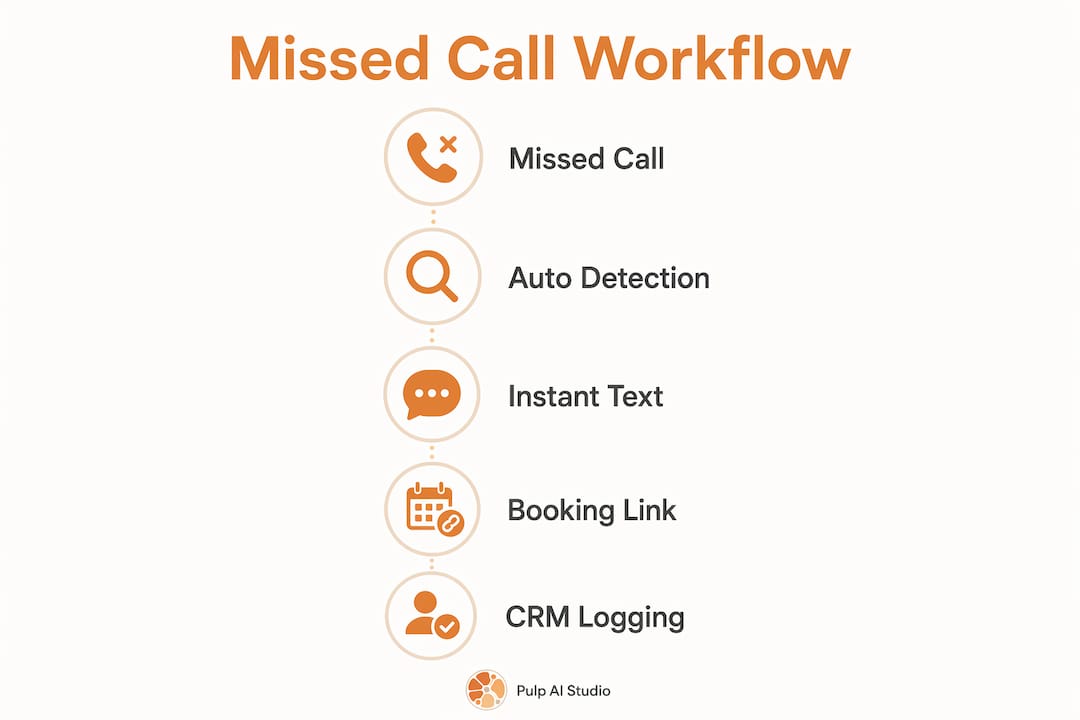
The core technology stack for missed call recovery has four layers: call detection, instant messaging, scheduling, and task tracking. Each layer handles a specific failure point in the traditional “we’ll call you back” approach.

VoIP phone systems with webhook triggers are the foundation. Modern VoIP platforms detect a missed call and fire an automated signal to your messaging system within seconds. Without this trigger, the entire recovery chain breaks down before it starts. Most small business VoIP plans that include webhook support run between $19 and $99 per month, which covers the full automation stack in many cases.
Instant SMS text-back automation is the most critical single tool. The system sends a personalized text message to the caller within 60 seconds of the missed call. That speed matters because responding within one minute can boost conversions by up to 391% compared to delayed responses. A text sent five minutes later performs dramatically worse.
Booking links embedded in the initial text remove friction from the scheduling process. Instead of asking the caller to wait for a callback, you give them a direct link to pick a time slot. This approach works especially well on weekends, when callers are often browsing from their phones and prefer self-service options.
CRM and task management integration closes the loop. Every missed call and every text reply gets logged automatically. If the caller doesn’t respond to the initial text, the system creates a follow-up task assigned to a specific team member with a due time.
| Feature category | What it does | Why it matters |
|---|---|---|
| VoIP with webhooks | Detects missed calls and triggers automation | Starts the recovery chain instantly |
| SMS text-back | Sends personalized message within 60 seconds | Keeps the lead engaged before they call a competitor |
| Booking link delivery | Lets callers self-schedule without waiting | Reduces friction and speeds up job booking |
| CRM task creation | Logs calls and assigns follow-up ownership | Prevents leads from falling through the cracks |
| Voicemail-to-task | Converts voicemail content into assigned tasks | Adds accountability for every inbound lead |
The choice between full automation and a live answering service comes down to volume and budget. Live answering services provide a human voice but cost significantly more and still fail outside their own staffed hours. Automated systems run 24 hours a day, 7 days a week, at a fraction of the cost. For most small service businesses, automation handles the volume efficiently and post-sale workflow automation tools can extend that coverage into follow-up sequences after the job is booked.
Pro Tip: Set your SMS text-back to fire within 30 seconds of the missed call, not 60. The faster the message arrives, the more likely the caller is still holding their phone.
How does the step-by-step workflow convert a missed call into a booked job?
A fast recovery script with defined callback workflows and clear accountability transforms missed calls into booked jobs efficiently. The process below reflects best practices for small service businesses, including contractors, clinics, and retailers.
-
Missed call detected. Your VoIP system registers the unanswered call and sends a webhook signal to your automation platform. This happens in real time, not on a delay.
-
Instant SMS fires within 60 seconds. The caller receives a personalized text. A strong opening message names your business, acknowledges the missed call, and offers two clear options: book a time online or reply to the text to start a conversation. Generic messages like “we will call you back” lose leads to competitors because they offer no next step.
-
Caller replies or clicks the booking link. If the caller replies, the conversation moves into a text thread. Your team or an AI assistant handles the exchange. If the caller clicks the booking link, they land on a scheduling page and pick a time without any further friction.
-
Voicemail-to-task creation runs in parallel. If the caller left a voicemail, the system transcribes it and creates a task in your CRM. Voicemail-to-task systems assign follow-up ownership with due times, which eliminates the “I thought you were calling them back” problem that kills leads internally.
-
Auto-callback attempts run at polite intervals. If the caller neither replies nor books, the system schedules a callback attempt. The first attempt happens within two hours. A second attempt, if needed, runs the following morning. Each attempt is logged.
-
All interactions are recorded and tracked. Every text, call attempt, and booking outcome gets stored in your CRM. This data shows you which days and times generate the most missed calls, which messages convert best, and which team members close the most callbacks.
| Stage | Action | Time target |
|---|---|---|
| Missed call detected | Webhook fires to automation platform | 0–5 seconds |
| Initial SMS sent | Personalized text with booking link | Under 60 seconds |
| Caller response | Text reply or booking link click | Caller-driven |
| Voicemail task created | Transcribed and assigned in CRM | Under 2 minutes |
| First callback attempt | Outbound call if no response | Within 2 hours |
| Second callback attempt | Follow-up if first attempt fails | Next morning |
The message wording in step two carries more weight than most business owners realize. Callers respond better to messages that feel personal and specific rather than automated and generic. Using the caller’s name when available, referencing the time of the call, and naming your business all increase reply rates.
Pro Tip: Test two versions of your initial SMS text: one that leads with the booking link and one that leads with a question like “Hi, this is [Business Name]. Did you need help with [service]?” Question-led messages often generate higher reply rates because they invite a response rather than directing to a link.
How do you tailor your system specifically for weekend and after-hours calls?
Weekend calls carry a different context than weekday calls. The caller knows it’s Saturday. They expect you might be closed. After-hours and weekend calls require clear messaging about your hours, next-business-day callback options, and emergency routing when necessary. Ignoring that context in your automated message creates friction instead of reducing it.
The most effective weekend text-back messages do four things:
- Acknowledge the timing. A message that says “Thanks for calling on a Saturday” signals that your system is aware of the context, which builds immediate trust.
- Set clear expectations. Tell the caller exactly when they can expect a callback. “We’ll reach out first thing Monday morning” is far more reassuring than silence.
- Offer a self-service option. A booking link lets callers who want to act immediately do so without waiting. Many weekend callers are in planning mode and will book on the spot if given the chance.
- Route emergencies separately. If your business handles urgent work, such as plumbing, electrical, or medical services, your weekend message should include a separate path for emergencies. A dedicated emergency line or a specific keyword reply that escalates the ticket protects both the caller and your business.
“Callers who reach a business’s voicemail on a weekend and receive an immediate, personalized text response are far more likely to stay engaged than those who hear a generic voicemail greeting and nothing else. The text signals that someone is paying attention, even when the office is closed.”
Callers prefer texting over voicemail, especially after hours. Text-back automation leverages that preference directly. Instead of asking a caller to leave a message and hope someone listens to it Monday morning, you meet them in the channel they already prefer. That shift alone increases engagement rates and reduces the number of leads who simply give up and call the next business on their list.
The after-hours AI call handling approach extends this further by using AI to qualify leads, answer common questions, and even confirm bookings without any human involvement. For businesses that receive a high volume of weekend calls, this layer removes the bottleneck entirely.
Weekend messaging script example:
“Hi, this is [Business Name]. We missed your call. Our office is closed today, but we don’t want you to wait. Book a time that works for you here: [link]. For emergencies, call [number]. We’ll confirm your appointment within the hour.”
That message is direct, respectful of the caller’s time, and gives them two clear paths forward.
What are the most common mistakes when converting missed weekend calls?
Slow follow-up is the single biggest conversion killer. Delays beyond five minutes severely reduce the odds of reaching a caller who is still engaged. By the time a business owner manually returns a Saturday call on Monday morning, the caller has already hired someone else. The automated text-back approach exists precisely to close that gap.
The other mistakes fall into a predictable pattern:
- Generic messages with no clear next step. “We’ll call you back soon” tells the caller nothing useful. It offers no timeline, no booking option, and no reason to wait. Leads exposed to this message leave at a high rate.
- No assigned follow-up ownership. When a missed call isn’t assigned to a specific person with a specific due time, it gets forgotten. Two team members each assume the other handled it. The lead disappears. Voicemail-to-task systems solve this directly by creating a named, timestamped task the moment a call is missed.
- Ignoring SMS as a channel. Some businesses still rely entirely on callbacks. Many callers prefer texting and won’t answer an unknown number calling them back. A text-first approach meets callers where they are.
- Not tracking outcomes. Without data on which calls converted and which didn’t, there’s no way to improve the system. Tracking source, response time, message type, and booking outcome turns your missed call log into a feedback loop.
Pro Tip: Assign one team member as the “missed call owner” for each weekend shift. Even with full automation, having a named human responsible for reviewing the log Monday morning catches anything the system flagged but didn’t resolve.
The role of automated text replies in business growth goes beyond just recovering individual calls. Consistent, fast responses build a reputation for reliability that generates referrals and repeat business over time.
Key Takeaways
Automated missed call recovery is the most cost-effective system a small service business can deploy to convert weekend calls into booked jobs without adding staff.
| Point | Details |
|---|---|
| Speed determines conversion | Responding within 60 seconds can boost conversions by up to 391% compared to delayed follow-ups. |
| Text beats voicemail | Callers prefer SMS after hours, so automated text-back systems outperform traditional callback-only approaches. |
| Booking links reduce friction | Embedding a scheduling link in the first text lets callers book immediately without waiting for a callback. |
| Task ownership prevents leakage | Voicemail-to-task systems assign named follow-up owners with due times, stopping leads from being forgotten. |
| Tracking enables improvement | Logging every call, response, and outcome creates a feedback loop that improves conversion rates over time. |
Why I think most small businesses are sitting on a revenue problem they don’t see
The businesses I’ve worked with that struggle most with missed calls share one belief: they think the caller will just try again. They won’t. The data is clear on this, and the behavior makes sense. A homeowner with a leaking pipe on Saturday morning calls the first plumber on their list, then the second, then the third. Whoever responds first gets the job. The others never hear from that caller again.
What surprises me is how many business owners treat this as a staffing problem. They think the answer is hiring someone to answer phones on weekends. That’s an expensive solution to a problem that automation solves for less than $100 a month. An HVAC business recovering just 11 booked appointments from missed calls at a $19 monthly cost generates a return that makes almost every other marketing spend look inefficient by comparison.
The deeper issue is trust. A caller who reaches your voicemail on a Saturday and gets a personalized text within 30 seconds doesn’t feel ignored. They feel like your business is attentive. That perception carries into the job itself and into the review they leave afterward. Automation isn’t just a revenue tool. It’s a customer experience tool that works while you’re off the clock.
My practical advice: start with the simplest possible setup. One VoIP system, one SMS automation rule, one booking link. Run it for 30 days and look at the data. The results will tell you exactly how much you were leaving on the table before. From there, you can layer in AI responses, emergency routing, and CRM integration as your volume justifies it. The contractor text-back examples that close real jobs are rarely complex. They’re fast, personal, and clear.
— Adam
How Pulp AI Studio helps small businesses capture every weekend lead
Pulp AI Studio builds custom AI chatbot systems for small businesses as a scoped build with an optional managed plan and a two-week deployment timeline. The system integrates directly with your existing phone and messaging setup, firing instant text-back responses the moment a call goes unanswered. Booking links, emergency routing, and CRM task creation are all included. The result is fewer ghosted leads and more closed jobs, because the first response goes out while the caller is still holding their phone. If your business receives calls on weekends and you’re not capturing them, a purpose-built AI system handles that gap around the clock without adding headcount.
FAQ
What is missed call text-back automation?
Missed call text-back automation is a system that sends an instant SMS to a caller the moment their call goes unanswered. The message typically includes a personalized greeting, a booking link, and a clear next step.
How quickly should I respond to a missed weekend call?
Responding within 60 seconds produces the best results. Research shows that responding within one minute can boost conversions by up to 391% compared to slower follow-ups.
How many missed calls can a text-back system actually recover?
Automated text-back systems convert 18%–34% of missed calls into conversations. Of those conversations, 30%–60% typically result in booked appointments.
Do callers actually respond to texts after hours?
Yes. Callers prefer texting over voicemail, especially after hours, because it’s lower pressure and doesn’t require them to stay available for a callback. Text-back systems consistently outperform voicemail-only approaches in after-hours engagement.
What does a missed call recovery system cost for a small business?
Most automation stacks that handle missed call text-back, booking links, and CRM integration run between $19 and $99 per month. That cost is typically recovered within the first one or two booked jobs.