
 Adam Pichardo
Automated replies reduce retail churn because they eliminate the silence that follows a customer’s first message, and that silence is often what pushes shoppers to a competitor. Retail customers expect a prompt reply, yet brands that fix issues quickly can significantly lift satisfaction, while slow resolution greatly increases the risk of churn. The core mechanism is straightforward: an automated reply acknowledges the customer instantly, sets a clear expectation for resolution, and routes the inquiry to the right person or process without delay. That combination addresses what retention researchers call the “silence of uncertainty,” the gap between a customer reaching out and feeling heard.
Here is why automated replies work so well at keeping customers:
- Instant acknowledgment stops the anxiety spiral that leads customers to assume they are being ignored.
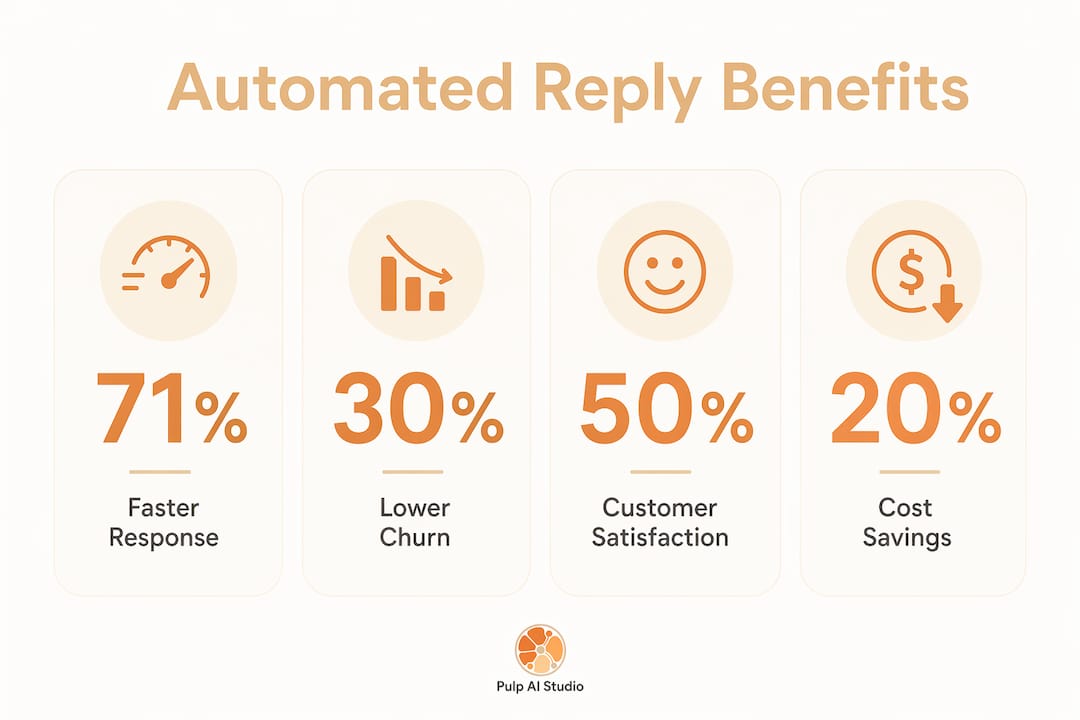
- Faster first response times correlate directly with retention. Companies that reply within one hour achieve 71% customer retention, compared to 48% for those that take 24 hours.
- Routine inquiry deflection frees your human agents to handle the complex, high-stakes conversations that actually require empathy and judgment.
- Expectation setting through automated messages that confirm receipt, provide a ticket number, and give a response window reduces perceived wait time even before a human responds.
- Consistent, measurable service across every channel builds the brand reliability that keeps customers coming back.
Why automated replies reduce retail churn: the core benefits
The impact of automated responses on churn shows up clearly in operational data. Merchants using automation respond 37% faster, resolve tickets 52% faster, and see a 36% increase in repeat purchases compared to those without automation. Those are not marginal gains. A 36% lift in repeat purchases is the difference between a customer who bought once and a loyal buyer who returns on their own.
The operational benefits compound quickly:
- Reduced ticket volume per order: Automation decreases the ticket-to-order ratio by 27%, meaning customers contact support less often because their issues get resolved before frustration builds.
- Staff efficiency: When automated systems handle routine inquiries like order status, return policies, and store hours, agents spend their time on conversations that genuinely need a human.
- CSAT improvement: Brands using automation see a 1% increase in CSAT scores within 30 days, reflecting a meaningful shift in customer perception at scale.
- Multilingual and multichannel reach: Automated systems can respond across email, chat, SMS, and social media simultaneously, and with translation capabilities, they serve customers in their preferred language without additional headcount.
Stat to know: AI-powered support cuts average first response time dramatically, based on Freshworks’ 2025 benchmark of millions of conversations.
The cost of getting this wrong is concrete. Slow response times cost U.S. companies billions annually in lost leads alone, and revenue at risk from slow responses constitutes a significant portion of annual revenue per company. Automated replies are not a luxury feature for enterprise retailers. They are a baseline requirement for any retail operation that wants to compete on customer experience.
How automated replies shape customer perception and reduce uncertainty
Customer churn often starts not with a bad resolution but with the feeling of being ignored. When a shopper sends a message about a delayed order or a defective product and hears nothing back, their mind fills in the worst-case scenario. Automated replies interrupt that process immediately.

The psychological effect of an instant acknowledgment is well documented in customer experience research. Customers who feel heard during service issues are 90% less likely to churn. An automated reply that confirms receipt, provides a reference number, and states when a human will follow up does exactly that: it makes the customer feel heard before a single agent has read the ticket.
Managing expectations through automation involves more than a generic “we got your message” reply. The most effective automated messages:
- Confirm the specific issue type (order inquiry, return request, product question) so the customer knows the system understood them.
- Provide a realistic response window based on current queue volume.
- Offer a self-service path for common resolutions, like a tracking link or a returns portal.
- Escalate immediately when the inquiry contains urgency signals, like words such as “urgent,” “broken,” or “refund.”
Pro Tip: Route high-value customers, those in a loyalty tier or above a spend threshold, to a dedicated queue with a shorter automated response window. Effective routing that prioritizes these customers, rather than treating every ticket identically, preserves the human touch where it matters most and protects your highest-revenue relationships.
Balancing automation with human escalation is where most retailers either win or lose on this front. Automated replies are most effective when they focus on categorization and routing rather than attempting full resolution of every inquiry. The goal is not to replace your team. It is to make sure every customer gets an immediate, accurate first response and that your agents receive pre-screened, prioritized tickets instead of a raw, undifferentiated inbox.
Best practices for deploying automated reply systems in retail
Deploying automated replies without a clear strategy produces the exact outcome you are trying to avoid. Generic automated responses that lack backend integration can actually increase churn by failing to calm customer anxiety, because a reply that says “we’ll look into it” without any specific information feels worse than silence to a customer who already knows something went wrong.
The deployment process that consistently produces results follows a clear sequence:
- Integrate with live backend data. Connect your automated reply system to your inventory database, order management system, and CRM. An automated reply that can tell a customer their order is in transit and expected Thursday is infinitely more valuable than one that says “your inquiry has been received.”
- Train on your actual FAQ content. Feed the system your real return policy, store hours, sizing guides, and shipping terms. Generic knowledge produces generic answers.
- Build escalation triggers. Define the conditions under which a ticket bypasses automation entirely and goes straight to a human agent: high-spend customers, repeat contacts on the same issue, or messages containing specific urgency keywords.
- Set response windows honestly. If your team cannot follow up within two hours, do not promise two hours. Broken expectations are a churn driver in their own right.
- Monitor and adjust continuously. Automation is not a set-and-forget system. Continuous monitoring based on customer data is what sustains churn improvements over time.
The table below maps each strategy to its measurable impact on retail service performance.
| Strategy | Measurable benefit |
|---|---|
| Backend data integration | Accurate, specific responses that resolve issues on first contact |
| FAQ-trained automation | Deflects routine inquiries, reducing ticket volume per order by up to 27% |
| Escalation triggers | Routes complex or high-value tickets to agents, preserving personalization |
| Honest response windows | Reduces customer anxiety and sets realistic expectations |
| Continuous optimization | Sustains retention gains; prevents automation drift over time |
| Analytics and CSAT tracking | Identifies friction points early, enabling proactive churn intervention |
Analytics deserve particular attention here. Retail automation analytics can detect churn signals earlier than any manual review process, flagging patterns like return spikes, repeated contacts on the same order, or a surge in defect-related questions. When your automated system surfaces those signals, your team can act before the customer decides to leave.
You can explore how different retail automation types map to specific service scenarios, which helps clarify where to start when building your deployment plan.
How automated replies work across omnichannel retail service
Retail customers do not stay on one channel. A shopper might send an email about a return, follow up on Instagram when they do not hear back, and then call the store. Without automation, each of those contacts creates a separate ticket, and your team ends up working the same issue three times while the customer grows increasingly frustrated.

Automated replies solve this by acting as the first response across every channel simultaneously. When a unified help desk platform connects email, chat, social media, and SMS into a single inbox, automated replies can acknowledge the customer on whichever channel they used first, reducing the multi-channel escalation pattern that multiplies ticket volume. Fast first reply times directly reduce multi-channel escalation and duplicated tickets, which is one of the clearest ways automation improves the customer experience without adding headcount.
The channel-specific benefits break down this way:
- Email: Automated replies with ticket IDs and response windows reset customer anxiety and prevent follow-up messages that create duplicate tickets.
- Live chat: Instant automated responses to common questions, like “where is my order?” or “what is your return policy?”, resolve a large share of inquiries before a human agent is needed.
- Social media: Automated acknowledgment on platforms like Instagram or Facebook prevents public complaints from escalating when customers feel ignored.
- SMS: For post-purchase follow-up and order updates, SMS automation achieves high open rates and keeps customers informed proactively rather than reactively.
Teams managing email, chat, and social from separate tools carry context-switching overhead and miss tickets. A single help desk platform removes that overhead and makes first response time tracking automatic, which is the prerequisite for measuring and improving your churn-related service metrics. If you are building toward this kind of setup, understanding how to automate retail customer service replies across channels is a practical starting point.
What the data shows: automated replies and retail churn reduction
The Urban Thread case study is one of the clearest documented examples of automated replies reducing retail churn. Urban Thread, a 12-store retail chain, deployed an AI auto-reply system trained on its FAQ content covering stock, sizing, store hours, and return policies. The result: return customer rate jumped from 28% to 41%, a 47% lift quarter-over-quarter. Median reply time dropped from 38 minutes to 4 minutes, CSAT improved from 3.9 to 4.7 out of 5, and support call volume fell 60%. One agent now handles what previously required three.
That outcome is not an outlier. The pattern holds across retail categories because the underlying mechanism is consistent: faster acknowledgment reduces anxiety, accurate information reduces follow-up contacts, and deflecting routine inquiries frees agents to handle the conversations that actually require human judgment.
Key figure: A 5% reduction in churn can boost profits by 25–95% over time, according to Bain and Company. Automated replies are one of the most direct and measurable levers for achieving that reduction.
Predictive analytics add another layer to this picture. When automation systems track patterns like return spikes, repeated contacts, or defect-related questions, they surface churn signals before the customer has made a decision to leave. That early warning capability lets your team intervene proactively, with a targeted offer, a personal follow-up, or an expedited resolution, rather than trying to win back a customer who has already churned.
Pulp AI Studio sets up these kinds of systems for retailers who want the speed and consistency of automation without the work of running the software themselves. We run it for you on a managed setup, live in about two weeks.
How live agent escalation makes automated replies more effective
Automation without a clear escalation path is where retail customer service breaks down. A customer who gets an automated reply, then another automated reply, then a third one without ever reaching a human will not just churn. They will leave a public review about it.
The most effective approach treats automated replies as the first layer of a two-layer system. The automated layer handles acknowledgment, routing, and resolution of routine inquiries. The human layer handles everything that requires empathy, judgment, or account-specific context. The handoff between the two is what determines whether the customer feels served or processed.
Designing that handoff well means:
- Transparent transitions: When a ticket escalates to a human agent, the customer should know. A message like “Your question has been passed to our team and you will hear from [Name] within [timeframe]” maintains trust through the transition.
- Context transfer: The agent who picks up an escalated ticket should see the full conversation history, the automated replies that were sent, and any customer data the system surfaced, like order history or loyalty tier. No customer should have to repeat themselves.
- Escalation thresholds: Define these clearly. Repeat contacts on the same issue, high-spend customers, and messages with emotional language are the most common triggers that should bypass automation and go directly to your best agents.
- Agent-assisted drafting: For the tickets that reach a human, AI-drafted reply suggestions reduce the time agents spend composing responses from scratch, which keeps resolution times low even on complex issues.
Human agents benefit most from automation that pre-screens and prioritizes inquiries, because it means they spend their time on conversations where their empathy and expertise actually make a difference. The combination of AI speed and human judgment is what produces the retention outcomes that neither approach achieves alone. For a broader look at how automated text replies contribute to this kind of growth, the underlying principles apply across retail formats and business sizes.
If you want a system built to these specifications, live in about two weeks on a managed setup, Pulp AI Studio’s automated answering systems demonstrate the kind of rapid-response architecture that translates directly to retail customer service. The same logic that keeps a medical practice’s patients from going unanswered applies to any retail operation where a missed message is a missed customer.
Key Takeaways
Automated replies reduce retail churn by eliminating the silence that drives customers away, with documented gains including a 47% lift in return customers, 52% faster resolution times, and a 36% increase in repeat purchases.
| Point | Details |
|---|---|
| Speed drives retention | Companies replying within one hour achieve 71% customer retention vs. 48% for 24-hour response times. |
| Automation lifts repeat purchases | Merchants using automation see a 36% increase in repeat purchases and resolve tickets 52% faster. |
| Escalation design matters | Automated replies work best as a routing and acknowledgment layer, with clear handoffs to human agents for complex or high-value tickets. |
| Backend integration is required | Automated replies without live data connections produce generic responses that can increase churn rather than reduce it. |
| Early churn detection | Automation analytics flag return spikes and repeated contacts, enabling proactive outreach before a customer decides to leave. |
A Plan Run for You, Not Another Tool to Run
Most owners did not lose the lead because a tool was missing. They lost it because nobody had time to run the tool. So we run it for you: a hosted CRM with the AI already wired in, set up and managed for your shop, live in about two weeks, and priced in the same range as the do-it-yourself AI receptionist plans, at one flat monthly price. The pieces most shops start with:
- Voice AI receptionist. Answers, qualifies, and books onto your calendar day or night, connected to the CRM or field software you already use, and hands the call to a person when it needs one. See the after-hours answering service.
- Speed to lead. A new form fill, ad lead, or missed call gets a text back right away, while the customer is still shopping. More on why the first few minutes decide the job.
- Database reactivation. The old leads and past customers already sitting in your system get a conversational text campaign that books the ones who are ready now. Related: why leads go quiet and how to restart them.
- AI social replies. Facebook and Instagram comments and DMs get answered and routed instead of sitting unread until Monday. The AI chatbot guide covers how those replies work.
Your contacts, your conversation history, and your phone number stay yours to export or port out if you leave. For shops that want the whole system on hardware they own, prompts, logs, and models included, we also do custom builds (about 30 days, since there is hardware to set up). Most shops start managed and grow into a rig, not the other way around.
FAQ
Does conversational AI reduce early churn?
Yes. Conversational AI reduces early churn by delivering instant acknowledgment that eliminates the “silence of uncertainty” most likely to push new customers away. Customers who feel heard during service issues are 90% less likely to churn.
What are three ways to effectively reduce customer churn?
The three most direct approaches are: deploying automated replies to cut first response time, using escalation routing to connect high-risk customers with human agents quickly, and running proactive follow-up after issue resolution. Brands that follow up after resolving a complaint see higher satisfaction and lower churn.
Why is quick response time so important in customer service?
Slow response is one of the most measurable drivers of churn because customers who do not get a timely reply rarely announce they are leaving. They simply stop returning. Many consumers will switch to a competitor after multiple poor service experiences, and some will leave after a single bad experience.
Do automated messages actually lower churn, or just delay it?
Automated messages lower churn when they are backed by backend data integration and a clear escalation path to human agents. Without those elements, generic automated replies can frustrate customers further. With them, automation resolves routine issues instantly and routes complex ones to the right person, which addresses the root causes of churn rather than masking them.
How do you measure whether automated replies are reducing churn?
Track first response time, resolution time, ticket-to-order ratio, repeat purchase rate, and CSAT scores before and after deploying automation. Retailers using automation see a 27% decrease in ticket-to-order ratio and a 1% CSAT increase within 30 days, both of which are leading indicators of improved retention.