
 Adam Pichardo
TL;DR:
- Automated customer service responds instantly, reducing delays and increasing lead conversion rates. It is more scalable, consistent, and available 24/7, outperforming manual replies in speed and cost. Proper automation enhances customer experience, frees staff for complex tasks, and prevents missed inquiries outside business hours.
Automated service is defined as technology that responds to customer inquiries instantly, consistently, and without human intervention. This is why automated service beats manual replies: it removes the delay, inconsistency, and capacity limits that cost businesses leads every day. Every hour a lead waits reduces conversion probability by 10%, and after 24 hours, conversion drops by more than 60%. Manual replies simply cannot compete with that math. That is the gap AI auto-replies close: they answer while the lead is still paying attention, which reduces ghosting and wins jobs before competitors even respond.
Why automated service beats manual replies: the core case
Automated customer service uses AI-powered tools, rule-based workflows, or a combination of both to handle incoming inquiries without a human typing each response. Manual replies depend on a staff member reading, thinking, and writing, one message at a time. The gap between those two approaches is not a matter of preference. It is a structural performance difference.

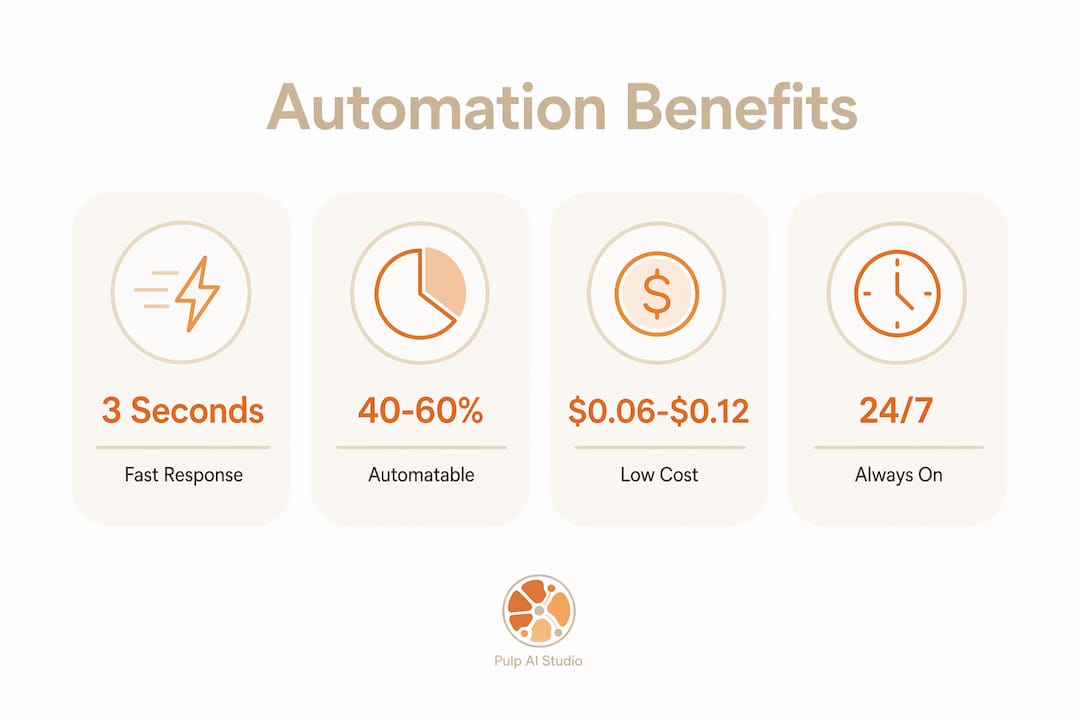
40–60% of all customer inquiries are repetitive and automatable, covering questions like order status, pricing, hours, and return policies. That means the majority of your team’s reply time goes to questions a well-built system can answer in under three seconds. Redirecting that volume to automation frees your staff for the work that actually requires judgment.
The advantages of automated responses show up most clearly in three areas: speed, consistency, and availability. A manual reply requires someone to be at their desk, focused, and not already handling five other tasks. Automation has none of those constraints. It is the equivalent of a front-desk employee who never sleeps, never has a bad day, and never forgets what your return policy says.
For small business owners, retailers, clinics, and contractors, this is not a luxury upgrade. It is a competitive necessity. When a potential customer sends an inquiry at 9:30 PM on a Friday, the business that replies in seconds wins. The one that replies Monday morning often finds the lead has already moved on. For stores specifically, a chatbot for retail that answers product and stock questions on the spot is usually the first automation worth installing.
How do automated responses improve the customer experience?
The first thing automation does well is acknowledgment. When a customer submits a question or request, receiving an instant confirmation tells them their message was received and that someone, or something, is on it. That single moment of acknowledgment reduces anxiety and sets a positive tone for the entire interaction.
Beyond acknowledgment, well-designed automation sets clear expectations. Good automated responses use a friendly, human-like tone, proactive messaging, and specific next steps to build trust rather than frustrate customers. A message that says “We received your inquiry and will follow up within two hours” performs far better than silence, even if the follow-up time is identical.
Automation also qualifies and routes leads accurately. Instead of a customer waiting for a human to read their message and decide who should handle it, an AI system can ask the right questions immediately, categorize the inquiry, and send it to the right person or queue with full context attached. That speed and accuracy reduces friction at every step.
The benefits of automation in customer service also include 24/7 availability without the cost of overnight staffing. For businesses that receive inquiries outside business hours, this is where the most leads are lost under a manual system. Automation captures those inquiries, responds immediately, and keeps the conversation warm until a human can take over.
- Instant acknowledgment confirms receipt and reduces customer uncertainty within seconds.
- Clear next steps tell customers what to expect, which lowers follow-up calls and repeat messages.
- Accurate routing gets the right inquiry to the right person faster, with full context.
- 24/7 coverage captures leads during evenings, weekends, and holidays without added staffing cost.
- Consistent tone delivers on-brand messaging every time, regardless of volume or time of day.
Pro Tip: Set your automated acknowledgment to include a specific timeframe for human follow-up. “We’ll be in touch within two hours” outperforms “We’ll get back to you soon” because it sets a measurable expectation and signals professionalism.
What are the cost and scalability advantages of automation?
The cost difference between automated and manual replies is not marginal. Automated interactions cost $0.06–$0.12 per exchange, compared to $6.00–$8.00 for a human-handled response. At scale, that gap compounds quickly. A business handling 1,000 inquiries per month pays roughly $80–$120 for automation versus $6,000–$8,000 for manual handling of the same volume.
That cost structure also means automation scales without proportional investment. Manual replies require more staff as volume grows. Automation handles a surge in inquiries with no additional cost per message. Industry leaders have automated over 81% of their support volume, absorbing a 300% increase in customer demand without adding headcount. That is the scalability advantage in concrete terms.
| Metric | Manual replies | Automated service |
|---|---|---|
| Cost per interaction | $6.00–$8.00 | $0.06–$0.12 |
| Availability | Business hours only | 24/7 |
| Volume capacity | Limited by staff count | Effectively unlimited |
| Response time | Minutes to hours | Under 3 seconds |
| Consistency | Variable | Uniform every time |
The table above shows why the manual vs automated replies debate is not really a debate at scale. The numbers favor automation decisively across every dimension that affects lead conversion and operational cost.
For a small business owner managing a team of two or three people, the scalability argument is even more direct. You cannot hire a part-time employee to answer messages at 11 PM. You can deploy an AI system that does exactly that — one you own, not one you rent. Pulp AI Studio builds these systems with a two-week deployment timeline and an optional managed plan, which means the cost savings start almost immediately.
The efficiency of automated replies also shows up in staff productivity. When your team is not spending three hours a day answering the same five questions, they can focus on estimates, follow-ups, and closing jobs. That redeployment of time is a real operational gain, not just a theoretical one.
What goes wrong with manual replies, and how does automation fix it?
Manual replies fail in predictable ways. Understanding those failure modes makes the case for automation concrete rather than abstract.
-
Inconsistency across staff members. Two employees answering the same question will phrase it differently, include different details, and project different levels of confidence. Automation guarantees consistent, accurate information every time, which protects brand reputation and prevents customers from receiving conflicting answers.
-
Delayed responses during peak hours. When inquiry volume spikes, manual reply times stretch. A customer who waits two hours during a busy Monday morning is a lead at risk. Automation responds in seconds regardless of how many other inquiries are in the queue.
-
Lost inquiries during off-hours. A missed call or an after-hours web form submission sits unanswered until the next business day. By then, the customer has often contacted a competitor. Pulp AI Studio’s missed-call text-back system addresses this directly by sending an immediate response to any missed call, keeping the lead engaged.
-
Human error under pressure. Tired or overloaded staff make mistakes. They forget to include key information, send replies to the wrong contact, or use a tone that does not reflect the business well. Automation removes that variable entirely.
-
No lead qualification at the point of contact. A manual reply often just acknowledges the inquiry without gathering the information needed to qualify the lead. Automation can ask qualifying questions immediately, so by the time a human follows up, the conversation already has context.
Pro Tip: Audit your last 30 days of incoming inquiries and count how many arrived outside business hours. That number is the floor of leads your manual system is currently failing to capture. Automation converts that floor into revenue.
The efficiency of automated replies is not just about speed. It is about eliminating the structural gaps that manual systems leave open by design.
How should businesses implement automation without losing the human touch?
Automation works best as the first layer of your communication system, not the only layer. The goal is to handle repetitive, time-sensitive interactions automatically while routing complex or sensitive inquiries to a human agent with full context. That handoff is where most businesses either get it right or lose the customer.
Bots must escalate complex queries with full conversation history to human agents. Without that context, the customer has to repeat themselves, which creates frustration and signals a broken process. Confidence-scoring thresholds, where the system routes a query to a human when it cannot answer with sufficient certainty, prevent the “bot loop” problem that drives 75% of customer frustration in poorly designed systems.
Tone matters as much as speed. AI-powered automated emails outperform rule-based templates because they understand full customer intent and provide contextually accurate replies. A message that reads like a form letter does not build trust. A message that references the customer’s specific question, uses their name, and provides a direct answer does.
Personalization is achievable even at scale. Personalized automation uses dynamic customer data, such as order history or past interactions, to craft individualized messages rather than canned responses. That level of specificity increases engagement and makes the automated reply feel like a genuine response rather than a generic acknowledgment.
- Layer automation first, humans second. Let automation handle the first response, qualification, and routing. Reserve human time for complex decisions and relationship-building.
- Build escalation with context. Pass the full conversation history to the human agent so the customer never has to repeat themselves.
- Use a human-like tone. Write automation scripts that sound like your best employee, not a legal disclaimer.
- Personalize with dynamic data. Pull in the customer’s name, inquiry type, or prior history to make each automated message feel specific.
- Test your escalation triggers. Review escalated conversations monthly to refine the confidence thresholds that determine when a human takes over.
Understanding the types of AI support agents available helps businesses choose the right layer for each part of their communication workflow. Not every inquiry needs the same level of AI sophistication, and matching the tool to the task improves both cost and quality.
Automation is not about replacing humans but about handling repetitive tasks so human agents can focus on complex and empathetic interactions. That framing matters for your team as much as for your customers. Staff who spend less time on routine replies have more capacity for the conversations that actually require their expertise.
Key Takeaways
Automated service outperforms manual replies because it delivers instant, consistent, and scalable responses that manual systems structurally cannot match at any comparable cost.
| Point | Details |
|---|---|
| Speed drives conversion | Every hour of delay reduces lead conversion probability by 10%; automation responds in seconds. |
| Cost advantage is decisive | Automated interactions cost $0.06–$0.12 versus $6.00–$8.00 for manual handling. |
| Scalability without added staff | Automation absorbs volume spikes with no proportional increase in cost or headcount. |
| Consistency protects your brand | Automation delivers the same accurate, on-brand message every time, eliminating human error. |
| Humans handle what matters most | Automation frees your team for complex, high-value interactions that require judgment and empathy. |
The uncomfortable truth about “we’ll get back to you”
I have worked with enough business owners to know that most of them believe their manual reply process is faster than it actually is. They think of the best-case scenario: a staff member sees the message immediately and responds within minutes. What actually happens is that messages arrive during a busy service call, get buried under three other notifications, and sit for four hours while the business owner assumes someone else handled it.
The leads that go cold are rarely the result of bad intentions. They are the result of a system that was never designed to handle real-time inquiry volume. Manual replies work when you have low volume and a dedicated person watching the inbox. The moment either of those conditions changes, the system breaks.
What I find most underestimated is the off-hours problem. Most business owners know they miss some after-hours inquiries. Few have actually counted them. When they do, the number is almost always higher than expected. A contractor who gets eight after-hours calls per week and converts even half of them with an automated text-back is looking at a meaningful revenue increase, not a marginal one.
The other thing I would push back on is the fear that automation feels impersonal. Done poorly, it does. Done well, it feels faster and more attentive than a human reply that arrives four hours late with a generic “Thanks for reaching out.” Speed and relevance together are what customers actually want. Automation delivers both when it is built correctly.
The businesses I have seen get the most from automation are the ones that treat it as a communication standard, not a cost-cutting measure. They build it to reflect their brand voice, they test it regularly, and they use it to give their team more time for the work that actually requires a human. That combination is where the real gains are.
— Adam
How Pulp AI Studio builds automation that captures leads around the clock
Pulp AI Studio builds custom AI chatbot systems for small businesses, retailers, clinics, and contractors who are losing leads to slow or missed replies. Every build is fixed-fee with an optional managed plan, and the system is fully operational within two weeks. The setup includes instant AI replies, lead qualification, and a missed-call text-back feature that responds to any missed call automatically. Businesses that deploy Pulp AI Studio’s system stop losing off-hours leads and start converting inquiries before competitors even see them. If you want a rapid deployment system that turns missed calls into active conversations, Pulp AI Studio delivers exactly that.
FAQ
What is automated customer service?
Automated customer service uses AI or rule-based systems to respond to customer inquiries instantly, without human input. It handles repetitive questions, qualifies leads, and routes complex issues to human agents.
How much faster is automation than manual replies?
Automation responds in under three seconds. Manual replies typically take minutes to hours, and every hour of delay reduces lead conversion probability by 10%.
Does automation replace human agents entirely?
Automation handles repetitive, time-sensitive inquiries while human agents manage complex or sensitive conversations. The two layers work together, with automation escalating queries alongside full conversation history.
Why use chatbots for support instead of email or phone?
Chatbots respond instantly at any hour, qualify leads before a human follows up, and handle high inquiry volumes without added staffing cost. They are available when phones go unanswered and inboxes go unchecked.
How quickly can a business deploy an automated reply system?
Pulp AI Studio deploys fully functioning AI reply systems within two weeks. That timeline means businesses start capturing leads faster than a traditional hiring or training process would allow.