
 Adam Pichardo
TL;DR:
- Human-in-the-loop AI involves human review, modification, or approval before execution, ensuring oversight on high-stakes decisions. It is implemented based on reversibility, impact radius, and regulatory needs, with workflow tailored to task risk levels. Proper governance, robust tooling, and continuous monitoring are essential for effective and compliant oversight.
Human-in-the-loop AI (HITL) is an architecture where a trained person must review, modify, or approve an AI-generated action before it executes or before its output enters a downstream system. Stanford HAI frames this as a design principle where humans remain in charge and the AI is the one “in the loop,” not the other way around.
The bottom line for practitioners: HITL is not a checkbox or a blanket policy. It is a per-workflow decision based on three questions.
- Reversibility: Can the action be undone in seconds, or is it permanent?
- Blast radius: If the AI is wrong, does one customer feel it or does an entire portfolio?
- Regulatory exposure: Does a law, contract, or clinical standard require a named human to authorize this decision?
If any answer points toward irreversible, wide-impact, or regulated, you need a human in the loop. Routine, low-stakes, easily-reversed tasks are candidates for full automation. Everything in between gets confidence-threshold routing.
How does human-in-the-loop AI actually work?
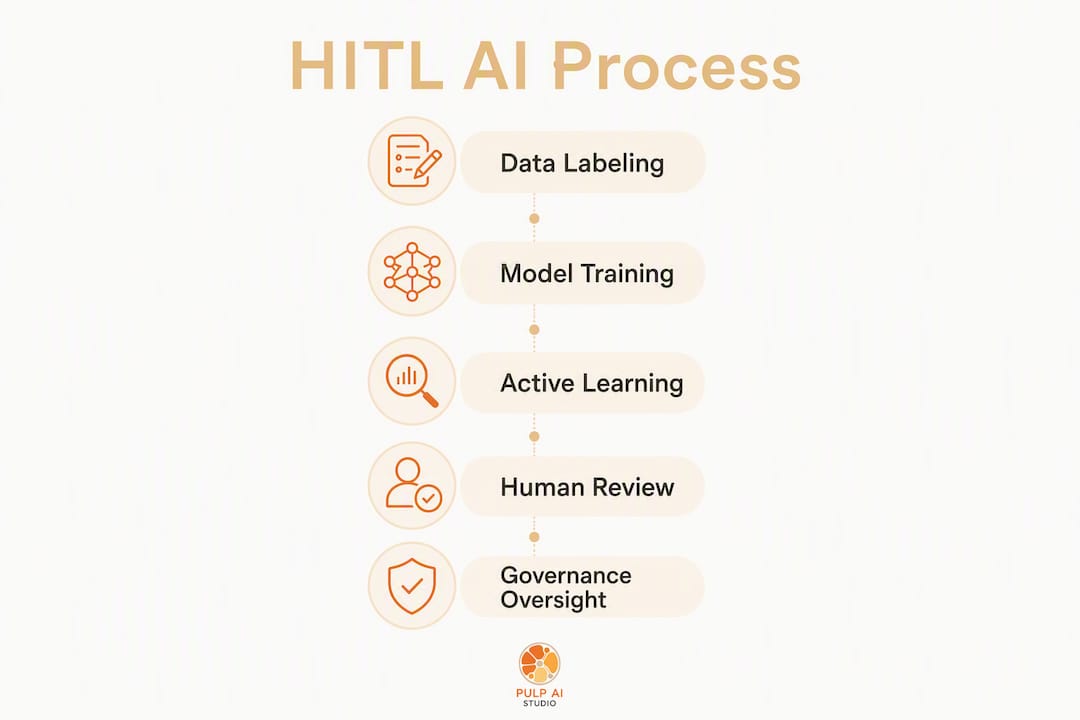
The logical flow is straightforward, but the engineering details matter. Here is the sequence every HITL system follows:
- Model inference: The AI processes input and generates a proposal, a classification, a draft action, or a decision recommendation.
- Confidence scoring: The model attaches a confidence score or uncertainty estimate to its output.
- Routing decision: A rules engine compares the score against calibrated thresholds. High-confidence, low-risk outputs may pass directly to execution. Low-confidence or high-risk outputs are placed in a human review queue.
- Human review: A trained reviewer sees the AI proposal alongside the supporting evidence, edits or approves it, and submits the decision.
- Execution and logging: The approved action executes. The system writes a provenance record: AI proposal, human edits, reviewer identity, timestamp, and contextual evidence.
- Feedback loop: Reviewer corrections are tagged and fed back into the training pipeline, either as new labeled examples or as fine-tuning signal, closing the active learning loop.
The points where humans attach to the model vary by workflow. In annotation pipelines, humans label raw data before training. In production review queues, humans verify AI outputs before they affect real users. In approval gates, humans authorize consequential actions like fund transfers or treatment recommendations. In escalation paths, humans handle cases the model explicitly flags as out-of-distribution.
Active learning tightens this cycle. Instead of labeling data randomly, the model requests human annotation on the examples where it is least certain, which means each labeled example carries maximum training value. Disagreement routing, where two reviewers independently label the same item and a third adjudicates conflicts, is standard practice for high-stakes classification tasks.

The engineering trade-off you cannot ignore is latency. A synchronous approval gate adds the reviewer’s response time directly to the user-facing transaction. For a loan decision that takes 24 hours, that is acceptable. For a real-time customer chat response, it is not. Asynchronous review queues decouple the human step from the user-facing flow, but they require optimistic locking or rollback capability so that an action can be reversed if the reviewer later rejects it.
Pro Tip: Set your confidence thresholds on held-out validation data, not on training data. A threshold calibrated on training examples almost always overstates model confidence on real production inputs.
Why HITL matters: accuracy, safety, and defensibility
The operational cost of human reviewers is real. The cost of skipping them in the wrong context is higher.
- Accuracy on edge cases: Models trained on historical distributions fail on distribution shift, novel inputs, and adversarial examples. Human reviewers catch errors that no automated test suite anticipates because they bring contextual judgment the model was never trained on.
- Safety and legal defensibility: An auditable decision trail with named reviewers is the difference between a defensible process and a liability. When a regulator or plaintiff asks “who approved this?”, a provenance log with a reviewer’s identity and timestamp answers that question. A fully automated system cannot.
- Adaptability under data drift: When the real world changes, a HITL system recovers faster than a fully automated one. Reviewer corrections become labeled training data, and a curated retraining cycle on drift-specific examples can restore accuracy far more quickly than waiting for enough organic data to accumulate.
- Controlled blast radius: Routing only high-impact decisions through human review limits the damage any single model error can cause. Routing edge and high-impact queries to humans while automating routine tasks is how small teams maintain oversight without drowning in review volume.
- Regulatory alignment: EU AI Act Article 14 requires effective human oversight for high-risk systems, and GDPR Article 22 already gives individuals the right to human intervention in certain automated decisions. U.S. legislative activity in financial services, healthcare, and hiring is moving in the same direction.
Enterprises are increasingly treating HITL as a competitive differentiator. When model capabilities converge across vendors, the organizations with cleaner audit trails, named decision-makers, and documented review processes are the ones that can operate in regulated markets and survive legal scrutiny. Accountability architecture, not raw model performance, becomes the moat.
When should you add humans to the loop?
The answer is not “always” and it is not “only for regulated industries.” It is a per-task decision based on the three questions from the opening: reversibility, blast radius, and regulatory exposure.
A practical tiering framework helps teams apply this consistently:
- Tier 1 (full automation): Low-stakes, easily reversed, no regulatory requirement. Examples: spam filtering, product recommendation ranking, internal document tagging. The model acts; a human can audit after the fact on a sample basis.
- Tier 2 (confidence-threshold routing): Moderate stakes or moderate reversibility. Examples: customer support response drafts, pricing suggestions, content moderation flags. High-confidence outputs execute automatically; low-confidence outputs route to a human queue. A decision-boundary framework formalizes this: automate low-risk, escalate medium-risk via calibrated thresholds, require explicit approval for high-risk.
- Tier 3 (mandatory human approval): Irreversible, wide blast radius, or legally regulated. Examples: loan origination, clinical treatment recommendations, contract execution, employee termination. No output executes without a named reviewer’s explicit sign-off.
To assign a task to a tier, work through this checklist:
- Can the action be reversed within 60 seconds at no cost? If yes, Tier 1 is a candidate.
- If the model is wrong, how many people or records are affected? More than a handful pushes toward Tier 2 or 3.
- Does a law, regulation, or contract require a human to authorize this? If yes, Tier 3 is mandatory.
- Is the model operating near the edge of its training distribution? If yes, add a human regardless of tier.
- Has the model’s accuracy on this task been validated on recent production data? If not, treat it as Tier 2 until it has.
Pro Tip: Approval fatigue is a real operational risk. If reviewers are approving 98% of items without modification, your confidence threshold is too low. Raise it until the human queue contains only genuinely ambiguous or high-stakes items.
Common HITL workflows and architecture patterns
Not all human oversight looks the same. The three primary workflow types differ in staffing, latency, and tooling requirements.
- Annotation pipelines run before model training. Humans label raw data, and quality depends on inter-annotator agreement rates and clear labeling guidelines. These are high-volume, lower-urgency workflows suited to asynchronous tooling.
- Review queues run in production. Humans inspect AI outputs before or shortly after they affect users. Latency requirements vary from seconds (customer-facing chat) to hours (back-office decisions).
- Approval gates are synchronous checkpoints where execution is blocked until a named reviewer signs off. These are reserved for Tier 3 tasks where the cost of an unreviewed error is unacceptable.
Architecture patterns and their trade-offs
| Pattern | Latency impact | Best for | Key requirement |
|---|---|---|---|
| Synchronous approval gate | High (blocks execution) | Irreversible, regulated actions | Reviewer SLA; rollback not needed |
| Asynchronous review queue | Low (non-blocking) | Moderate-risk, high-volume tasks | Rollback capability; optimistic locking |
| Confidence-threshold routing | Minimal | Mixed-risk workflows | Calibrated thresholds; monitoring |
| Dual approval (consensus) | Highest | Clinical, financial, legal decisions | Two trained reviewers; adjudication path |
| Boundary-triggered escalation | Low baseline | Agentic or multi-step pipelines | Out-of-distribution detection |

Every HITL architecture needs four infrastructure components regardless of pattern: a logging layer that captures AI proposals and human decisions, a provenance store that links decisions to the evidence used, a rollback mechanism for asynchronous flows, and an audit interface that lets compliance teams query the decision history.
Pro Tip: Build your rollback window into the SLA from day one. If a reviewer rejects an action two hours after it executed, you need a defined process for reversal. Discovering you have no rollback path after a bad decision is the wrong time to design one.
Where is HITL applied in practice?
These six domains illustrate how the oversight pattern maps to the task, not just the industry.
-
Loan and credit decisions: The AI scores applicants and flags borderline cases. A human underwriter reviews flagged applications, checks supporting documents, and approves or denies. Key metrics: override rate, time-to-decision, and false-negative rate on denied applications.
-
Medical triage and clinical support: AI flags abnormal lab values or imaging findings. A clinician reviews the flag before any patient communication or treatment order. Medical practices need clear escalation paths because a missed flag has irreversible consequences. Key metrics: sensitivity on flagged cases, reviewer response latency, and missed-escalation rate.
-
Content moderation: AI classifies posts or images as policy-violating. High-confidence violations are actioned automatically; borderline cases go to a human moderator. Key metrics: false-positive rate, reviewer throughput, and appeal reversal rate.
-
Customer support actions: AI drafts responses or proposes account changes. A support agent reviews the draft before sending. After-hours AI systems that handle inbound queries use this pattern, routing complex or high-value cases to a human the next business day. Key metrics: draft acceptance rate, customer satisfaction delta, and escalation rate.
-
Pricing and contract approvals: AI generates a pricing recommendation or contract clause. A sales manager or legal reviewer approves before the document goes to the customer. Key metrics: override rate, deal cycle time, and post-signature dispute rate.
-
Legal text generation: AI drafts clauses or summarizes case law. An attorney reviews before any client-facing use. The blast radius of an unreviewed legal error is wide, so synchronous approval is standard.
A common failure pattern across all these domains: deploying HITL without training reviewers on what “good” looks like. Reviewers who cannot articulate why they are overriding a model decision are not providing oversight; they are adding latency.
Pro Tip: Match reviewer skill level to the decision type. A generalist can approve a customer email draft. A licensed clinician must review a treatment recommendation. Mismatched reviewer expertise is one of the fastest ways to create the illusion of oversight without the substance.
How to implement HITL: a practical step-by-step checklist
Implementation fails most often at the edges: unclear reviewer authority, missing rollback paths, and thresholds set on the wrong data. Work through these steps in order.
-
Define the pilot scope. Pick one workflow, set a success metric (e.g., override rate below 15%, reviewer latency under 4 hours), and identify the edge cases you expect to stress-test. Do not pilot on your highest-stakes workflow first.
-
Hire and train reviewers. Reviewers need domain knowledge, a clear decision rubric, and practice on representative examples before going live. Document what “approve,” “modify,” and “reject” mean for each task type.
-
Design the reviewer interface. Show the AI proposal, the confidence score, and the supporting evidence on one screen. Minimize clicks. A reviewer who has to navigate three tabs to find the context they need will rubber-stamp to keep up with queue volume.
-
Set and validate confidence thresholds. Use held-out validation data. Calibrate so that the human queue contains a manageable volume of genuinely uncertain cases, not 80% of all outputs.
-
Build the audit log. Every decision record must capture: AI proposal, human edits, reviewer identity, timestamp, and the evidence the reviewer saw. This is not optional for any Tier 2 or Tier 3 workflow.
-
Run A/B testing and edge-case injection. Before full rollout, inject known-difficult examples into the reviewer queue and measure whether reviewers catch them. This is your calibration check for both the model and the reviewers.
-
Define rollback windows and escalation paths. For asynchronous flows, specify how long after execution a reviewer can trigger a reversal and who handles the reversal process.
-
Monitor continuously post-launch. Track the metrics below. Set alerts on disagreement rate spikes and override rate drops, both of which signal potential automation complacency.
HITL monitoring metrics
| Metric | What it measures | Alert threshold |
|---|---|---|
| Human vs model accuracy | Reviewer correction rate on AI proposals | Override rate drops below 2% (complacency signal) |
| Disagreement rate | Inter-reviewer agreement on same item | Falls below 80% (rubric clarity issue) |
| Reviewer latency | Time from queue entry to decision | Exceeds defined SLA |
| Override rate | Proportion of AI proposals modified or rejected | Sustained drop may indicate rubber-stamping |
| Audit coverage | Percentage of decisions with complete provenance logs | Below full for Tier 3 workflows |
Pro Tip: Run a well-designed AI workflow review at 30 days post-launch. Threshold drift, reviewer turnover, and queue volume changes all happen faster than most teams expect.
What are the real limitations and failure modes of HITL?
HITL solves real problems and creates new ones. Know both before you commit to a design.
- Automation complacency: Reviewers who see 500 correct AI proposals in a row stop reading carefully. Rotating reviewers and using audit-after-execution on lower-stakes high-volume flows are the primary mitigations. Periodic stress tests with injected errors are the validation mechanism.
- Approval fatigue: A queue that is too large or too fast degrades decision quality. The fix is raising confidence thresholds so humans see only genuinely uncertain items, not a firehose of borderline cases.
- Miscalibrated confidence: A model that is overconfident routes too many errors past the human gate. Recalibrate thresholds on recent production data quarterly, not just at launch.
- Audit gaps: Incomplete provenance logs are a compliance liability. If the log does not capture what evidence the reviewer saw, you cannot prove the review was substantive.
- Adversarial manipulation: Bad actors can craft inputs designed to push model confidence above the routing threshold, bypassing human review. Periodic adversarial testing and anomaly detection on routing patterns are necessary countermeasures.
- Bias amplification: Human reviewers carry their own biases. If reviewer decisions are fed back as training labels without quality control, the model learns the reviewers’ biases, not ground truth. Structured rubrics and inter-annotator agreement checks reduce this risk.
- Worker conditions and transparency: High-volume annotation and moderation work can be cognitively demanding and, in some contexts, psychologically harmful. Teams have an obligation to set sustainable throughput targets, provide support resources, and be transparent with end users that human review is part of the process.
The cost calculus is straightforward: human review time multiplied by volume multiplied by reviewer cost. For small teams, routing only edge and high-impact queries to humans keeps that cost manageable while preserving oversight where it matters.
Pro Tip: Never use override rate as the only health metric. A reviewer who modifies 12% of proposals might be doing excellent work or might be introducing systematic errors. Pair override rate with downstream outcome data to distinguish the two.
What tooling does a HITL system need?
The tooling stack for a HITL system spans five categories. You rarely need all five from a single vendor.
- Labeling platforms: Tools like Scale AI, Label Studio (open source), and Labelbox handle annotation workflows, inter-annotator agreement tracking, and label export to training pipelines.
- Review UIs: Custom-built or low-code interfaces that show AI proposals alongside supporting evidence. The key ergonomic requirement is single-screen context: the reviewer should not need to switch applications to make a decision.
- Task routing systems: Queue managers that apply confidence-threshold rules, assign tasks to available reviewers, and enforce SLAs. These can be as simple as a database-backed job queue or as complex as a dedicated workflow orchestration tool.
- MLOps orchestration: Platforms like MLflow, Weights & Biases, or Kubeflow manage model versioning, experiment tracking, and the feedback loop from reviewer corrections back to retraining pipelines.
- Logging and provenance stores: Append-only logs (structured JSON to a data warehouse or a purpose-built audit store) that capture every decision record with the fields described in the implementation section.
When selecting tools, prioritize these criteria in order:
- Latency fit: Does the tool’s processing overhead fit within your reviewer SLA?
- Reviewer ergonomics: Can a reviewer complete a decision in under 60 seconds without training on the tool itself?
- Integration APIs: Does it connect to your existing model serving layer and data warehouse without a custom ETL?
- Audit log completeness: Does it capture reviewer identity, timestamp, AI proposal, and human edits natively?
- Access controls: Can you restrict reviewer access to only the data their role requires?
- Cost model: Is pricing per decision, per seat, or per compute hour? For variable-volume workflows, per-decision pricing can be unpredictable.
For small teams, the build-vs-buy decision usually favors buying labeling and MLOps tooling while building a lightweight custom review UI. Generic labeling tools are mature and cost-effective; your review UI needs to match your specific workflow and data types, which off-the-shelf tools rarely do well out of the box.
Governance, compliance, and defensible oversight
Governance is where most HITL implementations fall short. A process that looks like oversight but lacks substance creates liability rather than reducing it.
Regulators expect documented processes with named reviewers who have the time, authority, and competence to meaningfully reject or modify AI actions. A passive “rubber stamp” review is not compliant oversight; it is a paper trail that proves the organization knew a human was needed and provided one who was not equipped to do the job.
The minimum governance requirements for any Tier 2 or Tier 3 HITL system:
- Named reviewer with documented authority: The policy must specify who can approve each decision type and what their qualifications are.
- Documented review process: Step-by-step instructions for what the reviewer examines, what evidence they must consult, and what constitutes a valid approval vs. an escalation.
- Training and competence checks: Initial training before live review, periodic refreshers, and a documented competence assessment.
- Decision provenance logs: As noted earlier, logs must capture the AI proposal, human edits, overrides, timestamps, and the contextual evidence used to make the decision. Retention periods should match the regulatory requirement for the domain (typically 3–7 years for financial and clinical records in the U.S.).
- Periodic audits: Quarterly review of a random sample of decisions to verify that the review process is being followed and that override rates are within expected ranges.
Regulatory context
In the U.S., sector-specific rules govern AI oversight requirements. The Equal Credit Opportunity Act and Fair Housing Act impose human accountability requirements on automated lending decisions. HIPAA requires covered entities to maintain audit trails for decisions affecting patient records. The FTC has issued guidance on algorithmic accountability that implies human review for consequential automated decisions.
For organizations with EU exposure, EU AI Act Article 14 requires effective human oversight for high-risk systems, and GDPR Article 22 gives individuals rights to human intervention in certain automated decisions. Cross-border teams should design their governance architecture to satisfy the stricter standard.
Sample governance policy elements
A defensible HITL policy should specify:
- Reviewer role title and minimum qualifications
- Decision types requiring review and the applicable tier
- Maximum queue latency (SLA) before escalation
- Escalation path and escalation authority
- Audit log retention period and access controls
- Frequency and scope of periodic audits
- Consequences for documented rubber-stamping
Governance health KPIs
| KPI | Target | What a deviation signals |
|---|---|---|
| Override latency | Within defined SLA | Reviewer capacity or tooling issue |
| Audit coverage | Full for Tier 3 | Logging gap or process bypass |
| Reviewer turnover | Stable quarter-over-quarter | Training investment or workload issue |
| Disagreement rate | Consistent with baseline | Rubric drift or new edge-case category |
| Complacency test pass rate | Complete on injected errors | Reviewer attention or training gap |
This article provides general informational guidance on HITL governance. Confirm current regulatory requirements with qualified legal or compliance counsel for your specific jurisdiction and use case.
Key Takeaways
Human-in-the-loop AI requires per-task risk tiering, substantive named-reviewer oversight, and complete decision provenance logs to be both effective and defensible.
| Point | Details |
|---|---|
| Risk tiering drives design | Assign each workflow to Tier 1, 2, or 3 based on reversibility, blast radius, and regulatory exposure before choosing an oversight pattern. |
| Substantive review is mandatory | Named reviewers must have the authority, time, and training to reject AI proposals; rubber-stamp reviews create liability rather than reducing it. |
| Provenance logs are non-negotiable | Every Tier 2 and Tier 3 decision record must capture the AI proposal, human edits, reviewer identity, timestamp, and supporting evidence. |
| Monitor for complacency | Track override rate, disagreement rate, and reviewer latency; a sustained drop in overrides is a warning sign, not a success metric. |
| Pulp AI Studio builds scoped HITL systems | Custom agentic builds with human escalation paths, audit logs, and named-reviewer workflows, delivered in two weeks with client ownership. |
The case for treating HITL as architecture, not afterthought
Most teams bolt human review onto an AI system after something goes wrong. That sequence is backwards, and the cost shows up in two ways: retrofitted logging that misses critical fields, and reviewers who were never trained on what they are actually approving.
The practitioners who get this right treat oversight as a first-class architectural decision, made at the same time as the model selection and the data pipeline design. They ask the reversibility and blast-radius questions before writing a single line of inference code. They design the reviewer interface before they design the model output format, because the interface determines whether the review will be substantive or performative.
There is also a subtler point worth making: HITL is not a permanent state for any given task. A workflow that requires human approval today may be a candidate for confidence-threshold routing in 18 months, once the model has accumulated enough curated feedback to be reliably accurate on that task. The governance architecture you build should support that transition, not lock you into perpetual manual review. Version your thresholds, track your override rates, and set explicit criteria for when a task graduates from Tier 3 to Tier 2.
For small businesses, the practical implication is that you do not need a team of annotators to run a defensible HITL system. You need clear decision rules, a reviewer who knows what they are approving, and a log that proves they did it. That is achievable with a well-scoped build and the right tooling choices.
Pulp AI Studio builds HITL systems for small businesses
Small businesses that need AI with human oversight often face a frustrating gap: enterprise HITL platforms are priced and scoped for large teams, while off-the-shelf chatbots offer no meaningful oversight at all. Pulp AI Studio fills that gap with custom-built agentic systems that include human escalation paths, audit logs, and named-reviewer workflows from day one.
The flagship build, an after-hours AI answering system, handles inbound calls and messages automatically, routes complex or high-value cases to the owner via instant SMS alert, and logs every interaction for review. Clinics and medical practices get a purpose-built version with the compliance considerations already built in, available through the medical after-hours answering service build. Every build is a scoped project, delivered in two weeks, and the client owns the system outright. The managed plan afterward is optional: the rig is yours either way.
If you are ready to deploy an AI system with real human oversight built in, reach out to Pulp AI Studio for a scoped build conversation.
Useful sources
The following primary research and practitioner resources informed this article. Each is worth reading directly for deeper coverage of its specific angle.
- Stanford HAI: What Is Human-in-the-Loop? — The authoritative definition framing humans as decision-makers, not passive monitors. Start here for governance language.
- Stanford HAI: Humans in the Loop — The Design of Interactive AI Systems — Research-level treatment of interactive AI systems design; useful for annotation pipeline and feedback loop architecture.
- Harvard Data Science Review: Data Science and Engineering With Human in the Loop — Academic treatment of HITL in data engineering pipelines; strong on feedback loop mechanics and active learning.
- Thorsten Meyer AI: Human-in-the-Loop Is Becoming the Defensible Moat in Enterprise AI — Practitioner argument for auditability as competitive advantage; essential for governance and provenance log design.
- Rohit Prabhakar: Human in the Loop AI — What It Means and When to Use It — Covers regulatory drivers including EU AI Act Article 14 and GDPR Article 22; practical checklist for defensible oversight.
- Cyberunit: Human-in-the-Loop AI — When SMBs Need It — SMB-focused compliance guidance; strong on the named-reviewer requirement and rubber-stamp liability.
- Salesforce: How AI Support Keeps Humans in the Loop for Small Business Success — Practical staffing model for small teams; covers routing strategy for edge and high-impact queries.
- StackForPros: Human-in-the-Loop Automation for SMBs — Decision-boundary framework for small businesses; useful for tiering and threshold design.
- Dr. Dave Heath: Human-in-the-Loop vs Full Automation — Risk-tier framework and automation complacency mitigations; practical rotation and audit-after-execution guidance.
FAQ
What does human-in-the-loop mean in AI?
Human-in-the-loop AI is an architecture where a trained person reviews, modifies, or approves an AI-generated output before it executes or enters a downstream system. Stanford HAI defines it as a design principle where humans remain in charge and the AI supports, rather than replaces, human decision-making.
What is the difference between human-in-the-loop and human-on-the-loop?
Human-in-the-loop means the AI cannot act without explicit human approval at a defined checkpoint. Human-on-the-loop means the AI acts autonomously but a human monitors outputs and can intervene to override or stop an action after the fact. The key distinction is whether human review blocks execution or follows it.
What is human-in-the-loop for AI agents?
For agentic AI systems that take multi-step actions, human-in-the-loop means inserting approval checkpoints at consequential steps, such as before the agent sends a message, executes a transaction, or modifies a record. The checkpoint pauses the agent’s execution chain until a named reviewer approves, rejects, or modifies the proposed action.
When is human-in-the-loop required?
HITL is required when an action is irreversible, has a wide blast radius if the model is wrong, or falls under a regulatory or contractual requirement for human authorization. Examples include clinical treatment recommendations, loan origination decisions, and contract execution. Routine, low-stakes, easily reversed tasks are candidates for full automation.
How do you measure whether a HITL system is working?
Track five metrics: override rate (the proportion of AI proposals a reviewer modifies or rejects), disagreement rate between reviewers on the same item, reviewer latency against the defined SLA, audit coverage (the percentage of decisions with complete provenance logs), and complacency test pass rate on periodically injected edge cases. A sustained drop in override rate is a warning sign that reviewers have stopped reading carefully.
Recommended
- Artificial Intelligence for Automation: 2026 Business Guide · Pulp AI Studio
- Artificial Intelligence Workflow: A 2026 Business Guide · Pulp AI Studio
- Local AI Agent on a Mini PC: A 24/7 Brain for Small Shops · Pulp AI Studio
- Artificial Intelligence Driven Automation for Business Growth · Pulp AI Studio