
 Adam Pichardo
TL;DR:
- GoHighLevel automations are useful for fast marketing workflows but do not provide control over built logic or data ownership.
- Pulp AI Studio builds custom AI automation that is permanently owned and more suited for operational needs like after-hours answering and inventory chatbots.
GoHighLevel automations are a solid starting point for marketing-driven workflows, but if you need a system you actually own, Pulp AI Studio builds bespoke AI automation that lives on your infrastructure, not a rented platform. For small businesses where missed calls mean lost revenue, the ownership question matters more than the feature count.
TL;DR:
- Keep GoHighLevel if you need marketing funnels and CRM fast, with minimal upfront cost.
- Commission an owned build if data control, custom AI behavior, or per-message cost exposure are concerns.
- Run a hybrid if you want GHL for campaigns and a bespoke system for operational automations like missed-call text-back or after-hours answering.
The core difference comes down to three things: who owns the code, who pays for ongoing maintenance, and how long it takes to go live.
What are Go High Level automations, exactly?
GoHighLevel automations are rule-based workflows that connect triggers to actions inside the platform. A trigger might be a missed call, a form submission, or a contact tag. The action that follows could be an SMS reply, an email, an appointment booking, or a webhook to an external system. GoHighLevel bundles CRM, email and SMS campaigns, appointment scheduling, landing pages, and reputation management under one login, which is genuinely convenient.
Three common examples show the range:
- Missed-call text-back: A call goes unanswered; GHL fires an SMS to the caller within seconds.
- Appointment reminders: A booked contact receives a sequence of SMS and email reminders at configurable intervals before their appointment.
- Follow-up drip sequence: A new lead enters a multi-step email and SMS cadence based on their behavior, with IF/ELSE branches routing hot leads to a sales rep.
The platform also includes Conversation AI and Voice AI for automated lead handling and inbound call responses, plus an Ask AI co-pilot for content and workflow suggestions.
GoHighLevel gives you the building blocks: triggers, wait steps, IF/ELSE branching, and webhooks. What it does not give you is ownership of the logic you build on top of those blocks. When your subscription ends, the workflows stay on their servers.
Why businesses choose GoHighLevel: real strengths and honest trade-offs
The appeal is real. GHL consolidates tools that most small businesses would otherwise stitch together from five separate subscriptions.
Strengths:
- One login for CRM, SMS, email, funnels, and reputation requests.
- Built-in Conversation AI and Voice AI without a separate vendor contract.
- SaaS mode (Agency Pro) lets agencies white-label the platform and provision client sub-accounts automatically using Snapshots, which include pre-built workflows, funnels, and calendar settings.
- Fast time-to-value for marketing-heavy use cases where a pre-built funnel template is close enough.
Trade-offs:
- Feature bloat: dozens of configuration menus that most single-location businesses will never touch.
- Usage-based fees for SMS, outbound email, phone calls, and AI interactions add up quickly at scale.
- Limited data portability in practice: contacts export cleanly, but workflow logic, conversation history, and AI training do not travel with you.
- Ongoing maintenance falls on whoever manages the account.
Pro Tip: If your primary need is a marketing funnel and lead nurture sequence, GHL’s template library gets you live faster than a custom build. Reserve the owned-build conversation for operational systems where the AI needs to know your specific inventory, hours, or triage protocols.
What does GoHighLevel actually cost you in time and ongoing effort?
The subscription fee is the visible cost. The invisible one is operator time. Setup can take hours or days, and the platform has dozens of settings and configuration menus that require someone who understands workflow logic to maintain them.

Successful implementations require what industry practitioners call an “operator mentality”: someone who can maintain workflow logic and update triggers as business processes change. For a plumbing contractor or a dental clinic, that person usually does not exist in-house.
Hidden costs to budget for:
- Time to configure and test each new workflow (often 2–8 hours per automation).
- Workflow breakage when GHL updates its platform or a connected integration changes its API.
- Per-message and per-AI-interaction fees that scale with volume.
- Snapshot drift: pre-built configurations go stale and need manual updates.
- Testing burden after every platform update.
For many small local businesses, GHL is “more platform than they need” and more work than owners want to manage. That is not a criticism of the platform; it is a design reality. GHL was built for agencies managing multiple client accounts, not for a single shop owner who wants one reliable automation running in the background.
When does a bespoke, owned AI system make more sense?
Certain use cases consistently outgrow what a SaaS platform handles well.
Use cases where owned builds win:
- Missed-call text-back with AI conversation: The AI needs to know your hours, services, and booking link. A generic GHL bot can send a text; a trained AI can answer follow-up questions.
- After-hours answering: A system that handles inbound questions at 11 PM without a human, trained on your actual service catalog.
- Inventory-aware chatbots: A retailer or dealership whose AI needs to query live inventory before answering “do you have this in stock?”
- Appointment booking connected to POS or scheduling systems: Custom webhook connectors beat GHL’s native integrations when your booking system is not on GHL’s approved list.
- Emergency triage via SMS: Clinics and contractors who need conditional routing based on urgency, not just a drip sequence.
Decision checklist — choose an owned build if:
- You need to own the source code and data outright.
- Your AI needs to be trained on proprietary data (inventory, protocols, pricing).
- Per-message costs are a concern at your expected volume.
- Regulatory or HIPAA-adjacent data handling applies.
- You want the system to outlast any vendor relationship.
A hybrid approach works well when GHL handles top-of-funnel marketing (ads, lead capture, email nurture) while a bespoke system manages operational conversations: after-hours answering, appointment confirmation, and lead triage.
What does a bespoke AI automation build actually deliver?
A scoped build from a studio like Pulp AI Studio is not a SaaS account with your logo on it. You receive tangible, transferable deliverables.
Typical deliverables:
- Owned source code, deployed to your hosting account or a client-controlled cloud instance.
- Conversational AI models trained on your business data.
- Webhook and API connectors to your phone gateway, SMS provider, calendar, Stripe, POS, or inventory API.
- Admin UI for monitoring conversations and adjusting responses.
- Monitoring hooks and alerting so you know when something breaks.
- Documentation and data export in standard formats.
The two-week delivery timeline for scoped small builds follows a clear four-phase schedule:
- Scoping (Days 1–2): Define triggers, actions, integrations, and acceptance criteria.
- Build (Days 3–10): Develop connectors, train conversational model, configure admin UI.
- Testing (Days 11–13): Unit tests, end-to-end flow validation, message deliverability checks.
- Deploy (Day 14): Live cutover with monitoring active from minute one.
How does the pricing actually compare?
The cost comparison is not just subscription vs. project fee. It is recurring exposure vs. a defined investment.
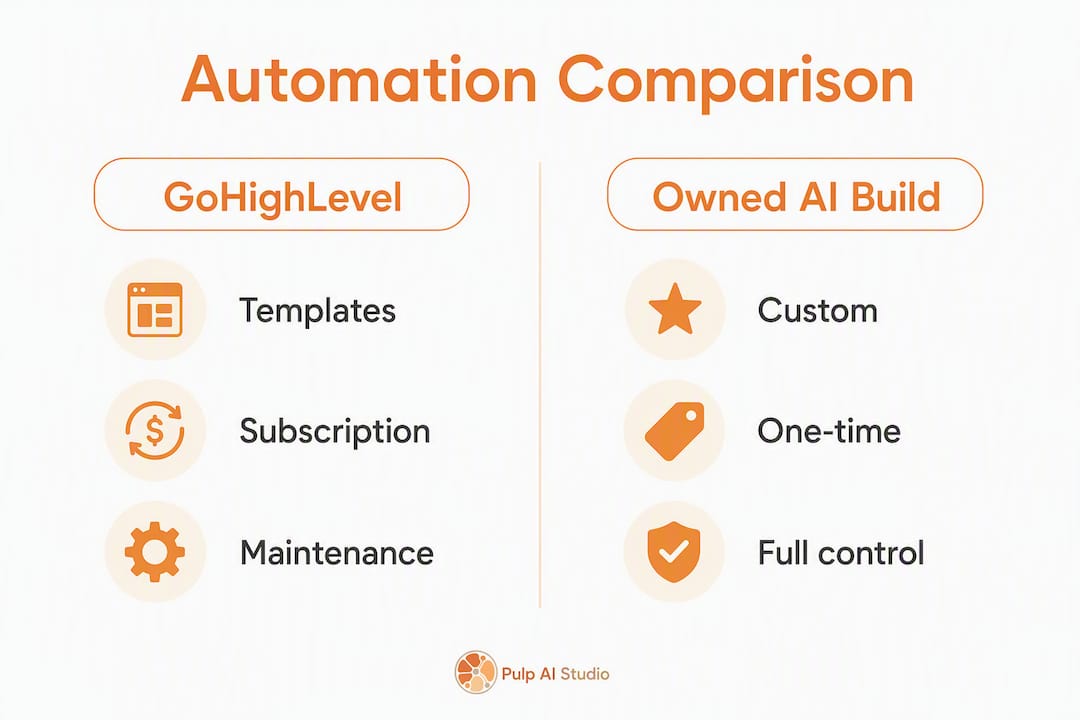
| Dimension | GoHighLevel (Agency Pro) | Bespoke Owned Build |
|---|---|---|
| Ownership | GHL owns the platform; you own contacts | You own code, data, and logic |
| Base cost | Recurring monthly platform subscription (Agency Pro tier) | Scoped project, quoted before work starts |
| Usage costs | Per-SMS, per-call, per-AI interaction | Depends on chosen SMS/phone provider |
| Ongoing maintenance | Your time or agency retainer | Optional managed plan |
| Data portability | Contacts export; workflows do not | Full export, you control everything |
| Customization ceiling | Platform feature set | No ceiling |
Key cost considerations:
- The subscription fee is a fixed monthly cost before usage fees, which can add unpredictable monthly variance.
- Usage-based billing for SMS and AI interactions adds unpredictable monthly variance.
- SaaS-mode rebilling shifts those costs to clients or requires a managed charging strategy for predictable margins.
- A bespoke build has a defined project cost and an optional managed plan with a fixed monthly fee, no per-message surprises.
How do you migrate from GoHighLevel to an owned system?
A safe migration follows the audit-first pattern recommended by experienced implementers: map everything before you move anything.
- Audit all active workflows, triggers, and integrations. Document every step.
- Export contacts, conversation history, and any assets GHL allows you to download.
- Map each workflow event to its equivalent connector on the owned platform.
- Build equivalent connectors and replicate workflows iteratively, starting with the highest-volume ones.
- Test on shadow traffic: Run both systems in parallel before cutting over.
- Staged cutover: Move one workflow at a time, not everything at once.
- Monitor for 7–14 days post-cutover before decommissioning GHL.
Testing checklist before cutover:
- Unit tests on each trigger-action pair.
- End-to-end flow tests with real phone numbers and email addresses.
- Message deliverability confirmation (SMS delivery receipts, email open tracking).
- Error handling: what happens when a webhook times out?
- Monitoring hooks confirmed active.
Rollback plan:
- Keep GHL active and paid through the monitoring window.
- Maintain DNS and phone number revert steps documented.
- Store snapshot backups of all GHL workflow configurations.
Questions to ask a builder before you sign anything
Not every “custom AI build” offer delivers what it promises. These questions protect you.
Ownership and IP:
- Who signs the IP assignment, and when does ownership transfer?
- Where is the code hosted, and do you have direct repository access from day one?
- Can you export all data and conversation logs at any time?
Operational and SLA questions:
- What is the response time for an outage at 2 AM on a Saturday?
- How is the system monitored, and who gets the alert when something breaks?
- What happens to the system if the builder stops operating?
Contract clauses to request:
- A defined delivery timeline (two weeks for scoped small builds is a reasonable standard).
- Written acceptance criteria before final payment.
- Repository or escrow access so you are never locked out.
- A clearly scoped managed plan with a fixed monthly fee.
Pro Tip: Ask specifically: “If I cancel the managed plan tomorrow, does my system keep running?” If the answer is no, you do not own the system. You are renting it.
Red flags and when staying with GoHighLevel is the right call
Red flags in a custom-build offer:
- Vague or absent IP assignment language in the contract.
- No written testing plan or acceptance criteria.
- Delivery window longer than four weeks for a simple missed-call or after-hours build.
- No documented rollback plan.
- Ongoing fees that are not itemized or capped.
When SaaS is still the right answer:
- You need a marketing funnel live within days and have no budget for a custom build.
- Your primary use case is email campaigns, reputation management, or lead nurture — all GHL strengths.
- You do not yet know which automations will actually drive revenue; validate on SaaS first.
Once you have proof of concept on a SaaS platform, you have the data to scope a bespoke build with confidence. Many owners run GHL for marketing and commission an owned system for the operational layer once they know exactly what they need.
Key Takeaways
Owned AI automation systems give small businesses permanent control over their workflows, data, and costs, while GoHighLevel automations offer faster marketing setup at the price of ongoing subscription and operator overhead.
| Point | Details |
|---|---|
| GHL strengths | Best for marketing funnels, lead nurture, and CRM when speed-to-launch matters most. |
| Ownership gap | GHL workflows stay on GHL’s servers; a bespoke build transfers code and data to you outright. |
| Cost structure | GHL bills a recurring platform subscription plus usage fees for as long as you stay; a scoped build is a defined project you keep. |
| Migration path | Audit, export, shadow-test, then staged cutover minimizes downtime and preserves message continuity. |
| Pulp AI Studio | Builds scoped, owned AI systems, including missed-call text-back and after-hours answering, live in two weeks with full client ownership. |
The ownership question is the only one that matters long-term
Most of the debate around GoHighLevel versus custom builds focuses on features. That is the wrong frame. Features change with every platform update. What does not change is who controls the system when something breaks at 9 PM on a Friday, or when the platform raises its prices, or when you decide to switch providers.
GoHighLevel is genuinely good at what it was designed for: helping agencies manage marketing for multiple clients. The missed-call text-back, the appointment reminder, the follow-up sequence — those work. But the design assumption baked into every GHL workflow is that an operator is watching, maintaining, and updating it. For a shop owner or a clinic manager, that assumption is a liability.
The businesses that get the most from automation are not the ones with the most features. They are the ones with the clearest, most reliable systems. A single well-built owned automation that fires every time, costs a known amount per month, and belongs to you outright is worth more than a platform full of capabilities you are paying to maintain.
Pulp AI Studio builds the system you own, not the one you rent
If you have been running GoHighLevel automations and find yourself spending more time managing the platform than running your business, there is a cleaner path. Pulp AI Studio builds scoped AI automation systems for small businesses: missed-call text-back, after-hours AI answering, appointment booking, and inventory-trained chatbots, all delivered as client-owned code within two weeks.
The scope is fixed before work starts. The system is yours: no platform dependency, no agency in the middle. The same person who scopes the build writes the code and hands it over. An optional managed plan covers ongoing monitoring and improvements if you want it, but the system runs without it.
If you are ready to own your automation rather than rent it, see how the build works and schedule a scoping call.
Useful sources
- Townsquare Interactive: What Is GoHighLevel? — operator overhead, small business fit, and feature scope.
- Black Swan Media Co: GoHighLevel SaaS Mode — Agency Pro tier pricing, usage-based billing, and SaaS-mode economics.
- GHL Central: What Is Go HighLevel? — AI features (Conversation AI, Voice AI) and agency-centric design context.
- HighLevel Blog: Workflow Automation Guide — migration best practices and incremental rollout guidance.
- Pulp AI Studio: Two-Week Business Automation Setup — scoped build delivery timeline and proof points.
FAQ
What can GoHighLevel automations actually do for a small business?
GoHighLevel automations handle missed-call text-back, appointment reminders, follow-up drip sequences, and lead routing using triggers, IF/ELSE branching, and webhooks. The platform also includes built-in Conversation AI and Voice AI for automated lead handling.
Do you own your workflows if you cancel GoHighLevel?
No. Your contact data exports, but the workflow logic, conversation history, and AI configurations remain on GoHighLevel’s platform. An owned bespoke build transfers all code and data to you outright.
How long does a bespoke AI automation build take to go live?
A scoped small build, such as a missed-call text-back or after-hours answering system, typically goes live within two weeks, following a scoping, build, testing, and deploy sequence.
When should I stay with GoHighLevel instead of commissioning a custom build?
Stay with GoHighLevel when your primary need is marketing funnels, email campaigns, or reputation management, especially if you need to launch quickly and have no immediate requirement for data ownership or custom AI behavior.
What does Pulp AI Studio deliver that GoHighLevel does not?
Pulp AI Studio delivers owned source code deployed to your infrastructure, conversational AI trained on your specific business data, and a fixed project fee with no per-message costs, all with a two-week delivery commitment and full client ownership from day one.