
 Adam Pichardo
TL;DR:
- Missed calls at dealerships represent potential sales that are often lost during peak and after-hours times.
- Implementing automated, multi-channel follow-up within 48 hours and prioritizing high-intent callers dramatically increases appointment conversions.
- Consistent processes and smart use of automation and human judgment outperform larger budgets in converting missed calls into customers.
A missed call at a dealership is a missed sale. 38% of inbound dealership calls go unanswered because they are abandoned, mishandled, or sent to voicemail. Each one of those calls represents a buyer who was ready to talk. The industry term for the recovery process is “missed call conversion,” and the goal is to turn missed dealer calls into appointments before that caller dials a competitor. This guide covers the tools, the follow-up cadence, and the prioritization logic that high-performing dealerships use to stop losing revenue to voicemail.
What do you need to convert missed calls into appointments?
The right infrastructure makes or breaks your conversion rate. Without it, even the most motivated sales team loses leads to slow response times and poor routing.

Staffing and coverage during peak hours
Peak call volume at most dealerships hits between 10:00 AM and 2:00 PM on weekdays, with a secondary spike on Saturday mornings. Staffing your BDC (Business Development Center) to match that pattern is the first step. After-hours coverage is equally critical. Callers who reach voicemail at 7:00 PM rarely leave a message and almost never call back.
Call tracking and analytics
Call tracking software records which calls were answered, which were missed, and what the caller’s intent was based on the page they visited or the ad they clicked. This data tells you which missed calls are worth prioritizing and which are likely low-intent. Without call tracking, your team is following up blind.
CRM and BDC systems
A CRM logs every missed call as a lead record and assigns it to a rep automatically. BDC systems add workflow automation on top of that, triggering follow-up tasks the moment a call goes unanswered. The combination prevents leads from sitting in a queue for hours while a manager manually reviews a call log.
Multi-channel communication tools
Phone calls alone are not enough. Multi-channel engagement using calls, SMS, and email tailored to the buyer’s stage increases appointment-setting efficiency. You need a platform that handles all three from a single interface so nothing falls through the cracks.
Call routing and IVR setup
IVR self-routing options direct callers to the right department and reduce call abandonment during busy or off-hours periods. An IVR also collects preliminary data, such as whether the caller wants sales, service, or finance, which personalizes the follow-up conversation.
Here is a quick-reference checklist of the core tools you need before launching a missed call recovery program:
- Call tracking platform with missed call alerts and intent data
- CRM or BDC system that auto-creates lead records from missed calls
- SMS and email automation for multi-channel outreach
- IVR menu routing callers to the right department
- Real-time alert system (such as Slack notifications or mobile push alerts) for immediate staff response
- Reporting dashboard to track missed call volume, follow-up speed, and conversion rates
| Tool category | Primary function | Impact on conversion |
|---|---|---|
| Call tracking | Identifies missed calls and caller intent | Prioritizes highest-value leads |
| CRM / BDC | Auto-assigns follow-up tasks | Prevents leads from going cold |
| SMS automation | Sends immediate text after missed call | Keeps caller engaged before they move on |
| IVR routing | Directs callers to right department | Reduces abandonment and misdirected calls |
| Real-time alerts | Notifies staff instantly | Enables rapid callback within minutes |
Pro Tip: Set your IVR to collect the caller’s preferred contact method before routing. A caller who selects “text me back” converts at a higher rate when you lead with SMS rather than a cold callback.
How to run a multi-channel follow-up that books appointments
Speed is the single biggest variable in missed call conversion. A caller who does not hear back within five minutes is already moving on. The follow-up cadence below is what top dealerships use to set appointments from missed calls at scale.
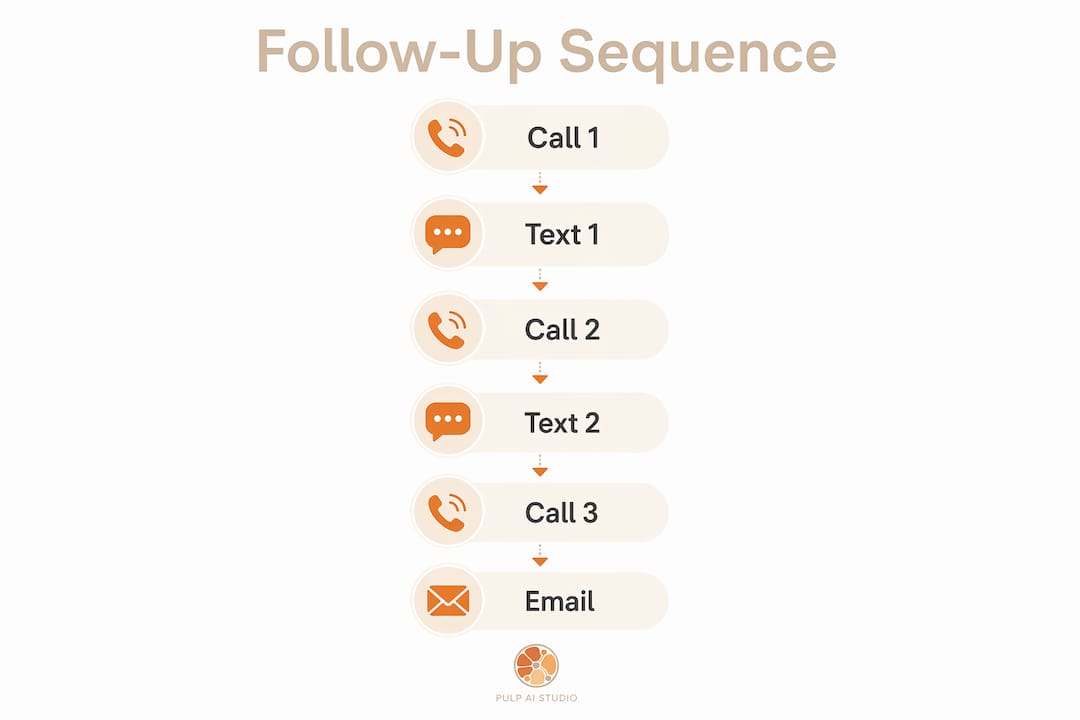
The 48-hour engagement sequence
-
Minute 1–5: Send an automated SMS acknowledging the missed call. Keep it short: “Hi, this is [Name] from [Dealership]. Sorry we missed you. What’s the best time to connect?” This single message re-opens the conversation before the caller reaches a competitor.
-
Hour 1: Make the first callback attempt. If the caller answers, your goal is one thing: book a specific appointment time, not just express interest.
-
Hour 3: Send a follow-up email with a direct scheduling link. Include the vehicle or service the caller was likely researching based on the page they visited.
-
Hour 6: Make the second callback attempt. Leave a brief voicemail if no answer. Reference the specific vehicle or service to show you know why they called.
-
Hour 24: Send a second SMS with a low-pressure message. “Still happy to help. Here’s a link to schedule at your convenience.” Include a one-click booking link.
-
Hour 48: Make the third and final callback in the initial sequence. If the caller has not responded after six touches, move them to the long-term nurture track.
This six-touch sequence in 48 hours matches the cadence that high-intent automotive leads respond to best. Persisting beyond 48 hours with two touches per week for four weeks captures buyers who are still in the research phase.
Escalating hot leads
Some callers show strong buying signals before you even speak to them. A caller who visited the financing page, clicked a “get pre-approved” ad, and selected “sales” in the IVR is not a cold lead. Flag these callers for immediate escalation to a senior sales rep rather than a BDC agent. The difference in close rate between a BDC handoff and a direct sales rep call on a hot lead is significant.
Script and tone guidelines
Your first message sets the tone for the entire relationship. Avoid scripted openers that sound like a call center. Use the caller’s name, reference the specific vehicle or service, and ask one open question. Buyers respond to specificity. “I saw you were looking at the 2025 F-150 inventory” outperforms “I’m calling about your recent inquiry” every time.
| Follow-up touch | Channel | Timing | Goal |
|---|---|---|---|
| Touch 1 | SMS | Minutes 1–5 | Re-engage before caller moves on |
| Touch 2 | Phone call | Hour 1 | Book appointment directly |
| Touch 3 | Hour 3 | Provide scheduling link and vehicle info | |
| Touch 4 | Phone call | Hour 6 | Leave voicemail with specific reference |
| Touch 5 | SMS | Hour 24 | Low-pressure booking link |
| Touch 6 | Phone call | Hour 48 | Final touch in initial sequence |
Pro Tip: Personalize every touch with the caller’s name and the specific vehicle or service they were researching. Generic messages get ignored. Specific messages get replies.
How do you prioritize missed calls for maximum efficiency?
Not every missed call deserves the same urgency. Treating a caller who visited your homepage the same as one who clicked a “schedule test drive” ad wastes your team’s time and dilutes your conversion rate.
Using intent data to score leads
Intent data is the combination of signals a caller leaves before they dial: the ad they clicked, the page they visited, the IVR option they selected. A caller who clicked a retargeting ad for a specific vehicle and selected “sales” in the IVR is a high-intent lead. A caller who came from a generic brand search and selected “general inquiry” is lower priority. Scoring leads on these signals lets your BDC team work the hottest calls first.
Call tracking platforms that connect digital ad data to phone call records give you this visibility. Prioritizing missed calls based on digital intent data such as the page visited, the ad clicked, or the IVR input focuses follow-up effort on the leads most likely to convert. That focus directly improves your appointment-setting rate without adding headcount.
Signals that flag a hot lead
- Caller visited a vehicle detail page (VDP) before calling
- Caller clicked a paid search or retargeting ad
- Caller selected “sales” or “financing” in the IVR
- Caller called during business hours (higher purchase intent than after-hours)
- Caller attempted to call more than once
Balancing frequency to avoid fatigue
Aggressive follow-up works until it does not. A caller who has received three unanswered texts and two voicemails in 24 hours is not more likely to convert on the sixth touch. They are more likely to block your number. The 48-hour sequence above is the upper limit for initial outreach. After that, drop to two touches per week and let the content do the work.
AI-powered conversation intelligence tools can flag when a lead’s engagement signals are dropping and automatically shift the cadence to a lower-frequency track. This is where AI in dealership communication moves from a nice-to-have to a genuine time saver for your BDC team.
Pro Tip: Build a “hot lead” queue in your CRM that automatically surfaces any missed call from a VDP visitor or paid ad click. Your best closers should work that queue first every morning.
What are the most common missed call conversion problems?
Even dealerships with good tools and motivated staff run into the same obstacles. Knowing where the process breaks down lets you fix it before it costs you appointments.
Staffing gaps during peak hours
The most common failure point is simple: nobody picks up because the phones are ringing faster than the team can answer. Excessive call transfers create poor call experiences for 54% of consumers, leading to abandonment. The fix is a combination of better IVR routing and an automated SMS fallback that fires the moment a call goes unanswered. That SMS buys you time to call back without losing the lead entirely.
Inconsistent follow-up amid competing priorities
Sales floors are busy. A rep who is mid-negotiation on a deal will not drop everything to call back a missed lead. Real-time Slack notifications tied to missed call alerts give managers visibility into which leads have not been contacted, so nothing slips through. Assign a dedicated BDC agent to missed call follow-up during peak hours rather than relying on floor staff.
Low appointment show rates
Booking an appointment is only half the job. High-performing dealerships achieve appointment show rates of 70–75%. If your show rate is below 60%, the problem is usually in the confirmation process, not the booking. Send a confirmation text immediately after booking, a reminder 24 hours before, and a final reminder two hours before the appointment. Each reminder should include a one-tap option to reschedule rather than simply cancel.
“The dealerships that consistently hit 30–40% lead-to-appointment conversion rates are not doing anything magical. They track every missed call, they respond within minutes, and they confirm every appointment three times. The process is the product.”
Using reports to improve continuously
Track three numbers every week: missed call volume, follow-up response time (the gap between the missed call and the first outbound contact), and lead-to-appointment conversion rate. If missed call volume rises without a corresponding rise in follow-up contacts, you have a staffing or routing problem. If follow-up contacts rise but conversion stays flat, you have a script or timing problem. The data tells you exactly where to focus.
Key takeaways
Missed call conversion is the highest-ROI process improvement available to most dealerships because the leads are already warm and the fix is largely a matter of speed and consistency.
| Point | Details |
|---|---|
| Speed determines conversion | Responding within five minutes of a missed call dramatically increases the chance of booking an appointment. |
| Six touches in 48 hours | Use 3 calls, 2 texts, and 1 email in the first 48 hours, then 2 touches per week for four weeks. |
| Intent data drives prioritization | Score missed calls by ad source, page visited, and IVR selection to focus effort on the highest-value leads. |
| Confirmation reduces no-shows | Send three appointment reminders (immediate, 24 hours before, and 2 hours before) to hit the 70–75% show rate benchmark. |
| Automation fills the gaps | Automated SMS fallback and real-time alerts prevent leads from going cold when staff are unavailable. |
What I’ve learned from watching dealerships handle missed calls
The pattern I see most often is not a technology problem. It is a prioritization problem. Dealerships invest in CRM systems, call tracking platforms, and BDC teams, and then let missed calls pile up because everyone assumes someone else is handling them. The leads go cold in the queue while the team focuses on floor traffic.
The second mistake is treating all missed calls the same. A caller who visited your inventory page twice, clicked a retargeting ad, and called during business hours is not the same as someone who called from a generic directory listing. Treating them identically wastes your best reps’ time on low-intent leads and lets hot buyers slip away.
What actually works is a combination of automation and human judgment. Automation handles the first response, the immediate SMS, the real-time alert to the manager, and the CRM record creation. Human judgment handles the escalation decision: which leads get a senior rep, which get a BDC agent, and which go into a long-term nurture track. The AI-powered dealer engagement tools available now make that triage faster and more accurate than any manual process. Our field note on AI for car dealerships lays out those handoff rules in more detail.
One more thing worth saying directly: the dealerships that consistently convert missed calls into appointments are not the ones with the biggest budgets. They are the ones with the most consistent processes. A $0 process improvement, like assigning one BDC agent to own missed call follow-up every morning, outperforms a $50,000 platform that nobody uses correctly. Build the habit first. Then add the technology to scale it.
For dealerships exploring AI-powered revenue growth strategies, the same principle applies: the tool only works as well as the process behind it.
— Adam
A Plan Run for You, Not Another Tool to Run
Most owners did not lose the lead because a tool was missing. They lost it because nobody had time to run the tool. So we run it for you: a hosted CRM with the AI already wired in, set up and managed for your shop, live in about two weeks, and priced in the same range as the do-it-yourself AI receptionist plans, at one flat monthly price. The pieces most shops start with:
- Voice AI receptionist. Answers, qualifies, and books onto your calendar day or night, connected to the CRM or field software you already use, and hands the call to a person when it needs one. See the after-hours answering service.
- Speed to lead. A new form fill, ad lead, or missed call gets a text back right away, while the customer is still shopping. More on why the first few minutes decide the job.
- Database reactivation. The old leads and past customers already sitting in your system get a conversational text campaign that books the ones who are ready now. Related: why leads go quiet and how to restart them.
- AI social replies. Facebook and Instagram comments and DMs get answered and routed instead of sitting unread until Monday. The AI chatbot guide covers how those replies work.
Your contacts, your conversation history, and your phone number stay yours to export or port out if you leave. For shops that want the whole system on hardware they own, prompts, logs, and models included, the custom build below is the step up (about 30 days, since there is hardware to set up). Most shops start managed and grow into a rig, not the other way around.
How Pulp AI Studio helps dealerships recover missed calls automatically
On the managed setup, we run an AI system that responds to missed calls within 30 seconds via SMS, handle the conversation, and send the dealer an instant mobile alert. There is no voicemail black hole. The caller gets a real reply before they dial the next number on their list. The system works around the clock, which means after-hours calls get the same fast response as midday calls. The managed setup is live in about two weeks, connected to the DMS or CRM you already use. Dealerships that want the system on hardware they own can step up to a custom build, live in about 30 days and owned outright by the dealership. If you want to see how the missed call text-back system works in practice, the full details are on the Pulp AI Studio service page.
FAQ
How quickly should a dealership respond to a missed call?
The target response time is under five minutes. Leads contacted within five minutes of a missed call convert at significantly higher rates than those reached after 30 minutes or more.
What is the best follow-up sequence for missed dealer calls?
The most effective cadence is six touches in the first 48 hours: 3 calls, 2 texts, and 1 email. After that, drop to two touches per week for four weeks to capture buyers still in the research phase.
How do you prioritize which missed calls to follow up on first?
Score missed calls using intent data: the ad source, the page the caller visited, and the IVR option they selected. Callers from vehicle detail pages or paid ads with a “sales” IVR selection are the highest priority.
What appointment show rate should a dealership aim for?
High-performing dealerships hit appointment show rates of 70–75%. Sending three confirmation reminders (immediately after booking, 24 hours before, and 2 hours before) is the most direct way to reach that benchmark.
Can automation handle missed call follow-up after hours?
Yes. An automated SMS system can reply to a missed call within 30 seconds at any hour, keeping the lead warm until a staff member is available to follow up. Pulp AI Studio’s after-hours AI system handles the full conversation, not just the initial reply.