
 Adam Pichardo
TL;DR:
- A virtual answering service manages business calls remotely using live agents or AI, reducing missed leads. It offers call routing, message taking, and appointment scheduling while integrating with business tools for optimal lead capture. Combining AI and live agents provides cost-effective, reliable coverage tailored to business needs and growth stages.
A virtual answering service is a remote call management system, staffed by live agents or AI, that handles incoming business calls professionally so no lead slips through. 78% of customers form their first impression of a business from that initial phone call. That single statistic explains why small business owners who rely on voicemail or missed calls are quietly losing customers every week. A professional phone answering solution gives you the coverage of a full front desk without the overhead of a full-time hire. This guide covers how these services work, what types exist, and how to choose the right fit for your business in 2026.
What is a virtual answering service and how does it work?
A virtual answering service routes incoming calls to a remote team of live agents or an AI system that responds on your business’s behalf. The caller never knows the difference between your “office” and a cloud-based answering platform. The experience feels local, professional, and consistent.

The core technology behind most services is VoIP (Voice over Internet Protocol), which transmits calls over the internet rather than traditional phone lines. VoIP and cloud-based routing allow agents or AI systems to receive, screen, and transfer calls from anywhere. That infrastructure is what makes true 24/7 answering service coverage possible without a physical office.
Call routing, message taking, and scheduling
When a call comes in, the system follows a pre-set routing logic. The call gets screened based on caller ID, time of day, or caller input. From there, it routes to the right agent, department, or automated response. If no live agent is available, the system takes a message and delivers it to you by text or email within seconds.
Appointment scheduling is another core function. Many services integrate directly with Google Calendar, Outlook, or practice management software. A caller can book a time slot without ever speaking to you directly. That kind of automation is what turns a call answering service into a genuine business tool rather than just a message-taking system.
Scripted prompts and brand consistency
Every call is handled using a script your business approves. The agent or AI greets callers with your business name, follows your preferred tone, and answers FAQs based on your approved responses. This keeps your brand voice consistent whether the call comes in at 9:00 AM on a Tuesday or 11:30 PM on a Saturday.
Pro Tip: Write your call script the same way you would train a new front-desk employee. Include your most common questions, your preferred greeting, and any phrases you never want used. The more specific your script, the better the caller experience.
What types of virtual answering services are available?
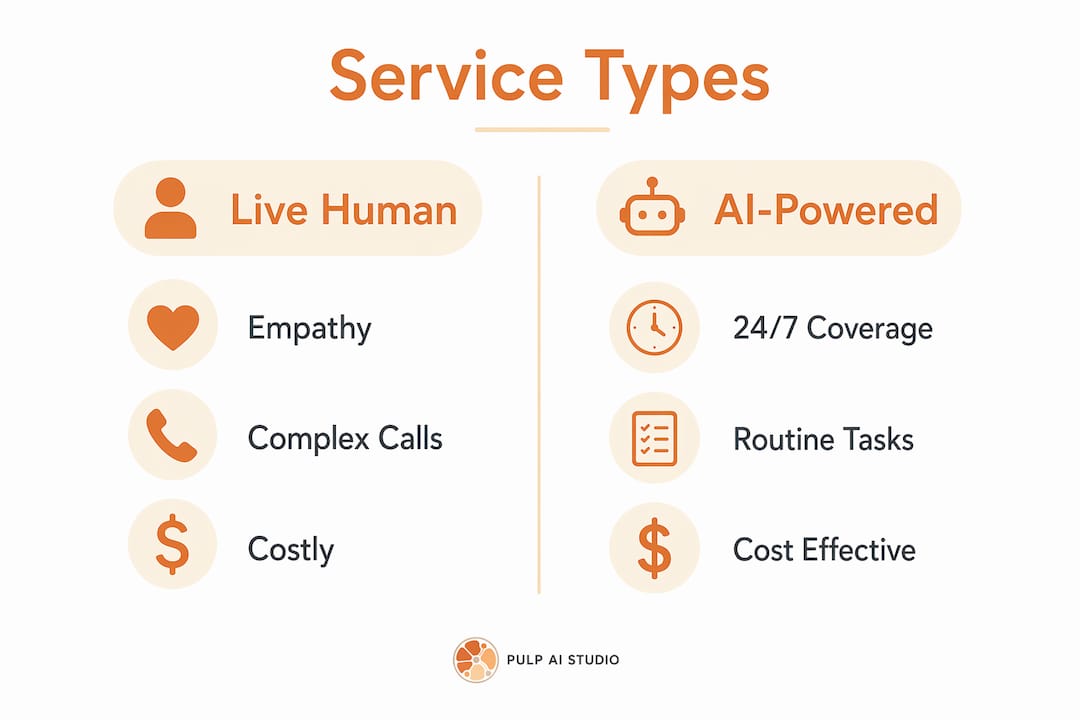
Three primary service types exist for small businesses: live human receptionist services, AI-powered answering systems, and hybrid models that combine both. Each has a distinct cost profile, capability set, and ideal use case.
Live human receptionist services
Live services employ trained agents who answer calls in real time. They handle complex inquiries, express empathy, and adapt to unexpected caller needs. Live virtual receptionists cost between $200 and $3,000 per month depending on call volume and service level. That range reflects the real cost of human labor, training, and management. For businesses that handle sensitive calls, such as medical clinics or legal offices, live agents are often the right choice.
AI-powered answering systems
AI systems handle calls automatically using natural language processing. They answer FAQs, collect caller information, route calls, and book appointments without any human involvement. AI virtual receptionists deliver 24/7 availability and instant routing, and they reduce missed leads at a mid-tier cost based on interaction volume. The cost advantage is significant. AI systems do not take sick days, require no training time, and scale instantly during high-volume periods.
Hybrid models
Hybrid models route routine calls to AI and escalate complex calls to live agents. Hybrid solutions capitalize on technological scalability and human empathy by handling more calls efficiently than either approach alone. A contractor business, for example, might use AI to handle quote requests and appointment bookings while routing complaints or urgent jobs to a live agent.
Core and advanced features to compare
Most remote answering services offer a standard feature set. Advanced tiers add integrations and multi-channel support.
| Feature category | Entry-level services | Advanced services |
|---|---|---|
| Availability | Business hours only | 24/7 coverage |
| Call screening | Basic | Custom logic by caller type |
| Message delivery | Email, SMS, CRM push | |
| Appointment setting | Manual callback | Direct calendar integration |
| CRM integration | None | Full sync with major CRMs |
| Multi-channel support | Phone only | Phone, chat, and text |
The right tier depends on your call volume and how tightly you want the service connected to your existing tools.
What are the pros and cons of live versus AI answering?
The live versus AI debate is not about which is better in general. It is about which fits your specific business model, budget, and caller expectations.
Advantages of live human agents
- Live agents handle nuanced, emotional, or complex calls that AI cannot manage reliably.
- They build rapport with repeat callers, which matters in service businesses where relationships drive referrals.
- Live agents can improvise when a caller goes off-script, something AI systems still struggle with.
- For businesses in healthcare, law, or financial services, human judgment on sensitive calls is a compliance and trust requirement.
Advantages of AI answering systems
- AI systems provide true after-hours answering service coverage with no per-call labor cost.
- They respond instantly, which is critical because speed to lead directly affects conversion rates in home services and contracting.
- AI scales without additional cost during busy seasons or promotional periods.
- AI systems never have a bad day, which means caller experience stays consistent.
Challenges worth knowing
Live services carry real cost and scheduling constraints. If your call volume spikes unexpectedly, a live service may put callers on hold or miss calls entirely. AI systems, on the other hand, can mishandle emotionally charged calls or fail on highly specific questions outside their training data. Neither approach is perfect in isolation.
Pro Tip: If you run a service business with seasonal demand, start with an AI system for routine calls and add a live escalation option for complex situations. You get cost efficiency during slow periods and coverage quality during peaks.
The hybrid model solves most of these trade-offs. Hybrid answering approaches give businesses the empathy of live agents for complex calls and the speed of AI for routine ones. For most small businesses, this is the most practical long-term setup.
How can small businesses implement a virtual answering service effectively?
Implementation works best when you treat it as a process, not a one-time setup. Follow these steps to get real results from your business phone support investment.
-
Assess your call volume and patterns. Pull three months of call data before choosing a service. Identify your peak hours, most common questions, and the percentage of calls that come in after hours. This data tells you whether you need AI, live agents, or a hybrid setup.
-
Write and approve your call script. Customizing scripts and workflows leads to higher caller satisfaction and conversion rates. Your script should cover your greeting, your top ten FAQs, your appointment booking process, and your escalation triggers. Review it with your team before going live.
-
Connect your calendar and CRM. Virtual answering services integrate with calendars and CRM software to automate scheduling and client data capture. This integration is what separates a basic answering service from a lead capture system. Every caller interaction should feed into your pipeline automatically.
-
Set quality benchmarks before launch. For live services, define what a good call looks like and review recordings weekly. For AI systems, monitor misrouted calls and unanswered questions in the first 30 days. Tune the system based on real call data, not assumptions.
-
Measure ROI at 60 and 90 days. Implementing a call answering service produces measurable ROI through reduced missed calls and increased lead capture. Track your cost per lead before and after implementation. Track customer satisfaction scores if you have a post-call survey in place. These two metrics tell you whether the service is paying for itself.
-
Reduce staff burnout as a secondary metric. After-hours call coverage reduces employee stress and prevents burnout by keeping work calls out of personal time. This is a real operational benefit that shows up in staff retention and morale, even if it does not appear on a revenue report.
One detail most guides skip: the transition period matters. Your first two weeks of live operation will surface gaps in your script and routing logic. Expect to make adjustments. Build that review time into your launch plan so you are not caught off guard.
Companies that switch from in-house staff to virtual answering solutions save over 60% in overhead costs. Those savings come from eliminating training expenses, salary, and office space. For a small business running lean, that difference can fund other growth priorities.
My take on where virtual answering is heading
The conversation about virtual answering services has shifted in the past two years. Business owners used to ask whether they needed one. Now the question is which type fits their stage of growth. That shift reflects how normalized AI-powered call handling has become, and how quickly the technology has improved.
What I have observed across businesses that adopt these services is a consistent pattern. The ones that see the biggest gains are not the ones with the highest call volume. They are the ones that treat the service as a lead capture system rather than a message-taking tool. When you connect your answering service to your CRM and calendar from day one, every missed call becomes a recoverable opportunity. When you leave it disconnected, you are just paying for a more polished voicemail.
The human touch question is real, but it is often overstated. Most callers do not need empathy. They need speed and accuracy. They want to know if you are available, what you charge, and how to book. AI handles all three of those reliably. Where live agents still win is in the 15% of calls that involve a complaint, a complex situation, or a caller who is genuinely distressed. Knowing which category your calls fall into is the most important decision you will make before choosing a service.
The businesses I find most interesting right now are the ones using conversational AI platforms to handle not just inbound calls but the full follow-up sequence. A caller books an appointment, gets a confirmation text, receives a reminder 24 hours out, and gets a follow-up after the job. That is not a virtual receptionist. That is a full customer communication system built on the same foundation. Small businesses that build this way are not just answering calls. They are building a repeatable customer experience that compounds over time.
— Adam
A Plan Run for You, Not Another Tool to Run
Most owners did not lose the lead because a tool was missing. They lost it because nobody had time to run the tool. So we run it for you: a hosted CRM with the AI already wired in, set up and managed for your shop, live in about two weeks, and priced in the same range as the do-it-yourself AI receptionist plans, at one flat monthly price. The pieces most shops start with:
- Voice AI receptionist. Answers, qualifies, and books onto your calendar day or night, connected to the CRM or field software you already use, and hands the call to a person when it needs one. See the after-hours answering service.
- Speed to lead. A new form fill, ad lead, or missed call gets a text back right away, while the customer is still shopping. More on why the first few minutes decide the job.
- Database reactivation. The old leads and past customers already sitting in your system get a conversational text campaign that books the ones who are ready now. Related: why leads go quiet and how to restart them.
- AI social replies. Facebook and Instagram comments and DMs get answered and routed instead of sitting unread until Monday. The AI chatbot guide covers how those replies work.
Your contacts, your conversation history, and your phone number stay yours to export or port out if you leave. For shops that want the whole system on hardware they own, prompts, logs, and models included, the custom build below is the step up (about 30 days, since there is hardware to set up). Most shops start managed and grow into a rig, not the other way around.
How Pulp AI Studio approaches missed-call recovery for small businesses
Pulp AI Studio builds AI-powered communication systems specifically for small businesses, contractors, clinics, and retailers who cannot afford to lose a lead to a missed call. Their missed-call text-back system responds to every unanswered call automatically, keeping the conversation alive before the caller contacts a competitor. If you want a two-week sprint that gets you live on the managed setup and capturing missed-call leads right away, or a custom AI build on hardware you own (about 30 days), Pulp AI Studio has a clear path for both.
FAQ
What is a virtual answering service?
A virtual answering service is a remote system, staffed by live agents or AI, that manages incoming business calls professionally. It handles call routing, message taking, appointment scheduling, and FAQ responses on behalf of your business.
How much does a virtual receptionist service cost?
Live virtual receptionist services typically cost between $200 and $3,000 per month depending on call volume and service level. AI-powered systems generally cost less and scale based on the number of interactions handled.
Can a virtual answering service work after hours?
Yes. AI-powered systems provide true 24/7 answering service coverage with no additional cost for after-hours calls. Live services may offer after-hours coverage at a premium tier, depending on the provider.
How do I know if I need a live agent or an AI system?
If most of your calls involve routine questions, bookings, or lead capture, an AI system handles those reliably and at lower cost. If your calls frequently involve complex situations, complaints, or sensitive topics, live agents or a hybrid model are the better fit.
What integrations should I look for in a call answering service?
The most valuable integrations are with your calendar system and CRM. These connections allow the service to book appointments directly and push caller data into your pipeline automatically, turning every answered call into a tracked lead.
Key takeaways
A virtual answering service pays for itself when it is connected to your calendar and CRM from day one, turning every call into a tracked lead rather than a missed opportunity.
| Point | Details |
|---|---|
| First impressions drive revenue | 78% of customers judge a business by their first call, making professional answering non-negotiable. |
| Overhead savings are significant | Switching from in-house staff to a virtual service saves over 60% in training, salary, and space costs. |
| AI handles volume, humans handle complexity | Use AI for routine calls and live agents for complaints or sensitive situations to balance cost and quality. |
| Integration multiplies ROI | Connecting your answering service to your CRM and calendar converts calls into pipeline entries automatically. |
| Measure results at 60 and 90 days | Track cost per lead and customer satisfaction scores to confirm the service is generating measurable returns. |