
 Adam Pichardo
TL;DR:
- After-hours texting in healthcare uses secure messaging platforms to facilitate patient communication outside office hours, improving engagement and reducing no-shows. It relies on structured triage workflows, HIPAA-compliant protocols, and automated acknowledgments to maintain efficiency and patient satisfaction. Successful implementation depends on clear message classification, staff training, continuous analytics, and strict data security measures.
After-hours texting in healthcare is defined as the use of secure, compliant messaging platforms to facilitate patient-provider communication outside normal office hours, routing inquiries to appropriate clinical responses without compromising privacy. The role of after hours texting healthcare operations play is no longer optional. 93% of patients opt in to healthcare texting programs, and 84% report being more likely to attend appointments after receiving SMS reminders. Platforms like Sinch Engage and clinIQ have demonstrated that structured after-hours messaging reduces no-shows by 20% and saves patients up to three hours they would otherwise spend on hold. For clinic administrators, this is the difference between a patient who stays engaged and one who calls a competitor at 9 PM.
How does after-hours texting improve patient engagement and care continuity?
After-hours patient communication works because it meets patients where they already are: on their phones, after dinner, when they finally have time to think about their health. The clinical term for this access point is the “digital front door,” and texting is its most effective mechanism. Rather than waiting until Monday morning to confirm an appointment or ask about a prescription, patients send a text and get a response that routes them to the right next step.
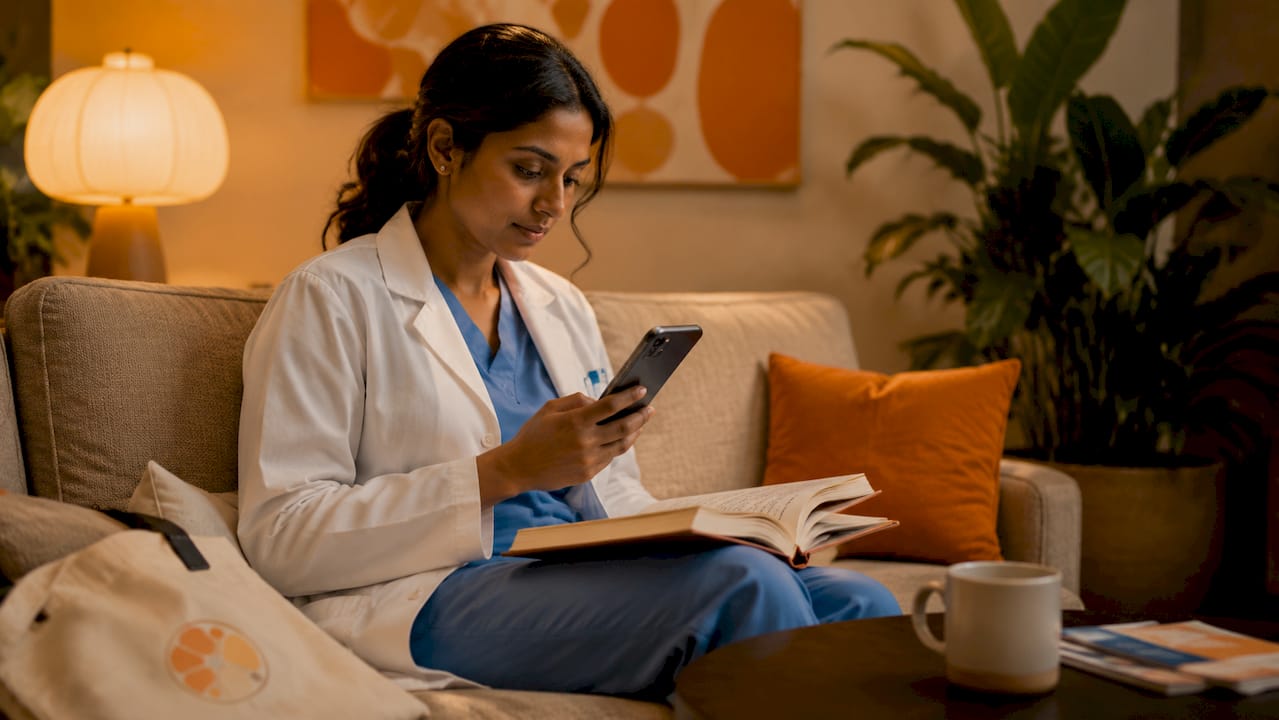
The numbers behind this are hard to ignore. Patients are 88% more likely to refill prescriptions after receiving SMS reminders. That single statistic represents real medication adherence gains across chronic disease populations. When a patient with hypertension gets a text nudge at 7 PM reminding them their refill is due, they act on it. A phone call they missed at 2 PM does not produce the same result.
Here is what effective after-hours messaging actually handles in practice:
- Appointment confirmations and rescheduling. A patient texts “cancel” and the system immediately offers three alternative slots, no staff involvement required.
- Prescription refill reminders. Automated messages trigger based on refill windows stored in the EHR, with a portal link for the actual request.
- Lab result notifications. SMS alerts patients that results are ready in the portal, keeping PHI off the text body entirely.
- Post-visit follow-up. Automated check-ins 24 to 48 hours after a procedure confirm the patient is recovering as expected and flag concerns for next-day clinical review.
- Chronic disease check-ins. Scheduled texts for diabetic or cardiac patients collect symptom data that feeds into care plans.
One health system’s SMS implementation confirmed 15,000 appointments and rescheduled 4,700 more on day one, with a 95% delivery rate and 36% response rate. That response rate is not a vanity metric. It represents thousands of patients who engaged with their care outside of office hours without a single staff member picking up a phone. The digital front door concept frames texting as the primary entry point for non-urgent patient interaction, reducing phone call volume and freeing clinical staff for higher-acuity work.
Pro Tip: Use short codes to categorize message types. Patients can opt out of marketing texts while staying enrolled in appointment reminders, which preserves the most clinically valuable communication channel.
What are the operational workflows and triage processes involved?
After-hours texting is not a free-for-all inbox. It is a triage workflow, and treating it as anything less creates both clinical risk and staff burnout. The goal is to classify every inbound message by type and attach a defined action to it before anyone reads it.
Here is how a structured after-hours triage workflow operates in practice:
- Patient sends a text after hours. The system logs the message and triggers an auto-acknowledgment immediately. The acknowledgment sets expectations: “We received your message. Our team reviews after-hours texts the following business day. If this is a medical emergency, call 911.”
- Non-clinical agents authenticate the patient. In contact center models, the first human touchpoint is a non-clinical agent who verifies identity, documents the concern, and categorizes the message. This keeps licensed nurses focused on clinical decisions, not administrative intake.
- Message classification routes the inquiry. Routine requests (refills, appointment changes, billing questions) go to a next-day review queue. Symptom-based messages trigger escalation to a licensed nurse on call.
- Nurse triage applies protocol. The nurse reviews the documented concern, contacts the patient if needed, and either advises on home management or escalates to an on-call physician. Calls are answered in 20 to 60 seconds in well-run contact center models, with EHR integration capturing every interaction.
- Documentation syncs to the EHR. No information lives only in a text thread. Every patient interaction is recorded, timestamped, and attached to the patient record before the next business day begins.
The American Medical Association permits text communication to clinical staff when secure platforms are used with authentication policies, prompt documentation, and regular security assessments. That guidance matters because it defines the boundary between acceptable and risky texting practice.
Pro Tip: Build a message classification matrix before you go live. List every message type your clinic receives after hours, assign a category (routine, urgent, emergency), and define the exact action for each. This prevents dropped follow-ups and removes ambiguity for staff handling the queue.
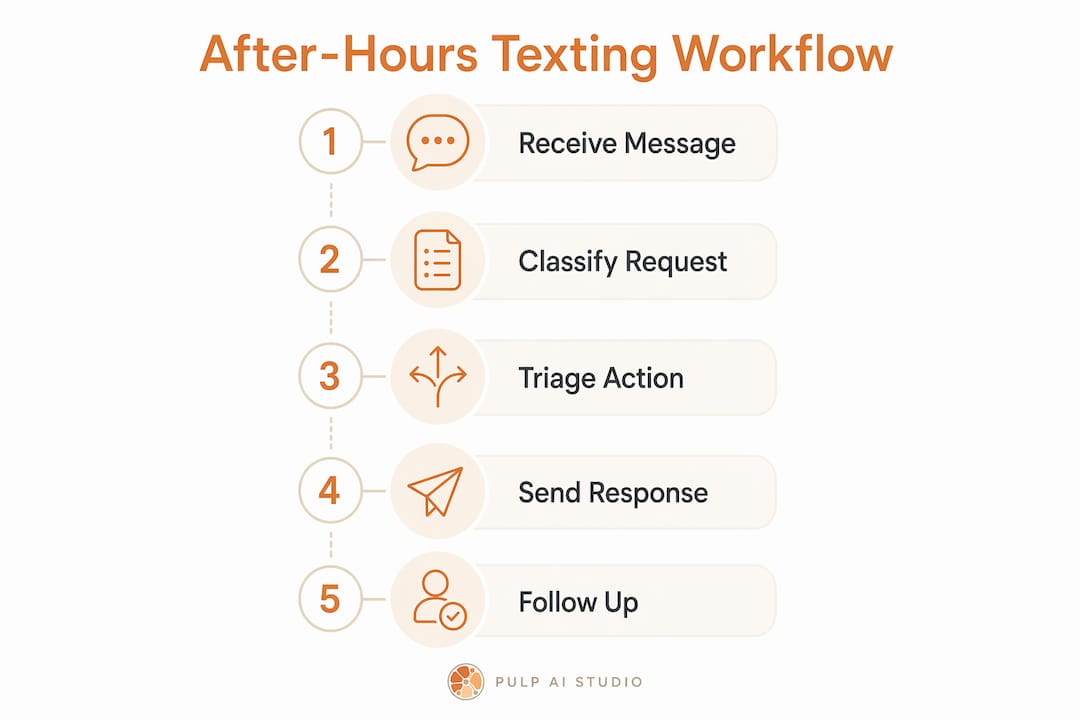
Triage workflows that categorize message types and link them to defined actions prevent the two most common after-hours failures: clinician overload from non-urgent interruptions and missed escalations for genuinely urgent concerns. The workflow is the product. The technology just runs it.
How to ensure HIPAA compliance and data security in after-hours texting
Standard SMS is not HIPAA compliant for transmitting protected health information. This is not a gray area. A text message traveling through a carrier network lacks the encryption, access controls, and audit trails that HIPAA requires for PHI. The distinction that matters for clinic administrators is this: SMS is a notification channel, not a clinical data channel.
| Communication type | Acceptable via SMS | Requires secure platform |
|---|---|---|
| Appointment reminders | Yes, with patient consent | No |
| Lab result notifications (no values) | Yes, with portal link | No |
| Lab result values or diagnoses | No | Yes |
| Prescription refill reminders | Yes, with patient consent | No |
| Clinical instructions or treatment details | No | Yes |
| Billing balance alerts | Yes, with portal link | No |
Appointment reminders via SMS with patient consent are acceptable under HIPAA. PHI transmission via SMS is not. The practical model is SMS as the nudge and the secure patient portal as the destination. A text says “Your results are ready.” The portal delivers the actual result. This keeps the sensitive content inside an encrypted, access-controlled environment while still using the communication channel patients actually respond to.
TCPA compliance adds another layer. Patients must provide explicit written consent before receiving automated texts, and that consent must be documented. Opt-out requests must be honored immediately and synchronized across every messaging platform the clinic uses. Synchronized opt-out records across platforms prevent the compliance violation that happens when a patient opts out of one system but continues receiving texts from another.
Pro Tip: Never put a patient name, date of birth, diagnosis, or medication name in an SMS body. If your platform auto-populates these fields in outbound texts, turn that feature off. The text should read “You have a message from your care team” with a secure link, not “John, your metformin refill is due.”
Platforms like clinIQ and California Telecom’s healthcare network services are built with HIPAA-compliant architecture, including end-to-end encryption, role-based access controls, and audit logging. Choosing a platform that handles these requirements at the infrastructure level removes the compliance burden from individual staff members and reduces the risk of human error.
What are the practical implementation strategies for clinics and administrators?
Implementation is where most clinics stumble. The technology is available. The compliance framework is clear. The failure point is almost always workflow design and staff training. Here is what actually works when you are setting up after-hours texting for the first time or rebuilding a system that is not performing.
Start with auto-acknowledgments. Every after-hours text must receive an immediate automated response. Setting accurate response-time expectations through auto-replies is the single most effective way to prevent patient frustration. The message should specify when the text will be reviewed and what to do in an emergency. Patients who receive no acknowledgment assume their message was lost and call the after-hours line anyway, defeating the purpose.
Choose platforms that support automation and escalation natively. Your messaging platform needs to handle auto-replies, message routing, EHR integration, and escalation triggers without requiring manual intervention at each step. Platforms that require a staff member to manually read and route every message are not after-hours solutions. They are just a different inbox.
Key criteria for platform selection:
- Two-way SMS with automated response capability
- Secure messaging module for PHI-containing conversations
- EHR integration (Epic, Cerner, Athenahealth, or your specific system)
- Opt-in and opt-out management with audit logging
- Analytics dashboard showing response rates, message volume, and escalation frequency
- Role-based access so non-clinical staff cannot view clinical message content
Train staff on the classification matrix, not just the platform. Staff need to know what a routine message looks like versus an urgent one. A patient saying “I have a question about my medication” is routine. A patient saying “I took double my dose by accident” is an escalation. The platform does not make that judgment. The trained staff member does.
Manage opt-in proactively. Collect consent at every patient touchpoint: registration, check-in, the patient portal, and post-visit surveys. SMS outreach timing and frequency directly influence both effectiveness and message fatigue. Patients who receive too many texts opt out. Patients who receive well-timed, relevant texts stay enrolled. A good rule of practice: no more than two to three automated texts per week per patient, and every text should have a clear purpose.
Use analytics to optimize continuously. Track response rates by message type, time of day, and patient demographic. If your appointment reminder texts sent at 8 AM get a 40% response rate but the same texts sent at 6 PM get 60%, shift the send time. The data tells you what is working. Most clinics set up their texting program and never look at the numbers again. That is a missed opportunity to improve both patient engagement and operational efficiency.
Key takeaways
After-hours texting in healthcare works when it functions as a structured triage and routing system, not a passive inbox, with HIPAA-compliant platforms handling PHI separation and auto-acknowledgments setting patient expectations from the first message.
| Point | Details |
|---|---|
| Texting drives measurable engagement | 93% patient opt-in rates and 20% fewer no-shows confirm SMS outperforms phone outreach for routine communication. |
| Triage workflow is the foundation | Classify every message type before going live and assign a defined action to prevent dropped follow-ups and clinician overload. |
| SMS is a nudge, not a data channel | Keep PHI inside secure portals and use SMS only for reminders and portal links to maintain HIPAA compliance. |
| Auto-acknowledgments prevent frustration | Immediate automated responses that set realistic review timelines are the most direct way to maintain patient satisfaction after hours. |
| Analytics close the loop | Track response rates and message timing continuously to reduce opt-outs and improve engagement across patient populations. |
Why after-hours texting is harder than it looks, and worth it anyway
I have watched clinics deploy texting programs with genuine enthusiasm and then quietly abandon them six months later because the inbox became unmanageable. The technology was fine. The workflow was not. Nobody had decided what happened when a patient texted at 11 PM saying they were in pain. Was that the on-call nurse’s problem? The next-day team’s problem? Nobody knew, so everyone ignored it.
Here is the uncomfortable truth about after-hours patient communication: the technology is the easy part. You can have a platform live in two weeks. What takes longer is getting your team to agree on what a “routine” message looks like versus an “urgent” one, and then actually following the protocol when a real message comes in at midnight.
What I have found works is treating the classification matrix as a clinical document, not an IT document. It should be reviewed by your medical director, signed off by your compliance officer, and updated quarterly. When staff see that the protocol has clinical authority behind it, they follow it. When it feels like an IT policy, it gets ignored.
The future of this space is genuinely exciting. AI-driven triage tools are getting good enough to pre-classify messages before a human reads them, flagging symptom-based texts for immediate escalation and routing routine requests automatically. Platforms that integrate with AI clinic inquiry handling are already reducing the manual review burden significantly. The combination of structured workflow and AI pre-classification is where after-hours texting becomes a genuine force multiplier for small and mid-sized clinics.
The balance I keep coming back to is this: texting should make the patient feel heard, not processed. An auto-acknowledgment that says “We received your message and will respond by 8 AM” does that. A generic “Thank you for contacting us” does not. The words matter as much as the workflow.
— Adam
A Plan Run for You, Not Another Tool to Run
Most owners did not lose the lead because a tool was missing. They lost it because nobody had time to run the tool. So we run it for you: a hosted CRM with the AI already wired in, set up and managed for your shop, live in about two weeks, and priced in the same range as the do-it-yourself AI receptionist plans, at one flat monthly price. The pieces most shops start with:
- Voice AI receptionist. Answers, qualifies, and books onto your calendar day or night, connected to the CRM or field software you already use, and hands the call to a person when it needs one. See the after-hours answering service.
- Speed to lead. A new form fill, ad lead, or missed call gets a text back right away, while the customer is still shopping. More on why the first few minutes decide the job.
- Database reactivation. The old leads and past customers already sitting in your system get a conversational text campaign that books the ones who are ready now. Related: why leads go quiet and how to restart them.
- AI social replies. Facebook and Instagram comments and DMs get answered and routed instead of sitting unread until Monday. The AI chatbot guide covers how those replies work.
Your contacts, your conversation history, and your phone number stay yours to export or port out if you leave. For shops that want the whole system on hardware they own, prompts, logs, and models included, the custom build below is the step up (about 30 days, since there is hardware to set up). Most shops start managed and grow into a rig, not the other way around.
How Pulp AI Studio handles after-hours patient communication for clinics
We set up exactly the kind of system described in this article, without the six-month implementation timeline. For clinics, the managed setup above comes as a HIPAA-compliant configuration with a signed BAA, encrypted in transit and at rest. Our missed-call text-back and AI auto-reply goes live in about two weeks (the compliance paperwork can stretch that a little), giving clinics an immediate response capability for after-hours patient inquiries. The AI handles initial acknowledgment, sets response-time expectations, and routes messages based on content, so your clinical staff only see what actually needs their attention. For clinic administrators who want to see how automated medical answering services work in practice, the triage rules are scoped to your clinic’s own intake patterns: we sit down with how your front desk already sorts urgent from routine, then wire the rules to match. Practices that want PHI on hardware they control can step up to a custom build instead, live in about 30 days with the hardware, integrations, and compliance setup included. On that tier, you own the rig when it goes live.
FAQ
What is the role of after-hours texting in healthcare?
After-hours texting routes patient inquiries to appropriate next steps outside office hours, including appointment management, prescription reminders, and urgent escalation to on-call clinical staff. It functions as a triage and communication system, not a diagnostic tool.
Is SMS HIPAA compliant for patient communication?
Standard SMS is not HIPAA compliant for transmitting PHI. Appointment reminders with patient consent are acceptable, but clinical details, diagnoses, and medication information must stay inside encrypted, access-controlled patient portals.
How quickly should after-hours texts be acknowledged?
Auto-acknowledgments should fire immediately upon receipt, specifying when the message will be reviewed and directing patients to call 911 for emergencies. Response time expectations set in the auto-reply directly determine patient satisfaction with the after-hours system.
What staff training is required for after-hours texting programs?
Staff need training on message classification protocols, not just platform operation. They must be able to distinguish routine requests from urgent symptom-based messages and follow defined escalation paths for each category.
How do clinics prevent patient opt-out fatigue with SMS programs?
Limit automated texts to two or three per week per patient, time messages based on response rate analytics, and use short codes that allow patients to opt out of non-clinical messages while staying enrolled in appointment reminders.