
 Adam Pichardo
TL;DR:
- An after hours phone answering service provides live call management outside regular business hours, capturing messages and escalating emergencies. It combines trained agents with AI triage to ensure customers reach a live person immediately, reducing missed opportunities and building trust. Proper setup involves clear escalation rules, script preparation, CRM integration, and ongoing review to maximize efficiency and client satisfaction.
An after hours phone answering service is a live call management system that answers your business calls outside regular office hours, captures messages, and escalates urgent issues to the right person immediately. The industry term for this category is “after hours answering service,” and it covers everything from live agent call centers to AI-assisted triage platforms. Small business owners who rely on phone calls for new leads or emergency requests cannot afford to let those calls go to voicemail. A missed call at 9 PM is often a lost customer by 9 AM.
What is an after hours phone answering service and why does it matter?
An after hours phone answering service is defined as a staffed or AI-supported call handling system that operates outside your standard business hours, including nights, weekends, and holidays. The core purpose is simple: your customers reach a real person, not a voicemail box, every time they call. Live agents answering calls in your brand voice improve professionalism and reduce caller frustration. That consistency builds trust with customers who call at inconvenient hours and expect the same quality they get during the day.

The business case is direct. A plumber, a property manager, or a medical clinic all share one problem: emergencies do not follow a 9-to-5 schedule. When a pipe bursts at midnight or a tenant locks themselves out on a Sunday, the business that answers wins the job. The one that sends callers to voicemail loses it, often permanently. An after hours call answering service closes that gap without requiring you to hire a night-shift employee.
We see this pattern again and again in the shops we work with. Businesses that implement prompt after-hours communication see reduced ghosting and higher job closure rates. The reason is straightforward: reaching a potential customer before they call the next business on their list is the single most effective way to win the work.
How do after hours phone answering services work to manage calls effectively?
The operational model for a 24-7 answering service combines trained human agents with AI-assisted tools to handle every call that comes in after hours. Here is how the workflow typically runs:
- Call intake: A caller dials your business number. The call routes to an answering service agent, not your personal cell phone.
- AI triage: AI-assisted screening identifies the nature of the call quickly, sorting routine inquiries from potential emergencies before a human agent picks up.
- Live agent handling: A trained agent answers using your business name and follows your approved scripts for common questions, appointment requests, and message taking.
- Message capture: For non-urgent calls, the agent records the caller’s details and sends you a summary by text, email, or directly into your CRM.
- Escalation dispatch: For urgent calls, the agent follows your predefined escalation rules and contacts your on-call staff immediately.
AI triage screens, transcribes, and routes calls quickly, while human agents handle decisions that require judgment. That division of labor keeps costs down and quality high. Routine questions get fast answers. Genuine emergencies get fast action.
Routine vs. urgent call handling
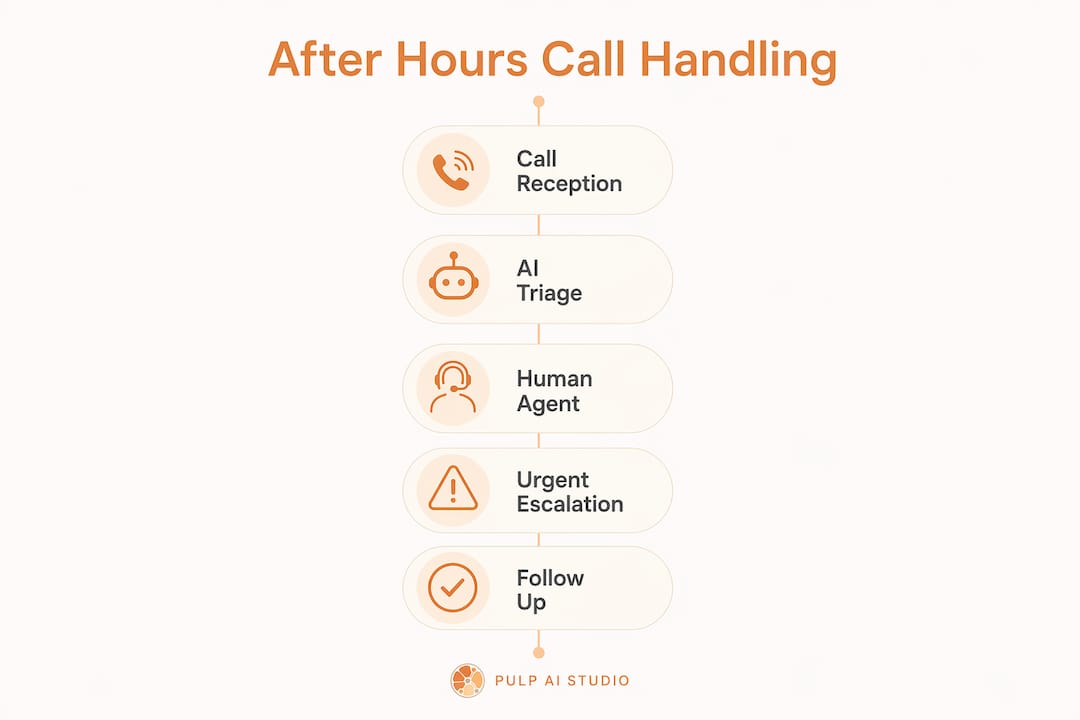
Routine calls include appointment scheduling, general inquiries, and pricing questions. These are handled entirely by the agent or AI, with a message sent to you the next morning. Urgent calls, such as a water leak, a security alarm, or a medical concern, trigger immediate escalation to your on-call contact. The difference between those two tracks depends entirely on the escalation rules you set in advance.
Pro Tip: Record a short audio greeting in your own voice for the answering service to play before the agent picks up. Callers who hear your name feel they have reached the right place, which reduces hang-ups and improves the quality of the conversation that follows.
What features should small businesses look for in an answering service?
Choosing the right 24 hour answering service means evaluating specific capabilities, not just price. The features below separate services that genuinely support your operations from those that simply take a message.
Coverage and availability
Global 24/7 coverage from multiple locations ensures no call goes unanswered even during high-volume periods. Distributed agent teams and AI support handle sudden demand spikes without missed calls. For a small business, this means you are covered during a local emergency, a holiday weekend, or a marketing campaign that drives unexpected call volume.
Escalation protocols
Escalation rules must be strict and clearly defined, including triggers such as specific client status or keywords, to ensure genuine emergencies are dispatched immediately. Vague rules create delayed responses and frustrated customers. You need to specify exactly which words, client types, or situations trigger an immediate call to your on-call staff.
CRM and workflow integration
Integrations with CRM and ITSM platforms enable smooth call handoffs and real-time updating of client records. This eliminates manual data entry and reduces the chance of a follow-up falling through the cracks. When a call comes in at 11 PM and the agent logs it directly into your system, your team sees the full context the next morning without needing to chase down a paper message.
Additional features worth evaluating
- Multi-language support: Useful for businesses serving diverse communities or operating across multiple regions.
- Industry-specific scripting: Medical, legal, and property management businesses have compliance requirements that generic scripts do not cover.
- Call recording and transcription: Provides a record of every conversation for quality review and dispute resolution.
- Scalable pricing: Costs typically depend on volume, complexity, and agent type, billed per minute or per call. This structure lets small businesses pay for what they use rather than funding a full night shift.
For businesses exploring AI-enhanced answering options, the combination of live agents and automated triage delivers the best balance of speed and accuracy.
How can small businesses integrate an answering service with existing operations?
Integration is where most small businesses either succeed or stall. A virtual receptionist service that does not connect to your existing phone system and workflow creates more work, not less. Follow these steps to set up a service that actually fits your operation.
-
Define your escalation criteria first. Write down exactly what constitutes an emergency for your business. A contractor might define it as a structural hazard or active water damage. A clinic might define it as chest pain or a medication error. These definitions become the agent’s instruction sheet.
-
Write your call scripts and FAQs. Agents answer in your brand voice only if you give them the words. Provide answers to your 10 most common after-hours questions. Include your business name, service area, pricing policy, and appointment booking process.
-
Connect your phone system. Most answering services work with call forwarding from your existing business number. You set the forwarding to activate after a set number of rings or at a specific time each evening. No new phone number is required.
-
Integrate with your CRM. If your service supports it, connect it directly to your customer management tool. CRM integration reduces manual follow-ups and keeps client records current without extra staff time.
-
Set a review schedule. Check call logs and message summaries weekly for the first month. Adjust scripts and escalation rules based on what you find. Most businesses discover two or three call types they forgot to account for.
Pro Tip: Start with a narrower escalation list than you think you need. It is easier to add triggers after you see real call data than to deal with a flood of after-hours alerts for non-urgent issues in your first week.
Managing cost versus coverage
Overnight phone support does not have to cost as much as a part-time employee. Per-minute billing models mean a slow night costs almost nothing. The real cost calculation is simpler: compare the monthly service fee against the value of one lost job. For most contractors and service providers, a single recovered lead pays for several months of coverage.
What are common challenges when adopting an after hours answering service?
Adopting a 24/7 answering service introduces real operational challenges. Knowing them in advance prevents the most common failures.
-
Poorly defined escalation rules: This is the most frequent problem. When agents cannot tell the difference between a frustrated caller and a genuine emergency, they either escalate everything or nothing. Both outcomes damage your reputation. Strict escalation protocols prevent delayed responses and customer dissatisfaction.
-
Over-reliance on automation: AI screening handles routine calls well. It does not handle ambiguous situations well. A caller who is upset but not in an emergency can be misclassified and sent to voicemail. Human agents need the authority to override automated routing when their judgment says otherwise.
-
Caller privacy and data security: Every call log, message, and transcript contains customer data. Confirm that your provider stores data securely, limits access to authorized personnel, and complies with any regulations relevant to your industry. Medical and legal businesses face stricter requirements than most.
-
False alarm fatigue: If your escalation rules are too broad, your on-call staff gets woken up for non-urgent issues. That erodes trust in the system quickly. Narrow your triggers and review them monthly.
-
Inconsistent brand voice: Agents who do not know your business sound like strangers to your callers. Invest time in onboarding your answering service with detailed scripts, your business background, and examples of how you typically talk to customers.
-
Skipping the trial period: Most services offer a trial or short-term contract. Use it. Real call volume and real caller behavior will reveal gaps in your setup that no amount of planning can predict.
The businesses that get the most value from a phone answering solution treat the first 30 days as a calibration period, not a finished product. Adjust early and the system runs itself.
Key takeaways
An after hours phone answering service works best when escalation rules are specific, agent scripts are detailed, and CRM integration is active from day one.
| Point | Details |
|---|---|
| Define escalation rules first | Specify exact triggers so agents dispatch emergencies without delay or guesswork. |
| Use AI plus human agents | AI handles routine screening; humans manage judgment calls and ambiguous situations. |
| Integrate with your CRM | Direct CRM connection eliminates manual follow-ups and keeps client records current. |
| Start with narrow escalation triggers | Expand triggers after reviewing real call data to avoid alert fatigue in the first weeks. |
| Treat month one as calibration | Adjust scripts and rules weekly based on actual call logs before locking in your setup. |
What I have learned about after hours answering services from working with small businesses
The conventional wisdom says any answering service is better than voicemail. That is mostly true, but it misses the more important point: a poorly configured answering service can actually damage your reputation faster than voicemail does. A caller who reaches a confused agent who cannot answer basic questions about your business hangs up with a worse impression than if they had simply left a message.
The businesses I have seen get the most out of their after hours call answering service share one habit. They treat the service setup like hiring a new employee. They write detailed onboarding documents. They test the system by calling their own number after hours. They review call recordings in the first month and rewrite scripts based on what they hear. That level of attention in the first 30 days produces a system that runs reliably for years.
The AI component deserves more credit than it typically gets. When AI triage is configured correctly, it filters out the noise so your on-call staff only gets contacted for real emergencies. I have seen contractors go from getting woken up four nights a week to once a month, simply by tightening their escalation keywords. That change alone is worth the cost of the service.
The one thing I would tell every small business owner considering this: do not wait for a slow season to set it up. The calls you miss during your busiest period are the most expensive ones. Set up your 24/7 answering coverage before you need it, not after you have already lost the jobs that would have paid for it.
— Adam
A Plan Run for You, Not Another Tool to Run
Most owners did not lose the lead because a tool was missing. They lost it because nobody had time to run the tool. So we run it for you: a hosted CRM with the AI already wired in, set up and managed for your shop, live in about two weeks, and priced in the same range as the do-it-yourself AI receptionist plans, at one flat monthly price. The pieces most shops start with:
- Voice AI receptionist. Answers, qualifies, and books onto your calendar day or night, connected to the CRM or field software you already use, and hands the call to a person when it needs one. See the after-hours answering service.
- Speed to lead. A new form fill, ad lead, or missed call gets a text back right away, while the customer is still shopping. More on why the first few minutes decide the job.
- Database reactivation. The old leads and past customers already sitting in your system get a conversational text campaign that books the ones who are ready now. Related: why leads go quiet and how to restart them.
- AI social replies. Facebook and Instagram comments and DMs get answered and routed instead of sitting unread until Monday. The AI chatbot guide covers how those replies work.
Your contacts, your conversation history, and your phone number stay yours to export or port out if you leave. For shops that want the whole system on hardware they own, prompts, logs, and models included, the custom build below is the step up (about 30 days, since there is hardware to set up). Most shops start managed and grow into a rig, not the other way around.
How Pulp AI Studio supports your after-hours call coverage
Most shops start with the managed setup above: the two-week Sprint gets text-back and after-hours coverage live together on a hosted system we run for you, at one flat monthly price. For small businesses, contractors, clinics, and retailers that want the whole system on hardware they own, we also do a custom AI answering build: scoped to your operation, live in about 30 days (hardware, software, integrations, and compliance setup), with an optional managed plan. It includes AI auto-replies, missed-call text-back, and escalation workflows configured to your specific business rules, built around your operation rather than a generic call center script. Most shops start managed and grow into a rig.
FAQ
What is an after hours phone answering service?
An after hours phone answering service is a staffed or AI-supported system that answers your business calls outside regular hours, captures messages, and escalates emergencies to your on-call contact. It ensures customers always reach a live response instead of voicemail.
How do escalation rules work in an answering service?
Escalation rules are predefined triggers, such as specific keywords or client types, that instruct agents to contact your on-call staff immediately rather than taking a message. Strict escalation rules prevent delayed responses and protect customer satisfaction.
How much does an after hours answering service cost?
Pricing typically depends on call volume, complexity, and whether you use shared or dedicated agents, often billed per minute or per call. This structure lets small businesses pay only for actual usage rather than funding a full-time night-shift employee.
Can an answering service integrate with my existing CRM?
Yes. Most modern after hours answering services connect directly with CRM and workflow platforms to log call details and update client records in real time. That integration eliminates manual data entry and keeps your team informed without extra effort.
What is the difference between a virtual receptionist and an answering service?
A virtual receptionist service typically handles a broader range of tasks, including scheduling, order processing, and customer support, while a call answering service focuses primarily on live call intake, message capture, and escalation. For after-hours coverage, both models can be effective depending on your call volume and complexity.